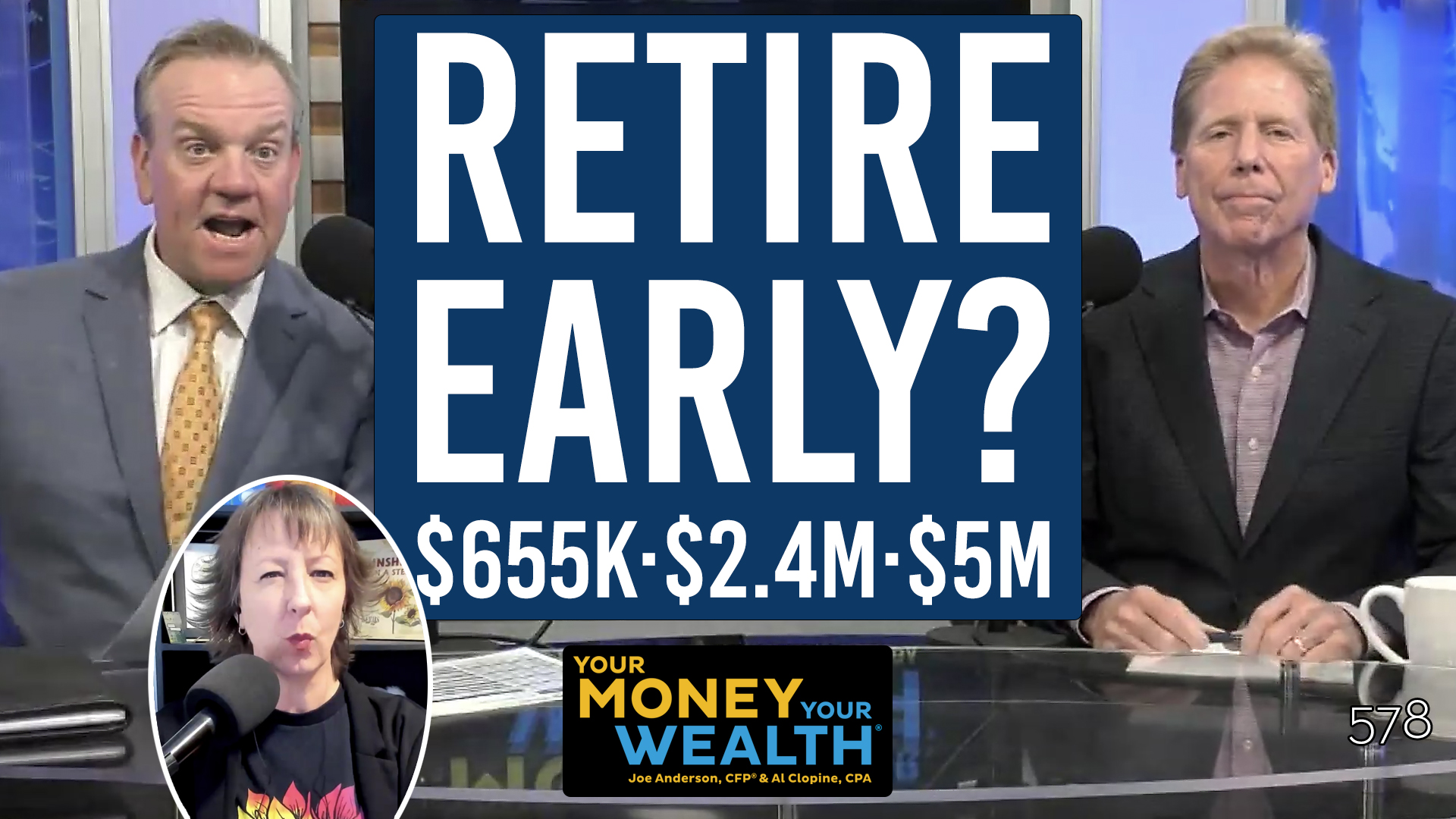
“Chase and Ryder” are 56 and 55 with $5 million saved and huge pensions the day they retire. So why are they so nervous about pulling the trigger? “Andy and April” are 46 with $2.4 million saved and 10 years until they want to retire. Can they get there, and do they need a trust? “Burt and Sally” are in their late forties with solid pensions and a retirement dream, but is the math close enough to make it work? Finally, does “Dolly” have any options for squeezing more out of Social Security when she and her spouse have identical benefits? She’s inheriting a brokerage account too, and wonders about the asset mix.

Show Notes
- 00:00 – Intro: This Week on the YMYW Podcast
- 00:58 – $5.5M, Big Pensions: Safe to Retire at 57? (Chase & Ryder, San Diego)
- 10:39 – We’re 46. Can We Retire in 10 Years? Do We Need a Trust? (Andy & April, CA)
- 21:28 – Can We Retire in 2027 With a Pension + $655K? (Burt & Sally, Nonesuch, KY)
- 34:19 – How to Max Social Security with No Spousal Benefit? (Dolly, TN)
- 41:41 – Outro: Next Week on the YMYW Podcast
Free Financial Resources:
Withdrawal Strategy Guide – free download
Retirement Spending: How Much is Too Much? – YMYW TV
Financial Blueprint: see if you’re on track for retirement – free, self-guided
Guides | Blogs | Educational Videos | YMYW Newsletter | Subscribe on YouTube

Watch today’s podcast episode on YouTube:
Transcription
(NOTE: Transcriptions are an approximation and may not be entirely correct)
Intro: This Week on the YMYW Podcast
Andi: “Chase and Ryder” are 56 and 55 with $5 million saved and huge pensions the day they retire. So why are they so nervous about pulling the trigger? That’s today on Your Money, Your Wealth® podcast number 578. “Andy and April” are 46 with $2.4 million saved and 10 years until they want to retire. Can they get there, and do they need a trust? “Burt and Sally” are in their late forties with solid pensions and a retirement dream, but is the math close enough to make it work? Finally, does “Dolly” have any options for squeezing more out of Social Security when she and her spouse have identical benefits? She’s inheriting a brokerage account too, and wonders about the asset mix. If you’re listening on Apple Podcasts, please do us a favor: follow the show and leave your honest ratings and reviews, so new listeners know whether YMYW is worth their time. I’m Executive Producer Andi Last, and here are the hosts of Your Money, Your Wealth®, Joe Anderson, CFP®, and Big Al Clopine, CPA.
$5.5M, Big Pensions: Safe to Retire at 57? (Chase & Ryder, San Diego)
Joe: We got Chase and Ryder.
Al: Okay.
Joe: Oh, Paw Patrol. my son loves Paw Patrol.
Andi: I was gonna say, have you been watching that?
Joe: Oh, yeah.
Al: No, I fortunately don’t know that show.
Joe: Paw Patrol. Paw Patrol. Oh wow. You’re in trouble.
Al: Oh boy. you know the whole thing.
Joe: Yeah. We’re coming on the double.
Al: Yeah,
Joe: don’t you worry about it.
Al: Okay. Got it.
Joe: okay. Hello Joe, Big Al. I’ll try to keep the complicated words to a minimum. Thanks, Chase.
Al: Gotta help Joe out. Right.
Joe: Gotta help me out. first of all, shout out to Andi. Kiss ass. As we all know, she is the one behind the success of the show. No shout out for Aaron.
Al: No. he doesn’t get much time on the show.
Joe: okay. The important stuff first, my wife, she enjoys a glass or two or three of Chardonnay in the evening, and I enjoy a good German lager.
All right. My family owns Schell’s Brewery. Wow. In Minnesota.
Al: I don’t think we’ve ever had a brewer.
Joe: Wow. In Minnesota. Schells.
Al: You don’t know that one?
Joe: No. Where’s Schells? Their Octoberfest is the best.
Al: Okay.
Joe: I’m gonna have to, I’ll be in Minnesota this summer.
Al: that’s perfect timing. Late summer.
Joe: I’ll be, I’m doing a little Airbnb on the Good Lake of Minnetonka.
Al: No fooling.
Joe: No fooling now.
Al: I feel like Octoberfest usually starts in September.
Joe: Yes. So I’m gonna be a little late,
Al: but for you, they’re a little
Joe: early
Al: for you. They’ll make an exception.
Joe: I’m gonna be a little early there.
Andi: So, August Schell Brewing Company in Ulm I guess? New Ulm?
Joe: New Ulm. Yeah. I know where New Ulm is.
Al: Okay.
Joe: That’s a little,
Al: I bet you they do a little part Octoberfest party for you when you show up. Yeah,
Joe: let’s do it. Oh, make to that brewery. Brewery looks cool.
Al: It looks amazing.
Andi: It does. It’s beautiful.
Al: Wow. It looks really nice.
Joe: Oh wow. That’s like old school.
Al: Yeah.
Joe: How old is that?
Andi: Ah, that’s a good question.
Joe: Vacation rental. Maybe I should,
Al: yeah, once, once you rent there. yeah,
yeah.
Joe: Else. Talk to Chase and Ryder.
Al: Get some good German beer. No. Yeah.
Andi: 1860.
Al: Wow. All right. Okay.
Andi: August Schell broke ground for the August Schell Brewing Company and paved the way for 157-year-old family tradition.
Joe: Wow. That’s cool.
Andi: I’m surprised you don’t know about this place and aren’t best friends with the company already, Joe.
Al: I know he will be shortly.
Andi: Yeah, totally.
Joe: Okay. It’s on the list. How much? For $10 for a tour. I wonder if you can get a little coupon.
Al: sell little discount, 1200 free, make money. Wealth.
Joe: Yeah. Throw, a little bone. He lives in San Diego. Now he can just come down to the office. Throws the bone.
Al: Yeah, yeah,
Joe: I drive a little, what does he drive? A Chevy. E. E Equinox. My wife drives a Subaru Forester. We have a 2004 Honda I Odyssey that we drive down to Rosarita, Mexico. Where we have a condo on the water.
Oh, this guy’s just got everything going for.
Al: Yeah, he’s got not bad.
Joe: Read that. His family owns little German beer.
Al: Yep.
Joe: Chevy Equinox.
Al: Got the good life.
Joe: No, my question, am I gonna retire in September, 2026? Here’s the situation. I think it works, but very nervous about pulling the trigger. Appreciate the spitball.
Currently it is October 31st, 2025. Okay. All right. So Chase and Ryder, I’m 56, wife is 55. Both of us planning to retire 57 a year from now. So he’s got a couple months.
Al: Yeah.
Joe: As we’re reading the question, so getting nervous. Yeah. Yeah. Perfect timing.
Al: It is.
Joe: So my salary is 220,000. My wife’s is $360,000 bonuses, long-term incentives.
RSUs being a hundred grand, wife is 200,000. Total annual is $880,000. Pensions immediate upon retirement is $8,800 per month for me. 16,500 for, per month for my wife. 303 annually. What the hell do you guys do,
Al: man? They got, they worked at the brewery.
Joe: No, she’s gotta be a judge. that’s a badass pension right there.
Yeah. 16,000. I, thought 8,800. I was like, wow, that’s a really healthy pension. And her is double.
Al: Yeah.
Andi: Yeah. Their fixed income turns out to be $433,000 a year. I think that might be a record on this show
Al: with the Social Security. Yeah. Yeah. but 300,000 right away, Joe.
Joe: Yeah. Immediately he,
Al: yeah.
Joe: Yeah. Okay. Social Security. Same for both of us. $2,500. alright. $60,000 annually. Okay. $130,000 annually at 70, we have $5 million in 401(k) accounts, 4.7 deferred, 300 in Roth, $35,000 in a Roth. IRA $500,000 in a brokerage. Why is this guy nervous? What is wrong with him? It’s probably all the anxiety from the German beer that he’s been drinking
Al: since he was, he’s
Joe: five years old,
Al: not drinking enough beer’s.
Joe: Me, he’s gotta drink more. Yeah, you get nervous. Just pour yourself a pint. We need to supplement our pensions with 401(k) withdrawals to meet our annual budget. can, we can adjust this when we turn the Social Security on. Concerned about taxes and RMD. So. We’ll need to conversion strategy in place, but we’ll always be in a high tax bracket or should we just bite the balloon and convert it all right away?
Am I crazy to think we can retire at what I think we can at age 57? I think you’re crazy not to, is what I’m saying.
Al: I would agree with that.
Joe: My wife and I are done with corporate America, but can’t complain at all. We have been blessed with incredible careers and compensated extremely well. Cheers, Chase and Ryder.
first of all, congratulations, you’re the envy of all of our listeners here at Your Money, your Wealth. $300,000 of fixed income, he could blow every last dollar and still live better than most.
Al: You know? I mean, this is an easy one, right? I mean, so you wanna spend $336,000. Your pension’s 300,000, right?
So you got about 35,000 that you gotta pull from your accounts. Now I know you’re not 59 and a half yet, but you got 500,000 in a taxable account and that’s, and you’re gonna retire 57. So
Joe: here’s what I would do a 72 T on. You would wanna start draining the money from the tax deferred anyway. You retire at 57.
You only have to do five years or 59. you still have to do it years, five years,
but after five years, it’s.
Al: Is gonna need it anyway. Yeah.
I agree. this is a,
Joe: but he’s gonna retire at, so he has full access to the 401(k) account, so you don’t gotta do something.
Al: Oh yeah.
It’s 401(k) back to the rule of 55. You’re right.
you are right.
Joe: Yeah. You’re sitting in great shape.
Al: and as far as. Roth conversion.
Joe: What do you think? Yes, absolutely. Do the conversions. You’re always gonna be in a larger tax bracket. You’re only gonna be taxed more. Don’t bite the bullet and convert everything.
Convert to the probably the top of the 24 or 32.
Al: Yeah, that’s what I think. So based upon just a quick look, I think a hundred thousand conversion gets them to 24, 2 4. I only think that’s enough. 200,000 gets them to 32. 450,000 gets ’em to the top of the 35. So I would, consider all those, because here’s the thing.
You’re probably not gonna spend your retirement accounts anyway with this income. And your account could double twice by the time you have r and d age. And even at 15 million, you have five Right now, even at 15 million, that’s not doubling twice in 20 years. 4% of that, Joe, that’d be $600,000 of RMD income on top of your pensions.
So it’s a big number.
Joe: Yeah.
Al: Which is, and here’s a case where, and we don’t. Typically sort of talk about this, but this actually might be a case where it’d be okay to pay for the conversion dollars through distribution.
Joe: Yeah.
Al: Because there’s not a lot of taxable dollars, and this is a clear case where if they don’t do anything, they’re gonna be in a super high tax bracket for life.
Joe: Yeah. I don’t got much else to say here.
Al: I think, but what I would say is, and this, we’ve talked about this before, people with a lot of money, they get nervous about it. People with less money, they think they’re okay. And we see all over the board.
Joe: Yeah. Because they got a lot more to lose.
Al: Yeah. And I get it.
Joe: Yeah.
Al: and the thing is, you’ve spent your whole life adding to your portfolio. And now you’ve actually taken a little bit out. It just feels kind of weird.
Andi: Here’s the thing about Chase and Ryder, and honestly a lot of people in their position, maybe even you: you’re doing everything right saving money, but the scary part is getting it out once you retire, whether that’s at age 57 or 73. Pull it out too soon, and you might run out of money while you’re still healthy and still spending. Pull from the wrong accounts, and you hand a huge chunk of it to the IRS that you didn’t have to. Joe and Big Al walk you through exactly how that happens and how to avoid it, this week on YMYW TV. And if you want something that you can actually sit down with and work through for your own situation, download our Withdrawal Strategy Guide. It’ll help you figure out how to make your money last as long as you do, and how to keep more of it in your pocket instead of Uncle Sam’s. Click or tap the links in the episode description to watch “Retirement Spending: How Much is Too Much?” on YMYW TV and to download the Withdrawal Strategy Guide for free.
We’re 46. Can We Retire in 10 Years? Do We Need a Trust? (Andy & April, CA)
Joe: We got Andy and April.
Andi: That’s from Parks and Rec. That’s your buddy, Chris Pratt.
Joe: Okay. yep. All right. We get a lot of Andy and April’s,
Andi: We get a lot of Parks and Rec. Yeah. We’re starting to get a lot of repeats. We get a lot of Fred Flintstone. There’s a number of people that,
Al: it depends what a age group they’re in.
Andi: Exactly. Yeah.
Joe: I’m guessing what this they’re gonna be forties.
Al: Yeah, you’re right. 46.
Joe: Oh, look at that. Joe, Al, Andi. Your show is by far my most favorite of all podcasts that I listen to. I came across your show on Pandora while looking for something to replace Dave Ramsey because I feel like it was time for me to graduate from the save, save mindset and Plan Ahead mindset. And I was hooked on your show in the first episode. During the last four months. I’ve listened to most, if not all of your shows from 2016 and on Texas.
Al: That’s a decade.
Joe: That is
Al: in four months.
Joe: That is bad. Andy and April. Gotta get a life here. I listen to them on my way to work while I’m driving my 16-year-old Mazda while I’m walking my dog, Elvis.
Al: Okay.
Joe: Okay. Let’s cool man. Oh, wow. This is a big one here. Let’s get it is all right.
By the way, my wife drives a much nicer 2024 Infiniti. My beautiful wife, April, and I live in California with two teenagers. April likes an occasional lager or pilsner, or a margarita. I prefer bourbon, scotch, or a glass of imperial stout. so April likes the beer. Yeah, he’s a bourbon scotch and out guy.
Al: Yeah, that’s what it, that’s what it says.
Joe: we are both employed earning around $400,000 in taxable income, including our 401(k) and HSA contributions, which we maximize every year. We are both 46 and would love to retire in 10 years. Here’s the assets. We got a house of $1.3 million, no mortgage retirement accounts, 401(k)s, IRAs, HSA 1.8 million.
We got brokerage and cash, 600,000 5 29 plans, 220,000. We are not counting on this money. It’s for the kids. Yes, it’s called a 5 29 plan. Our spending, investing retirement accounts 401(k) where max contributions plus employer match plus the HSA told us $80,000 a year. We are planning to contribute maximum to our retirement.
No Roth yet. I feel we have plenty of time to convert. Currently spending about $80,000 per year, which does not include health insurance premiums. Our major purchases like a new car, for example. We have no debt. I like to mention that because I’ve been listening to the Dave Ramsey before. The remaining a hundred and $175,000 a year goes into the brokerage account.
When we retire, we would like to spend $120,000 or more per year in today’s money, but we can scale back to a hundred thousand dollars during a down market. If needed. Our Social Security is estimated to be $50,000 per year for each at full retirement age, but then assumes that we work until the full retirement age, so it may be lower than that.
I have two questions. One, can we retire in 10 years or sooner? I’m gonna say yes.
Al: I think it looks pretty good. I’ll do the math here in a second.
Joe: I like my work. But I also like the idea of being financially independent from my paycheck. The second question is about trust protection. I haven’t heard much about, trust protection on your shows, but I hear about trust from my friends who are talking about placing their house in other assets in a trust, and my wife keeps telling me that we need to do the same, but I don’t see any reason to do it.
None of these friends can explain why they had it. Or then it is protection and it’s good for you. Just like broccoli. I read somewhere that it helps to avoid probate, but I don’t know if that’s an. Good enough reason to do so. Can you tell me if there’s benefits to having a trust in our situation? Thank you very much.
I really appreciate your opinions on this. PS English is my second language, so I hope it’s not too hard to follow the writing. Sincerely, Andy and April, oh,
Andi: Andy and April did a much better job speaking in English than we would’ve done in their language,
Joe: guaranteed.
Al: I think it was perfect.
Andi: Yep,
Al: no issues.
Joe: We’ve had some letters that, that have come in.
Al: We have, and that was their first language
Joe: and English was their first language, and you would think it was their third. so no, this was very well written. A lot of really good stuff going on here. And, Why don’t you tackle the retirement? I’ll tackle the trust.
Al: Okay, love it. Okay, so let’s start with the retirement. So two, 2.4 million. I just ran it at 10 years, just because that was what you first asked. 6%, rate of return adding 180,000 a year, right? 80,000 in retirement accounts. I did the lower number on brokerage account of a hundred. And guess what? In 10 years, Joe, they end up at 6.7 million.
Joe: Yep.
Al: It’s a big number.
Joe: Huge.
Al: Now if you look at their spend, they wanna spend 120,000 in today’s dollars. Let’s, go forward at 3% inflation rate for 10 years. That’s about one 60, 160,000 divided by 6.7 million. That’s a 2.4 distribution rate at age 56. I’m good with that. That’s without even considering Social Security.
Joe: Yeah. Or the other 75,000 that they’re probably putting in a brokerage account.
Al: Yeah, exactly. Yeah. I just went the more conservative, I mean, you could run this at 7%. You could also add, 175 per year in the brokerage account set of a hundred. So, yeah, no, this looks good. And you could probably retire a little bit sooner if you want to, but before you retire this, I think we’ve said this before in other shows, it’s nice to know that you can retire in 10 years or sooner, but before you do.
Rerun the numbers and make sure it still looks good at that point because no one knows exactly what the market’s gonna do or if you continue saving at the same rate. So, but Joe, on paper, this looks very good.
Joe: Yeah. Really good job of saving money. you got no debt, you’re saving a ton of cash. yeah, you’ll have a lot of diversification.
They must have just started making some of this money ’cause they’re saving roughly a hundred to $200,000 a year and they have $600,000 in a brokerage account. So what the, probably the last four or five years.
Al: Yeah, I’m,
Joe: I’m guessing is when they really put the gas on. Yeah.
Al: I’m guessing that too.
They were probably like a lot of us when they were younger, they didn’t make a lot and so they,
Joe: but are they 45? So I guess they started saving pretty aggressively at 40.
Al: Yeah, probably 40. I mean, they’re probably Dave Ramsey, you know, making sure they don’t go into debt, which is a great message for younger people.
And, now it’s time to, plan ahead. So I commend them.
Joe: alright, so a living trust.
Al: Do you have one? First of all,
Joe: I do have a living trust now
Al: and I do too. So we both have them.
Joe: alright, so protection. There’s a living trust is to avoid probate. Period. It’s to transfer non-retirement assets to loved ones without going through the court system.
That’s basically what a living trust does. There’s no asset protection in a living trust. It’s a see through look through trust, right? It’s a revocable living trust. All of that. If they have irrevocable trust, which is outside of your taxable estate, where you have very little control over those assets and everyth, you know, then those are a little bit more complex, where they’re a lot more complex.
And those can provide some sort of protection from creditors. but I’m guessing you’re talking about in your situation a living trust makes sense. You live in the state of California, you have a lot of non-retirement assets, such as your home of $1.3 million, plus the brokerage account of 600,000.
You’re adding a lot of money to that account. You wanna have it titled in the name of a trust. You and your wife would be, or the wife and your husband? I’m not sure if Andy or April’s writing in. would be the trustees of that trust. So you have full access, you have full control, you can do whatever you want with those assets.
But then when you pass away, then the successor trustee takes over, and then they can distribute those assets to your beneficiaries without going through the court proceeds or, proceedings. So it avoids time. Lengthiness what? Public record and
Al: Yeah, it’s public record and
Joe: probate
Al: and its costs. Yeah.
Yeah. So that’s why, that’s really why most people do it. And my parents passed away, my mom last year, they had a living trust that I had her get, I’m the successor trustee. It made it so easy to distribute the assets without waiting months and months, sometimes years, to get these things done.
Joe: Yep.
Al: Yeah, that’s reason enough right there. There’s protection for you, just like Joe said. But when you pass away and your kids inherit the trust, if they keep the assets in the trust, they do have protection there. So no protection for you. But there could be for the next generation, once they get the assets, if they keep it in the trust.
So that, that’s the,
Joe: how many people do you think keep it in the trust?
Al: Very few.
Joe: Very few.
Al: But
Joe: I guess if it was million,
Al: if it was a lot, yeah. Yeah, exactly right.
Joe: But in. You know, and I’m saying like tens of millions. Yeah. If it’s gotta be a pretty big number,
Al: yeah, but that is a benefit for in some cases, yeah.
even a few million could be a good benefit,
Joe: but the kids are gonna like, Hey, I just inherited a couple million dollars. I’m not gonna keep it in Mom and dad’s trust that in my own I’m gonna buy a new house, but maybe
Al: mom and dad hire professional trustee. So they, that wouldn’t happen.
Joe: Oh yeah. Now you gotta talk to Uncle Al to get some cats.
Al: I’m gonna be kinda stringent on that.
Joe: Yeah. Then that’s kind of a pain too. It is. then, but you’re controlling the money from the grave if that’s what you want to do. Yeah. It’s like, all right, I don’t trust my kids. I wanna make sure that I divvy the money out, or they’re only gonna use the money for things that I would approve while I’m living.
Al: but, you know, and sometimes, I mean, let’s be realistic. So some, a lot of kids are very responsible. Not all are. And if you know that as a parent, you might wanna protect ’em that way. So
Joe: look at, short sleeves to short sleeves in two generations or three generations.
Al: It’s, I think
Joe: and then cobbler choose to,
Al: yeah.
It, in, in other words, I guess the saying is that in inherited money doesn’t last long. I think maybe even one generation, but certainly by two
Joe: it is gone.
Al: Yeah. Yeah,
Joe: yeah.
Al: Yeah.
Can We Retire in 2027 With a Pension + $655K? (Burt & Sally, Nonesuch, KY)
Joe: Okay. We got Burt and Sally from Nonesuch, Kentucky.
Andi: Kentucky. And you get the Burt and Sally, we’ve been talking about Smokey and the Bandit and Cannonball Run and all that. It’s Burt Reynolds and Sally Field.
Al: Oh yeah.
Joe: Burt Reynolds and Sally Field.
Al: That’s gotta be. Yep.
Joe: But they were just lovers in a movie. I don’t think they ever dated in real life did they?
Andi: I think they actually did at that time.
Joe: Yeah. Did they really?
Al: They did, yeah. Yeah.
Joe: Did they get married?
Al: No, I don’t think so.
Joe: Was Burt ever married?
Al: I don’t know, but probably
Joe: Lonnie Anderson. Wasn’t he married to Lonnie Anderson?
Al: I think maybe you’re right.
Joe: Stroker Ace.
Al: I think. I think you’re right.
Yeah. I don’t think he ever married Sally though.
Joe: No. Okay. But I think Lonnie,
Andi: he was married to Lonnie Anderson from, 88 to 94, and Judy Carne from 63 to 65.
Al: Okay.
Joe: Yeah, look at me, Lonnie.
Al: It’s just, you’re like this. just pull that right outta there of celebrities.
Joe: I am, man. I am just locked in. all right, Andi Joe and Al, great podcast. Appreciate all the information you provide about retirement preparation and the calculations. I’m listening to the podcast trying to figure out all. That I’ve manipulated the assumptions too much in my favor when using my online calculator. I can see that happens every single time people use those online calculators. They’re just gonna keep tweaking the assumptions until I get it right.
Al: Yep.
Joe: all right, so I’m eligible to retire 2027. Can I really retire or should I keep working for the good old American life? For the money, for the glory, and for the fun, mostly for the money. Here’s our info. Thanks for this spitball. We have three dogs, a pepita, pita, a Chihuahua, a dash…
Andi: Dachshund.
Joe: Thank you.
Al: I’m enjoying this
Andi: actually here in Australia they pronounce it Dash hound.
Joe: Dash hound.
Al: But we do dachshund here. You’re right.
Andi: Yep.
Joe: Okay. Alright. all right. And then we have a regular dog. Sounds good.
Al: Not with a weird name.
Joe: Yes. Plus we really have a foster and or fospice.
Andi: Fospice. So they foster a hospice dog,
Joe: Fospice. What the hell is fospice?
Andi: That’s where you take care of an elderly dog until it passes.
Joe: Really there’s such, he’s not making that up? That’s a real thing?
Andi: He’s not making that up. That’s a real thing. You can foster a dog at the end of its life so that it doesn’t have to live in the pound.
Al: Oh, okay. I have to.
Joe: So it goes to fospice
Al: not hospice. It goes to make sure you don’t get ’em mixed up.
Joe: Got it.
Al: Got a fospice dog.
Joe: I usually drive a 23 Subaru Impreza and Sally mostly drives a 19 Subaru Outback. But we switch in the winter since the Impreza has heated seats and the W goes to work with Sally every day.
Al: Yeah.
Joe: We enjoy beers. Anything from a multi stout brown owl to a juicy New England IPA to a funky wild owl. Wow. And we enjoy traveling around the country for Sally to run her half marathons. And I find the breweries and the bakeries. Burt, he’s 49, works in education. Sally’s 47 works for a nonprofit, Burt’s income 70.
Sally’s income’s 80. Current expenses is $6,500 a month, including $1,200 a month for travel, but mostly include, but, not including our savings to Roth Emergency brokerage except similar in retirement, excluding healthcare debt-free. Thanks to Donald Ramsey.
Al: I
Andi: don’t know who that is.
Al: No, he means Dave’s Ramsey.
Andi: I know.
Joe: All right.
Al: I think he met Donald Rumsfeld. He mixed up with Dave Ramsey, I think.
Joe: All right. I didn’t think Donald Rumsfeld he gave, financial
Al: No, but Dave Ramsey did.
Joe: Got it. all right, Sally, she’s got a Roth IRA. She’s got 40,000, Burt’s, got 130 in his, Sally’s got a rollover IRA of 130.
Sally’s also got a simple IRA of 275,000. Emergency funds is 60. We got a brokerage count of 20, emergency of brokerage on the same accounts. All right, expected income in retirement. Burt can receive a pension of $3,400 a month paying in June of 2027. It will be state tax exempt up to $33,000 a year.
Pension amount increase of about a hundred thousand dollars a month for each additional year worked until age 55, then increases $150 a month until age 60. It also has a 1.5% annual cola. Social Security for salaries estimated at $1,900 a month at age 62, but can receive spousal benefits thanks to the elimination, we and GPO.
Al: Okay,
Joe: expected expenses $6,500 a month. healthcare, Burt’s insurance, and retirement is $250 a month. Selling can a be added for additional $1,100 a month. Retirement hopes and dreams, Burt retired 2027. Or June, 2029. Salary retire in December of 2031.
Al: Okay.
Joe: All right. Questions. Burt would like to retire in 2027.
Is it feasible? What about June, 2029? Sally would like to retire in December of 2031, but is it feasible because of the healthcare cost? Maybe the marketplace has more affordable option. We will need to take Social Security as soon as possible. Or should we wait till full retirement age or the bandit?
Frog going to need another bootleg run for extra cash to retire early. Oh, that’s funny.
Or can we do it without the, or can we do it with the pension and savings we’ve accumulated over the next few years? Thanks for your time, bur and Sally. all right. Did you do some math bal?
Al: I did. since he first said 2027, that’s close enough.
I just took the current numbers.
Joe: All right.
Al: we can extrapolate from there. Okay. But so what they currently have is about 650,000. They wanna spend 78,000 per year. Okay. and they’ve got 41,000 of pension, which is great. So there’s shortfalls about 37,000 against 650,000 would be a 5.7% distribution rate.
Joe: That’s the bridge to Social Security.
Al: That’s the bridge to Social Security. Yeah. Which would be a number of years. So, so
Joe: you’ll retire at 50?
Al: Yeah. And I know, I’m, oversimplifying because they will save for a few more years.
Joe: Sure.
Al: But that, it just gives us an idea kind of where they stand and they’re not, I mean, if, they both retired right now, they probably need 1.3, 1.5 million to get a 3% distribution rate for the Bridge to Social Security, is what I would say.
And they’re probably about halfway there, so I’m, I think that would be a little tough.
Joe: Okay.
Al: What do you think?
Joe: yeah, at 50, I think that’s in,
Al: and I partly say that because
Joe: if Sally continues to work in Burt Retire because she wants to retire in 2030, Sally makes $80,000 a year. They wanna spend a hundred thousand dollars a year.
$80,000 a year. Yep.
Al: Yep.
Joe: So Burt retire next year because Stanley can cover the living expenses until you bridge pensions and Social Security. I think you’re fine.
Al: You think they’re fine?
Joe: Okay. Yeah, because I don’t think they need to pull in the, you know, you know, 2026. So what, 2031 is another five years from now.
Al: Yep.
Joe: So five years he’s gonna be 55. That’s when they’ll need to start drawing at. So, let’s see. So they got 600. That’s gonna be, I don’t know, close to a million.
Al: I think if they’re living on her 80, they’re not saving anymore. I don’t. So five years of growth, six 50. May they add a little bit more while he’s still working.
Maybe it’s 700, maybe it makes 2 million. I don’t know. That might be a stretch, but let’s just use a million. So there,
Joe: the fixed income looks good.
Al: and it even looks better if he could work a little bit longer.
Joe: Right. ‘
Al: cause he gets a little bit more each year. He waits. If it were me, I’d work a little bit longer.
Joe: the pensions alone are gonna give him, what,
Al: 41,000, but
Joe: $63,000 of fixed income
Al: with Yeah.
Joe: Non in Social Security.
Al: Yeah. With her. Yep.
Joe: So they need 80.
So they need 20,000. yeah. I like this scenario a little bit better than the other ones that had millions of dollars because of that pension is, I mean, both of ’em have really good sized pensions.
Al: Yeah.
Joe: and if, and they don’t spend a ton.
Al: That’s Right.
Joe: And so if they can tone down the spending, and let’s say they spend a little bit too much. Can they stop spending out of their liquid assets for a couple of years and just live off their pensions and bridge the gap to Social Security?
And that’s, I, mean, there’s a lot of options there.
Al: Sure.
Joe: I think they could go back to work and make minimal dollars to, still live the lifestyle that they want because of the pensions.
Al: Yep.
Joe: No, I like this scenario probably the best out of all three that we saw today with, even though that this one doesn’t necessarily have the liquid assets, but with the pensions that equates to very large, you know, like asset base right?
Or net worth base.
Al: And what makes this trickier is there’s retiring at different ages and on a back of the envelope calculation, it’s pretty hard to do. But yeah, I would say if you’re, I just ran at your booth retiring now, I think it’s a little bit tough. The fact that she could work longer, and if her salary Joe covers the, their payments so they can let their assets grow.
I’m not sure they’re saving a lot right now given the amount of their assets, so I’m not, I think it would only be maybe a little assets and growth, but pension looks good.
Joe: Yeah, Burt retired 2027 or ’29. ’29 is probably the better answer. Let her retire at 2031 and kind of just see where you sit.
Al: Yeah. I like we say, a lot of times I think, you know, you rerun the, so let’s say you worked till 29, for example. You rerun the numbers before you retire and see how it looks at that point.
Joe: and I could tell, is this the one that, or. There is playing with the calculators, right? Online. Because it’s close.
Al: It’s close. Yeah.
Joe: And then you just start dialing, all right, maybe inflation’s gonna be 2% and I’m gonna get 8% on my money. And Oh, look at how great this looks.
Al: They all make eight and a half.
Joe: Yeah. maybe I’m not gonna spend 78, we’re gonna spend 70,000.
Al: Yeah.
Joe: So I could see, be careful with, I mean, calculators are dangerous.
Al: Good point.
Joe: Financial planning software sometimes is really dangerous too. It gives people like a, some false confidence. It’s an x-ray. In a point in time that can give you the best answer for what the strategy should look like that day. But it’s a living, breathing kind of thing that you have to update, you have to change, you have to adapt, you have to do different things. So from a back of the envelope for you to be like, you know what, can I be confident enough to leave my job because I have these. These pensions, we’ve done a really good job of saving. and I think we can kind of tone down, our spend. sure. But if you’re trying to dial this thing into the penny, forget about it. You’re gonna have to work another 10 years.
Al: and I guess the point you’re trying to make is you can run this right on the margin, but you really wanna run this where you have extra. ’cause you never know what’s gonna happen. Markets may not cooperate. You know, one of you may have an expense for parent or a child, or even yourself that you didn’t expect, right? And so just make sure you have some extra that’s when you’re at the point where it could work. We get a little nervous, right? Because things don’t always go according to plan.
Andi: Now, Joe just called retirement calculators dangerous, and he’s not wrong. Plug in a rosy rate of return or shave a little off your projected spending and suddenly every calculator on the internet tells you you’re fine. Our Financial Blueprint is a little different. It’s a free and self-guided tool, that, instead of giving you one optimistic number to feel good about, will give you three scenarios so you can see the realistic range of how your retirement could actually play out. Just input your cash flow, your assets, and your projected spending, and you’ll get a personalized report with your probability of retirement success, what your taxes could look like down the road, and concrete steps you can take right now to get on track or to stay there. Click or tap the Financial Blueprint link in the episode description and find out where you actually stand. And if you’ve got a friend who keeps tweaking their retirement calculator until it tells them what they want to hear, send the Financial Blueprint their way.
How to Max Social Security with No Spousal Benefit? (Dolly, TN)
Joe: And we got Dolly from Tennessee, guessing Dolly Parton.
Al: No, I’m guessing that too.
Joe: great service you provide. How old is Dolly Parton? Like 80.
Al: Oh, she’s in her eighties.
Joe: She still looks phenomenal.
Al: She does,
Andi: yeah, she does. Let me find out. Hold on.
Joe: I gotta figure out what,
Al: what she did,
Joe: what that secret is.
Al: She,
Andi: you know it’s a whole lot of plastic surgery. She doesn’t try to hide that.
Joe: Yeah. But you know, you look at some people, most of,
Al: most of ’em are horrible.
Joe: It’s like, what is that? What are you doing? Oh, no, you didn’t, did you? but yeah.
Al: Yeah. I think,
Andi: she is 80 years old. She was born January 19th, 1946.
Al: Oh, there you go.
Joe: 80 years old.
Al: Wow. Good for her. Yeah, she does. I agree. She looks great.
Joe: Yeah. Traveling, being on the road. Country music singer.
Al: Yep.
Joe: That’s,
Al: she’s got a great personality and a great laugh.
Joe: Yeah.
Al: Yeah. And she’s good at singing too.
Joe: Hey, let’s,
Al: we love Dolly.
Joe: Oh god. Great. Great service you provide.
And thanks for the laughs. I have two strategy related questions. Yeah. You always talk about taking advantage of spousal benefits with the Social Security, but in my situation, my husband and I are both 62 this year, only six months apart. We always talk about taking advantage of spousal.
Al: I not always, no.
Andi: I guess every time Social Security comes up, how about that?
Al: Maybe frequently? Yeah.
Joe: Okay. And our projected benefits are identical unless there are some catastrophic events that wipe us out. We plan to wait until 70 years old. Are there any other ways to squeeze out more from the pot or did I make a mistake by not marrying a much older dude?
Al: That’s, okay.
Andi: Good thinking, Dolly.
Al: very poignant.
Joe: All right. Number two, I’ll be hearing my mother’s brokerage account with a new basis of around $950,000. Currently it’s in probate. Right now it’s around $60,000 equity, 37% large cap value, 33% large cap growth, 20% international, 5% small, in mid cap value, 5% small and mid cap growth, 36% fixed income.
all right. 4% cash. Is this a good mix? Should I reallocate? Yeah, boy. Okay. I don’t need this money for now. We have in total of about $400,000 in cash, 2.2 in pre-retirement accounts, $90,000 in a Roth, 80,000 in HSA, and $600,000 in a brokerage account. Husband and I will work one or two more years and retire.
I’m already retired in getting my pension. Right now our monthly take home covers our expenses. We both drive Toyota to trucks and they have two chocolate labs in SIP bourbon. I’m the CFO of the family. And listen to you and my car everywhere I go.
Al: Wow.
Joe: All right. PS – like Big Al’s list on the older shows. Thanks again. Those were awful.
Al: Those were amazing.
Andi: Don’t we love them Now? Come on.
Al: I have a fan.
Joe: The lists. Remember the lists?
Al: Yeah. I go to Money Magazine. Remember someone called on me. they, they said. Big Al just finds an article, yep, that’s exactly what I did.
Andi: And read it.
Joe: Yes, please use Dolly if right on the air. I live in a small town and can’t even pass gas without everyone knowing.
Al: That’s a small town.
Joe: Okay. So she’s gonna inherit some money in a fully globally diversified portfolio.
Al: Yeah.
Joe: I’m good with that. Keep it there. That’s fine.
Al: Yeah. Yeah. I’m good with that too.
Joe: You know,
Al: with, one,
Joe: I have no idea. I mean, you might wanna change it, you may not. you know, when it comes to asset allocation with the spitball. It’s almost,
Al: yeah, you can’t, I mean, this is a normal allocation. The only thing I would add to what Joe just said is a lot of people when they get inheritance, wanna put it in a vacuum.
How should I invest this? Really, you should now put this on your entire portfolio. Look at your goals, figure out what the entire portfolio should be, and then you figure out, all right. The, as far as the stocks or the equities, what accounts should they go into? Probably more Roth man, maybe non reti retirement.
Maybe the safer money, maybe that goes into your retirement account, just because taxation, the stocks go up more in value over time, so you want them in a tax free environment like a Roth. You want them in the non-retirement ’cause you get capital gain. Now, it’s not as simple as that because you’re gonna have a lot more probably in a retirement account. But nevertheless, you look at things as a whole to do this right.
Joe: Yep. Because they got a ton of money outside of this inheritance.
Al: They do.
Joe: You got a couple million dollars sitting in 401(k)s Roth IRAs.
Al: Yeah, they got over brokerage 3 million. So they’re been It’s been good. It’s been pretty.
Joe: Exactly. So it’s not like here’s my, here’s this brokerage account that I inherited. And look at that separately, just, alright, combine that with your $600,000 brokerage account and invest that appropriately, I think is what
Al: you’re right. That’s what I’m saying. And until you get to that point, go ahead and keep it where it’s at. But do that step to figure out what makes sense for you.
Joe: Yeah. Because you wanna make sure that you tax manage the account as best you can because you’ll have now $1.6 million in a non-retirement account, which is great for liquidity and creating income.
Al: Right.
Joe: it’s also a really good way to create income.
Very tax efficiently.
Al: Correct.
Joe: but you don’t wanna look at this in a bubble. We see this quite often. Is that all right? I inherited some money. I’m gonna keep it exactly where it is. I’m, I have an emotional attachment to these funds because they were my mothers or fathers or grandfathers or whatever it is.
And I totally get the emotional attachment. But don’t be emotional towards investments, you know, have an emotional attachment towards an heirloom, you know, or, something else. Yeah. Versus the cash because you wanna make sure that it’s invested appropriately for your given goals, your parents or your whoever, got you received that money from, wanted to probably to make sure that you use it appropriately for your goals.
Not necessarily just kind of sit there and look at a brokerage account as an heirloom. So invest it right. and don’t let it just keep growing on you, and don’t touch it. And then all of a sudden you might need it, and then you have so much gains and you kinda get blown up with taxes. So just think of it as your overall strategy, as you’re thinking, about your upcoming retirement.
Al: How about Social Security,
Joe: right? So, 62, they’re both waiting until age 70. That’s fine.
Andi: there’s no other tricks that they can play are there?
Joe: No, not anymore. I mean, before, what we would probably say is, have one of you. File, then suspend at your full retirement age, and then you would take the spousal benefits based on the suspended, you know, benefit. But now those rules change.
Al: That was like a decade ago. We can’t do that.
Joe: Has that been that long?
Al: I think so, yeah.
Andi: I think that changed in 2015, didn’t it?
Al: Something like that. The only thing I would say, and I don’t know if this is a great strategy or not, but you could both wait till 70. That’s fine if you both have good longevity. But I would say at the very least, one of you should wait till you’re 70. Case one. Yeah. In case one of you survives the other, so you got a bigger benefit. One could take it at 62, 64, 6 67. I don’t really care. I want one of you to wait till 70. that’s what I would suggest, or that’s what I would do in this situation.
Joe: Yeah. Yep. sounds good.
Outro: Next Week on the YMYW Podcast
Andi: Next week on YMYW, “Captain Morgan”, “Klo Jopine”, Brian in New York and Kyle and Katie all need Roth conversion guidance, and Todd and Margo are hoping to retire this year. Tune in for the spitballs, and stay for the lifestyle cravings. That’ll make sense next week.
You know, a lot of you have been soaking up all this retirement and tax strategy on YMYW for months or even years. And I’ve got about a hundred pages of questions from many of you who are still waiting for a spitball from Joe and Big Al. But here’s the thing: we call ‘em spitballs for a reason. They aren’t exactly comprehensive. Skip the wait and schedule a free assessment with Pure Financial Advisors. The experienced professionals on Joe and Big Al’s team at Pure will help you craft a robust retirement plan that accounts for EVERY aspect of your financial life. They’ll help you pay less tax in retirement, ensure your investments are aligned with your tolerance for risk, and show you how to ride out the uncertainties of the market and rising costs with confidence. Like a spitball, the cost is zero. The obligation is zero. Not only will you get a much deeper and more useful dive than a spitball, you’ll probably get it sooner, too. Meet in person at one of over a dozen Pure locations from California to Tennessee, or you can take your meeting over Zoom from anywhere. It’s only the rest of your life we’re talking about here. What’s holding you back? Click or tap the free financial assessment link in the episode description or call 888-994-6257 to book yours.
Pure Financial Advisors is a registered investment advisor. This show does not intend to provide personalized investment advice through this podcast and does not represent that the securities or services discussed are suitable for any investor. As rules and regulations change, podcast content may become outdated. Investors are advised not to rely on any information contained in the podcast in the process of making a full and informed investment decision.
_______
Listen to the YMYW podcast:

Amazon Music

AntennaPod

Anytime Player

Apple Podcasts

Audible

Castbox

Castro

Curiocaster

Fountain

Goodpods

iHeartRadio

iVoox

Luminary

Overcast

Player FM

Pocket Casts

Podbean

Podcast Addict

Podcast Index

Podcast Guru

Podcast Republic

Podchaser

Podfriend

PodHero

podStation

Podverse

Podvine

Radio Public

Rephonic

Sonnet

Spotify

Subscribe on Android

Subscribe by Email

RSS feed

YouTube Music
IMPORTANT DISCLOSURES:
Pure Financial Advisors is a registered investment advisor. This show does not intend to provide personalized investment advice through this podcast and does not represent that the securities or services discussed are suitable for any investor. As rules and regulations change, podcast content may become outdated. Investors are advised not to rely on any information contained in the podcast in the process of making a full and informed investment decision.
• Investment Advisory and Financial Planning Services are offered through Pure Financial Advisors, LLC, a Registered Investment Advisor.
• Pure Financial Advisors LLC does not offer tax or legal advice. Consult with your tax advisor or attorney regarding specific situations.
• Opinions expressed are not intended as investment advice or to predict future performance.
• Past performance does not guarantee future results.
• Investing involves risk including the potential loss of principal. No investment strategy can guarantee a profit or protect against loss in periods of declining values.
• All information is believed to be from reliable sources; however, we make no representation as to its completeness or accuracy. As rules and regulations change, content may become outdated.
• Intended for educational purposes only and are not intended as individualized advice or a guarantee that you will achieve a desired result. Before implementing any strategies discussed you should consult your tax and financial advisors.
CFP® – The CERTIFIED FINANCIAL PLANNER® certification is by the CFP Board of Standards, Inc. To attain the right to use the CFP® mark, an individual must satisfactorily fulfill education, experience and ethics requirements as well as pass a comprehensive exam. 30 hours of continuing education is required every 2 years to maintain the certification.
AIF® – Accredited Investment Fiduciary designation is administered by the Center for Fiduciary Studies fi360. To receive the AIF Designation, an individual must meet prerequisite criteria, complete a training program, and pass a comprehensive examination. Six hours of continuing education is required annually to maintain the designation.
CPA – Certified Public Accountant is a license set by the American Institute of Certified Public Accountants and administered by the National Association of State Boards of Accountancy. Eligibility to sit for the Uniform CPA Exam is determined by individual State Boards of Accountancy. Typically, the requirement is a U.S. bachelor’s degree which includes a minimum number of qualifying credit hours in accounting and business administration with an additional one-year study. All CPA candidates must pass the Uniform CPA Examination to qualify for a CPA certificate and license (i.e., permit to practice) to practice public accounting. CPAs are required to take continuing education courses to renew their license, and most states require CPAs to complete an ethics course during every renewal period.