Joe Anderson, CFP® and Big Al Clopine, CPA spitball for people sitting on life-changing gains who are just one wrong move away from handing a third of it to the IRS. How should they diversify their concentrated stock positions? That’s today on Your Money, Your Wealth podcast number 583. First up, Walter’s a software engineer who got lucky 15 years ago. Now he’s got $1.6 million in company stock, and a retirement clock ticking down in six years. Richard from Staten Island listened to his son six years ago, went big on oil, saw a huge gain, and now 80% of his portfolio is in that one position. His custodian wants him to sell, but he’s not so sure. Finally, Doctors “Bones and Beverly” just discovered they’ll be inheriting millions still sitting in an old 401(k) loaded with company stock.

Show Notes
- 00:00 – Intro: This Week on the YMYW Podcast
- 01:09 – How Do You Sell $1.6M in Company Stock Without Writing the IRS a Giant Check? (Walter & Jesse, NM)
- 13:04 – One Oil Stock is 80% of My Portfolio. My Financial Advisors Want Me to Sell It. I Don’t Trust Them. (Richard, Staten Island, NY)
- 30:10 – We’re Two Doctors About to Inherit a $1.35M Tax Bomb. What Now? (Bones & Beverly, MI)
- 45:23 – Outro: Next Week on the YMYW Podcast
Free Financial Resources:
2026 Tax Planning Guide – free download
10 Steps to Improve Investing Success – free download
Strategies for Diversifying Concentrated Stock Positions – blog post
Once Retirees See This Data, They Stop Worrying About Investing – YMYW TV
Guides | Blogs | Educational Videos | YMYW Newsletter | Subscribe on YouTube
Joe at Comic-Con 2014 || Joe at Comic-Con 2016
Follow the YMYW Podcast in your favorite podcast app

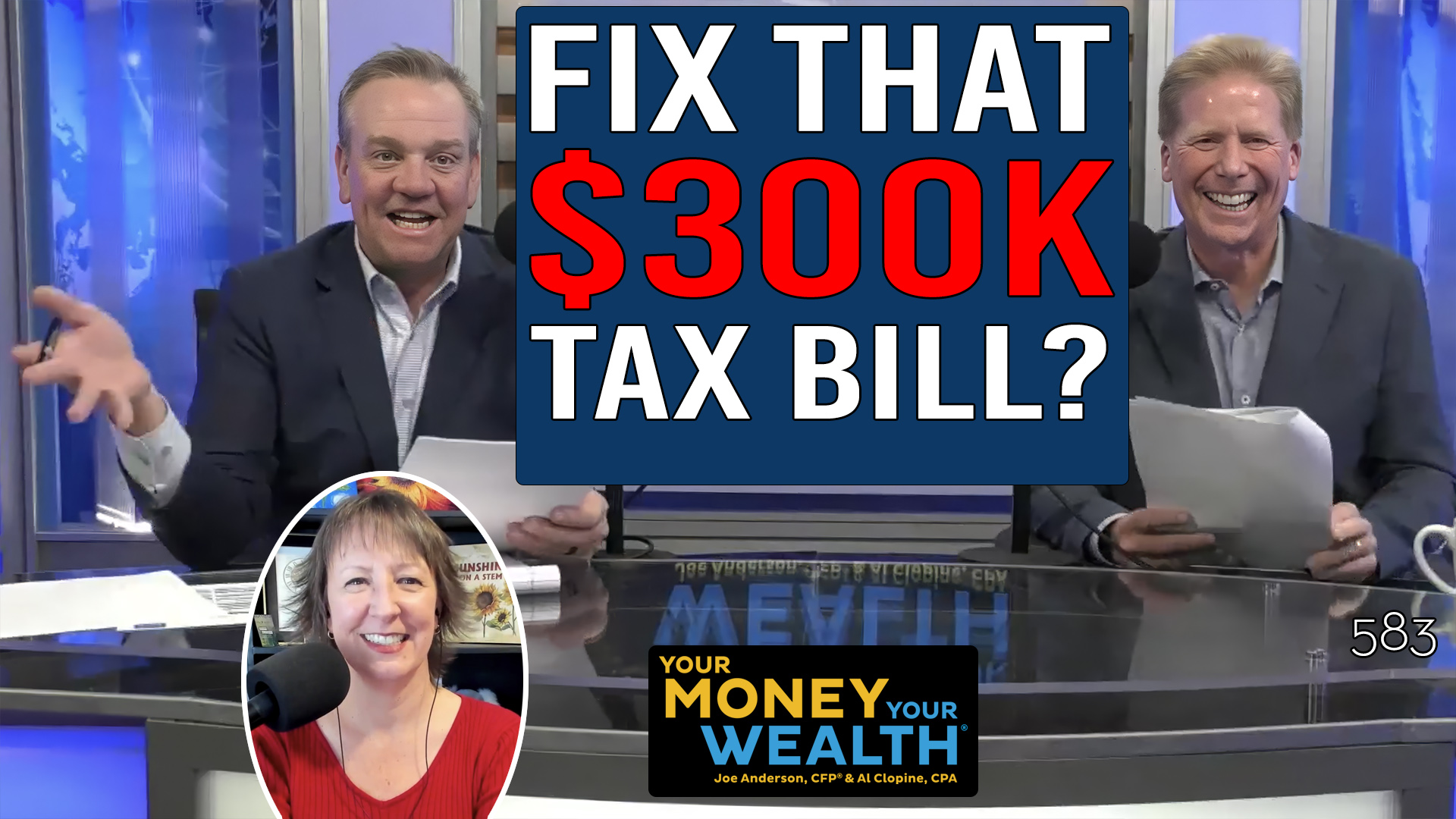
Watch today’s podcast episode on YouTube:
Transcription
(NOTE: Transcriptions are an approximation and may not be entirely correct)
Intro: This Week on the YMYW Podcast
Andi: Joe and Big Al spitball for people sitting on life-changing gains who are just one wrong move away from handing a third of it to the IRS. How should they diversify their concentrated stock positions? That’s today on Your Money, Your Wealth podcast number 583. First up, Walter’s a software engineer who got lucky 15 years ago. Now he’s got $1.6 million in company stock, and a retirement clock ticking down in six years. Richard from Staten Island listened to his son six years ago, went big on oil, saw a huge gain, and now 80% of his portfolio is in that one position. His custodian wants him to sell, but he’s not so sure. Finally, Doctors “Bones McCoy and Beverly Crusher” just discovered they’ll be inheriting millions still sitting in an old 401(k) loaded with company stock. Make sure you’re following YMYW wherever you listen so you never miss an episode. And if you’re watching on YouTube, subscribe, hit the bell, and jump into the comments and share your thoughts on concentrated positions. I’m Executive Producer Andi Last, and here are the hosts of Your Money, Your Wealth®, Joe Anderson, CFP® and Big Al Clopine, CPA.
How Do You Sell $1.6M in Company Stock Without Writing the IRS a Giant Check? (Walter & Jesse, NM)
Joe: Hey, Joe, Big Al, Andi. “I’m Walter, and my wife is Jesse.” Walter and Jesse, funny. After Spotify had showed me an episode of my financial stuff I probably should have cared about 10 years ago rabbit hole, and we haven’t come out for air ever since. We do our weekend, a weekend meal prep, half watching and half listening to YMYW, her with a spicy margarita and me with a cerveza from Marble Brewery here in,”
Al: ABQ, probably Albuquerque maybe?
Andi: Albuquerque, yeah.
Al: Yeah.
Joe: You ever been to Albuquerque?
Andi: I have. I’ve driven past. I’ve driven through it on a road trip. Didn’t really spend any time there.
Al: I’ve stayed there overnight with friends.
Joe: All right. You? No.
Al: nope. Okay.
Joe: “You all are basically family at this point.”
Al: Me?
Joe: Interesting.
Al: Yeah.
Joe: All right. “Our combined income is $340,000. Jesse’s a physical therapist, and I’m a software engineer who got lucky about 15 years ago, took a chunk of my compensation in equity and rode it all the way up. We’re hoping to retire in about six years. I’m 58. She’s 57. I currently have $1.8 million in my 401(k) /403(b) , $290,000 in Roth IRAs, and $2.4 million in a brokerage account.
About 1.6 million of the 2.4 is in my company stock with a cost basis of $180,000.” Okey-doke. “Social Security at 67 will be $58,000 combined, and Jesse will have a small pension that will kick in around $14,000 a year. We’ll probably spend about 130 in retirement. I’m not an idiot. I know I need to diversify that company stock, but we’re talking about a potential $300,000-plus in capital gains tax if I sell it all at once, and that’s not before New Mexico takes its cut.
How can I avoid handling so much of this to the feds and the state? Appreciate the spitball. Keep doing what you’re doing. Stay cool. Walter and Jesse, Albuquerque, New Mexico.”
Andi: Now, that’s a reference to Breaking Bad, but I believe in the show weren’t Walter and Jesse both men? And in this case, Walter says his wife, Jesse. So I guess it’s a reference. It’s a nod.
Joe: Got it.
Al: Okay.
Joe: Breaking Bad, did you like that show?
Andi: Me? No. I didn’t ever watch it. Wasn’t my thing.
Joe: You never watched it?
Andi: No.
Al: I watched about five episodes. Yeah? I liked it. I don’t know why I didn’t go on. But did you watch it?
Joe: I’ve never watched an episode.
Al: Never watched it. Okay.
Joe: I don’t know why. Yeah. maybe I should, get into it. Aaron, you a big, Breaking Bad guy? That’s the guy that’s, The school teacher that makes meth or something?
Al: Yeah.
Andi: Doesn’t he become a drug dealer or something?
Al: Well, ’cause he didn’t have enough pension money, so he decided to make meth, and it’s pretty hilarious, actually.
Joe: Got it. All right.
Al: Well,
Joe: meth is not cool.
Andi: I was gonna say, that does not sound like your kind of thing, Al.
Al: Yeah, or hilarious. No. Say no to drugs.
Joe: But the show is funny.
Al: Yeah. That’s a good point there-
Joe: Got it …
Al: Mr. Anderson.
Joe: Okay. what do, what do you got, Al? Do you got anything here?
Al: Oh, I got all kinds of stuff.
Joe: All right, let’s see it.
Al: You know, this is capital gains. That’s my thing, right?
Joe: That’s your thing. All right.
Al: Being the tax guy. Well, the first thing I would say, is you don’t have to sell it all in one year. So I got a lot of strategies, but let’s just start with the obvious, of selling and you pay a whole bunch of tax. Well, did you know, that 20% capital gain bracket doesn’t happen until $614,000, Joe, of taxable income? So based upon a rough calculation, I don’t really know your situation well enough, but let’s just say, you said your income’s 340. I’m guessing your dividends are 30 and your standard deduction’s 30. So let’s just say your taxable income’s 340. Then you could do, you go up to the 20% tax bracket. You could probably do about 270,000 of, gains, which actually means you could sell more, like 300,000, because not everything you sell is at gains. And that would keep you in the 15% bracket. So that’s number one. I might do it over a few years to stay out of the 20% bracket. That’s one thing. Secondly, you gotta look at passive versus active, and this is very confusing and accountants don’t necessarily agree, Joe, with this, what I’m gonna say.
Joe: Okay.
Al: But my feeling is if it’s a company that you work for, you’re an active investor, and you shouldn’t be subject to the net investment income tax, which is 3.8%, starting at $250,000 of, of adjusted gross income for married, 200,000 for single.
Joe: He’s a software engineer working for XYZ company.
Al: Yeah.
Joe: Public company. Yeah … you think he qualifies?
Al: I think so, but not everyone agrees with me.
Joe: All right.
Al: So, so yeah.
Joe: That the risk?
Al: It’s a risk. Yeah. Check with your accountant and, make your own decision. anyway, that could save 3.8%, and that-
Joe: Would that hold up an audit?
Al: I think so. Think so. I mean, I would do it, but I can’t guarantee it. So a couple things there. another thing is-
Joe: So all right, let’s, hold on. So you have to be an active participant in the company-
Al: Yeah …
Joe: to avoid the net investment income tax, which is an additional 3.8% tax on top of the capital gains at 200,000 single, 250,000 of-
Al: You got it.
Joe: adjusted gross or taxable income?
Al: adjusted gross. Yeah.
Joe: Got it.
Al: So anyway, so that’s… But here’s the distinction. If you just own stock, it’s passive. If it’s your company, it’s active. If you’re an employee, it gets a little bit gray. That’s what I’m saying. I don’t take it to the bank, but check with your accountant to see if that, that might fly. Another thing I would say is tax loss harvesting, right? I mean, there’s other assets in the taxable account, maybe some are at a loss. Maybe you could sell some of those positions, lock in the loss, buy something else similar so you’re still in the market. So that could help.
And then of course, our favorite, tax-exempt trust, right? And that’s, in simplest terms, you put your stock into this trust, also known as a charitable remainder trust. The trust sells it, and then you get to pay no current tax, but then you get an income stream for life, and it’s actually the majority of the account. There’s a charitable factor. Charity’s supposed to get 10%. it’s a good play if you have longevity. It’s not a good play if you have a short life expectancy, because when you pass away, whatever’s in the trust goes to charity.
Joe: Yeah, it’s a bet to live.
Al: It’s a bet to live, yeah. But the cool, you will pay the capital gains tax, Joe, as the assets come out of the trust, but it’s slowly over time, and you never get in those high brackets, don’t even have net investment income tax probably.
Joe: No, I think that’s a good point because I don’t think there’s a strategy that zeros you out of anything.
Al: No,
Joe: But you’re delaying the tax in most cases for any tax strategy, and delaying the tax will lower the tax because of how the capital gains tax is tiered.
Al: Yeah, if you can stay in lower brackets, including the net investment income tax, let’s say for some reason that didn’t work with the accountant, well, then the tax-exempt trust, yeah, because only a little bit would come out each year for the rest of your life. It’s like an income stream for life.
Joe: All right, a couple of others. You could do a direct index, and you could do something that is very interesting, but you wanna make sure that you understand what you’re doing here, is that you could do a direct index and you could put leverage on the direct index.
Al: Okay.
Joe: So we talked about this a little bit before. It’s called a long-short strategy. It’s the 130-30.
Al: Okay, like it.
Joe: So basically what happens is that you’re going- you have a direct index, and then you’re gonna go 30% long and then 30% short. So that’s the 130-30.
Al: Okay, like it.
Joe: And that’s leverage. So I’m long, so $1 of investment is buying a $1.30 of stock.
Al: Got it.
Joe: Okay. $1.30. All right?
Al: Okay.
Joe: And so what you’re doing is you’re keeping the risk, the beta, at one. You’re not adding any more risk to the overall portfolio because you’re long and you’re short the same percentage. But let me explain it like this. So let’s say the S&P 500. You have 500 stocks, and the S&P 500 over the last year did, let’s say, 10%.
Al: Okay.
Joe: But do you think all 500 stocks of the S&P 500 did 7%?
Al: Absolutely not.
Joe: Right. Half of them probably lost money. So you have half of them down, and you have half of them up. So in a direct index, you can then accelerate the tax loss harvesting. So with the ones that are down, you can sell those securities at a loss, and you can buy something similar, but the account still went up that 7%. So with a 130-30 strategy, you’re just adding leverage. You’re buying more stocks. So you’re looking at the ones that you think are gonna go up. All right, let’s leverage those so I can get a little bit more juice on the up.
And then you look at the stocks that you think, “Hey, maybe these aren’t going to do so great.” All right? And so if they do well, well, you shorted them so that created more loss. And if they do poorly, well, then you’re just adding that back to the overall portfolio. So you’re not adding any more risk per se to the portfolio, but what you’re doing is you’re accelerating the tax losses within the portfolio to maintain, like, a positive investment experience, but you’re getting a lot more losses. So if he’s trying to diversify out, those capital gains will offset those capital losses. So he could do a strategy like this, but it doesn’t avoid the tax. It just gives you losses to offset maybe in this one large year.
Al: Right.
Joe: But those… As you tax loss harvest, you’re just lowering your basis. You’re gonna have to pay taxes on those stocks at some point in the future anyway.
Al: Yeah, unless you never sell.
Joe: Unless you never sell and die, and then you get a step-up. So this is good for people that wanna get out of, like, a concentrated position. Let’s say if you sell a business, let’s say if you sell a property, real estate, and things like that. So these strategies are getting more and more popular, and, like, some of the custodians are like, “Man… We’re getting so many flows into these strategies.”
Al: Into these things, right.
Joe: I don’t even know how to handle it.” So Fidelity, Schwab, and everyone else is like, “Okay, well, maybe we gotta, cool this down.”
Al: So it, it’s complicated.
Joe: It is.
Al: So say what it is again so that then they could go to their advisor.
Joe: Well, it’s a 130-30. It’s basically a direct index with leverage.
Al: Okay. Fair enough. Yeah. Well, there you go. That’s another one.
Joe: There you go.
Andi: And guess what?
Joe: I love that one.
Andi: I got more on that topic for you coming up.
Al: Yeah. Okay.
Joe: I think I’m gonna do that now.
Al: Well, you, said you were gonna, and you explained it to me last time, and this time, and I still don’t really get it, but it sounds interesting.
Joe: Okay. All right. Sounds good.
Andi: Walter just laid out exactly what keeps a lot of people stuck: they made money, they know they need to make a move, and the tax bill is so big it freezes them. The good news is there are real strategies to manage this, and a lot of them come down to understanding how capital gains brackets actually work, how tax-loss harvesting can offset some of those gains, and how to time all of it without blowing up your overall plan. Our 2026 Tax Planning Guide walks you through the current brackets, the capital gains rates, and year-end moves you can actually use. It’s free, it’s 21 pages long, and it’s the kind of thing you read once and reference all year. Click or tap the link in the episode description to download your copy, and tell a friend, too.
One Oil Stock is 80% of My Portfolio. My Financial Advisors Want Me to Sell It. I Don’t Trust Them. (Richard, Staten Island, NY)
Joe: Let’s go to Richard from Staten Island. Okay. All right. “It all started six years ago. my son mentioned I should buy barrels of oil and store them in my commercial lot. I asked why. He said it was worthless.” So why would you store them if it’s worthless?
Andi: Because they’ll be worth something later?
Al: Well, that, that’s the point, right? If they’re-
Joe: Just store them. Get- put them in your s-
Al: In your backyard.
Joe: So he’s like, “All right. Well, then I’m g-”
Andi: You got a commercial lot, it’s empty, just throw some oil on there.
Joe: Just throw some oil in there.
Al: Got a big backyard. All right. Well, maybe not in Staten Island, but somewhere.
Joe: I then decided to buy oil companies.
Al: Okay.
Joe: I looked for the cheapest at the time, which was OXY. Okay. Ever heard of OXY?
Al: No, but I haven’t- I do now. I say it right here.
Joe: You a big investor in OXY?
Al: I’m not and I just for fun saw the price.
I didn’t look at the name of the stock, but I saw the price currently, well, as of right now, $55 a share. Okay. Just for reference.
Joe: Got it. What’s, what is OXY?
Andi: Occidental Petroleum.
Joe: Occidental. Oh, there you go. Oh, that’s kind of-
Al: Oh, that’s a, good initialism. All
Joe: So I bought big.
Al: Okay.
Joe: I paid $9 to $10 a share in my Roth IRA. Today I own-
Andi: And in a traditional IRA.
Joe: in tra- yeah, traditional IRA. I own 15,275 shares and receive 85 every three months from DRIP.
Al: Ooh, okay.
Joe: OXY is about 80% of my holdings. Okay, so 15,275 times 55 bucks a share.
Al: Yeah.
Joe: Anyone keep score up there?
Al: Yeah, it’s, so I did the gain, but it’s probably about s- maybe 800.
Joe: 800?
Al: Yeah, something like that.
Joe: Oh, you started at nine to go to 800. Yeah. All right.
Al: The gain is about 700. 7?
Joe: Okay.
Al: Yeah.
Joe: All it’s in his Roth IRA, so that’s a good win.
Al: That it is. Gigantic win.
Joe: So, all right. It’s about 80% of my holdings. I did sell 3,000 shares at $68 a share. I took that money and bought JEPQ, PDI, UTF, SCHD, FSCO, UPG. Never- these are obscure.
Al: Yeah, I don’t know what any of those are.
Andi: And OMG WTF.
Al: OMG, that’s-
Joe: OMG. All right, and then he bought some equities and some tech stocks and others. I got it. There are so many times I wanted to exit the position until I learned Mr. Buffett bought shares at 55 to 56, even at 60. So he must see the value.
Al: Okay.
Joe: My problem is I contacted Schwab Wealth Management and they wanted me to sell the position and give them my high-interest savings. All right? My wife and I just sold our business and we have zero debt, two and a half million dollars in savings, not including my home and commercial real estate. We have a family trust that we set up two and a half years ago, and I’m totally disabled. Investing was all new to me years ago. Now I feel better about it. I invested with a company,” we won’t say the name, “and lost a lot of money on real estate REITs. Very bad experience. So I don’t feel good about financial planners.”
Al: I don’t blame you.
Joe: Well, I wouldn’t, either. Sitting right next to one
Al: Yeah, me too.
Joe: Yeah, I know. “I may consider a planner to look over my accounts. I’m- I have many. I also have accounts that I manage for my children. I felt pressured. It will come one day that I do worry about it, is my wife listens to me when we discuss investing, but still knows nothing when it comes to investing.
Maybe a relationship with an advisor may be something to think about. I mentioned my story on Reddit. It was directed to you on Reddit.”
Al: Wow.
Joe: Wow.
Al: Who knew we were on Reddit?
Joe: They mentioned, “It may be good to chat about this on Your Money or Wealth. I know energy has had a slow few years. Maybe this year changes. Thanks for your time.”
Al: Okay.
Joe: All right.
Andi: And this email did come in at the beginning of the year before oil changed.
Joe: Yeah.
Al: Okay.
Joe: Interestingly, we’ve had a little bit of a conflict this year.
Al: Yeah, we have.
And we don’t get into politics or wars.
Joe: No. Or any of that. But there is a war going on.
Al: Yep.
Joe: all right, so oil.
Al: So he-
Joe: He’s told to sell it,
Al: 80% of your portfolio, to- two and a half million.
Joe: He’s got two and a half million dollars, but $800,000 of it is in, this OXY.
Al: No, 80%. Or I’m sorry. Wait a minute, that’s not right.
Joe: No. That’s not right. I think we got two and a half million dollars on top of the OXY.
Al: Yeah, maybe so. Okay, so it’s about 800 in OXY.
Joe: Yes.
Al: Yeah, okay. I’m with you.
Joe: So he, that’s in his Roth IRA and traditional IRA. yeah. He also has a couple million dollars in the savings account.
Al: Right.
So if he-
Joe: No debt …
Al: if he does sell, there’s no current taxation ’cause it’s his retirement account.
Joe: Right.
Al: So why don’t we talk about concentrated position versus diversification, what you should, how you should think about it.
Joe: Okay.
Al: You wanna start it?
Joe: Well, I don’t know. So this guy’s made a killing on oil.
Al: I know.
Joe: So he bought it for $9 a share. It’s 60- then he sold it for 68. Right now, today, you looked it up, it’s like 55, 56.
Al: Yeah, apparently,
Joe: Yeah. Okay, so $9 to 56, that’s a pretty good gain.
Al: Yeah.
Joe: In a Roth IRA, he’s not gonna pay any taxes on it.
Al: Yeah,
Joe: Oil’s pretty volatile.
Al: It is.
Joe: What do you do? So concentrated risk is that, all right, I’m gonna double down on a single stock or a single industry.
And that’s how you really make a lot of wealth. That’s also how you lose everything.
Al: That’s right. It’s a double-edged sword.
Joe: The best investment you could ever make is one individual stock.
Al: Yeah.
Joe: Or the worst investment you could possibly make is one individual stock.
Al: Yeah.
Joe: Are you lucky enough to pick the right one at the right time to get a 10-bagger here?
Al: Well, and I would agree. That’s how you build a lot of wealth.
Joe: Right.
Al: Which is you, pick the right company, and sometimes it’s, your own company, right? You get stock options or restricted stock, or you can employee stock purchase plan or whatever it may be, and if it’s a company that’s growing and you kinda ride it out, you work for 20 years, it could be worth a lot of money, right?
And that’s how you can really build your wealth. Well, I guess what I like to tell people is a couple things. There’s a difference between building wealth and having assets for retirement. Building wealth is one thing. You can kinda handle the ups and downs, but when you’re using the money for retirement, diversification is probably your friend, and here’s why.
It’s because that volatility that went way up can come way down, but a diversified portfolio is gonna move much more slowly in terms of fluctuations. So as you get to retirement, and Joe, building a cash flow, you kinda like diversification. But I have n- no problem w- with, with concentration, as long as you know what you’re doing.
Joe: Yeah.
Al: Yeah.
Joe: Let’s say if he doesn’t need the money- never wants to touch it, and he likes to watch it, and
Al: Let it ride if, you don’t need it, right?
Joe: but in most cases, y- you’re building wealth, you wanna take on a little bit of risk because you can afford to make up for it, because you’re saving into your 401(k) plans, or you’re saving into your brokerage accounts or whatever. You’re building that wealth. Once you transition into retirement, and I’m not sure how old Richard is, but it sounds like he’s retired. And he’s kinda worried about his wife, if he were to pass, does his wife really know? He’s got many, you know, several accounts all over the place. I don’t know, maybe it’s a t- it might be the time to say, “Hey, let’s tone down the risk. Let’s make sure that there’s enough capital for your wife if something were to happen to you.” Is it organized? Is it all in one place? Can she have access to it? Does she know how to get online to look at the balance? Is there a point of contact if she needs cash or income, that she knows where to go?” You know, it’s funny, one spouse usually takes control of the finance, the other one is pretty passive in it and so you wanna make sure that both spouses are on the same page.
Al: Yeah, 100% agree. And so that’s where a financial advisor can be useful. But you have to get one that’s not pressuring you. So I’m gonna say this, if you’re getting pressure from your financial advisor, it’s not the right one, ’cause it shouldn’t be. That’s your money. You’re the steward of your own money. You get to decide. An advisor is supposed to advise you, and you can say, “Yeah, that makes sense,” or, “You know what? I understand what you’re saying, but I’m not gonna do it because,” you know, whatever. But as you, as you get a little bit older, and if one spouse handles all the finances, you might wanna consider an advisor just to have that fallback, right? If something happens to you. So that’s, you know, I guess that’s one thought I have.
Joe: I wonder where he’s picking his stocks from. Look up, Andi, what is like DDI?
Andi: DDI is PIMCO Dynamic Income, actively managed bond-
Joe: Dynamic income …
Andi: closed-end fund
Joe: Oh, it’s a closed-end fund bond, closed-end fund. Okay.
Andi: Yes.
Joe: Who doesn’t want dynamic income?
Al: Sounds amazing. I like, the word.
Joe: I love dynamic income.
Al: It just keeps coming.
Joe: It is so dynamic. My income is so dynamic.
Al: And it just, it goes up, just I’m not even looking. It’s dynamic.
Joe: I love the names of… All right. What’s, UTF?
Andi: UTF is Cullen and Steers Infrastructure Fund.
Joe: Ooh.
Al: Oh, wow.
Joe: Infrastructure.
Al: Well, that sounds good.
Joe: So we have a little alternative. Yeah. Non-correlated asset class.
Al: Yeah.
Joe: All What’s S- SCHD?
Andi: Schwab US Dividend Equity ETF, dividend growth. Popular.
Joe: Okay. Okay. Dividends,
Al: You gotta get income, you know?
Joe: So here’s a… Yeah, I think this is what a lot of retirees do too, is that they love the word dynamic income.
Al: They love- They want income.
Joe: Dividend income.
Al: They want, they want,
Joe: they want income. Even if they don’t make income.
Andi: As they say, dividends is a big deal.
Joe: It’s like the guy’s going bananas on oil, and then he’s got all these dynamic income funds, infrastructure. Okay. It’s an interesting diversified approach.
And let’s keep going. FSCO. Not judging here, Richard. I think this is interesting.
Andi: FS Credit Opportunities Corp.
Joe: Ooh, FS opport- credit opportunity. So what, little maybe,
Al: Private credit …
Joe: private credit …
Al: I’m guessing.
Joe: Yeah. Probably get a little bit juice on his debt. Private. I like that. So that’s more income.
Al: Yeah, it’s all income.
Joe: It’s all income. Yeah. So he’s got dynamic income, he’s got- ‘
Al: Cause the oil isn’t paying much, it’s just kinda-
Joe: It, yeah. Yeah. Well, he, gets $80 on the DRIP, 85 on the DRIP every couple months.
Al: 8- 85 shares.
Joe: I got it.
Andi: And UTG is Reeves Utility Income Fund.
Joe: Ooh.
Al: Ooh, more income.
Joe: More income.
Al: Love it.
Joe: Okay. A couple of things in regards to creating income in retirement, you don’t necessarily have to buy funds that say income.
Al: And why, why-
Joe: That’s number one …
Al: Why is that? And Warren Buffett doesn’t do that, so why, why-
Joe: He loves Buffett too. He’s like, “Well-” I know … “I bought this at 55, 56, and even 60, so good value.”
Al: Explain why Buffett doesn’t buy income funds.
Joe: It’s all about taxes. Because the fund is forcing income out, and it could be taxed at ordinary income, versus creating your own synthetic dividend is like I’m selling a share. So you have $10 a share, you sell one share, right? You take that and you pay a capital gain tax, and you decide when you wanna get your income.
Well, you decide when you wanna get your dividend. It’s the same concept, but people are like, “All right, well here, it pays me a dollar dividend.” Well, you know your stock price goes down a dollar every time it pays you a dividend. Nope. No, it doesn’t.
Al: Everyone argues that way.
Joe: No way. No, it doesn’t. Yes, it does.
If your st- stock price is $10 a share, it pays you a dollar dividend, stock price goes to $9 a share.
Al: Plus or minus what the market did that day.
Joe: Yes, and if the market goes up a dollar a share, guess what? It’s back at 10. But how many times do you gotta explain that? No, it doesn’t. Not mine. Okay, your stock is so different in the universe that you live in than anyone else’s.
Andi: Do I take it this comes from personal experience with somebody that you had to deal with in the past?
Joe: hundreds.
Al: Yeah. Over and over- Oh, wow … and over again. I’ve been fortunate to have one concentrated position in my life that’s paid off And here’s how I kinda thought about it, which was every so often when the gain is enough that it’s meaningful, you take a few chips off the table because you never know what’s gonna happen, right?
You don’t take them all off the table, but you take some off the table. Maybe you have another opportunity, it goes up a little bit more, you take more chips off the table. To me, that’s kind of a sensible thing instead of wondering, “Should I sell? Should I keep?” Just kinda have a, strategy to kinda to get- Yeah,
Joe: you have to have a disciplined strategy when you first buy out, and you gotta live by it, even no, no matter what the stock price is at that point, it seems like, or else you’re gonna second-guess it, and you’re gonna drive yourself bananas.
Al: Yeah.
Joe: Because no one has a crystal ball to know what’s gonna happen over the next, you know, 30 days or 30 years.
Al: Right.
Joe: If you can take the risk, then it’s like, okay, all right, take on a little bit risk for a certain period of time. But we see executives, we see people, that have everything in their company stock.
Their income, their wealth is all in the company stock And they’ve done quite well.
Al: Mm-hmm.
Joe: u- until they won’t.
Al: Until that turns.
Joe: Until it turns, and you don’t know when it’s gonna turn. It could be a really solid company. If the market turns, well, that’s a lot of risk. If you get laid off, you know?
There’s so many different risks that are involved, and if you’re willing to take the risk, that’s one thing. Some people are just doing it blindly is another.
Some people think, oh, like my, my, my grandfather worked for GE for I don’t know how many years, 30 some odd years.
Al: Sure.
Joe: They would never, ever, sell GE.
Al: Yeah, ’cause it’s guaranteed to go up.
Joe: Well, it’s guaranteed to go up, right? I remember- That was a little quick.
Al: We’re just saying that. We’re not suggesting it is. We’re just making a point.
Joe: I would run around their house, and then I would count how many things that were made by GE.
Al: Yeah.
Joe: It was, like, hundreds.
Al: So m- it must be good.
Joe: But it’s like it’s never gonna go down. This is the company that provided us-
Al: Yeah …
Joe: food on the table, shelter.
Al: and I can see why they felt that way.
Joe: And they had a loyalty to it.
Al: Right.
Joe: So yeah, I understand. There’s all sorts of different types of risks, and sometimes it’s great to take it, and sometimes it’s not. It really depends on your life cycle, what the money’s for, what are your goals, what are you trying to accomplish, and making sure that you have the, portfolio that is set for you. But if, someone’s telling you to diversify for the sake of diversifying without really truly understanding everything that you have, all the goals that you’re trying to accomplish, and that you’re willing to take on a little bit of risk and you wanna speculate a little bit, well, then that’s probably not the right advisor because they’re not listening to you, right?
Mm-hmm. But if you’re taking on 100% of your wealth is in one stock, and then you’re looking to transition to retirement and you’re not even set for retirement and they’re telling you to diversify, yeah, then you, might wanna listen to them.
Al: Yeah. You remember, Joe, we had an advisor on our show maybe 15 years ago. This was around the Great Recession.
Joe: Okay.
Al: And he had a client that had a-
Joe: We had an advisor on the show?
Al: We had an advisor on the show.
Joe: Like a guest?
Al: Yeah.
Joe: A guest advisor?
Al: We did. We used to do that. He, you might remember who it is, but we, he said, “I had a client that had 13 million And the Great Recession hit and it went down to three million and the wife was rather upset.
And this, advisor kind of said, “You know, if your 13 million had gone to 26, would your lifestyle have changed?” “No, not really at all. We’re li- spending, we, there’s no way we could spend this much.” “How about if it went from 13 to three?” “Yeah, big problem.” So just when you have a concentrated position, think about that. That’s why I say maybe take some chips off the table.
Andi: Richard’s situation is a good reminder that the hardest part of investing isn’t always picking what to buy, it’s knowing what to do when every instinct is telling you something different. That’s really what this week’s brand new episode of Your Money, Your Wealth on TV is all about. It’s called “Once Retirees See This Data, They Stop Worrying About Investing,” and Joe and Big Al dig into the behavioral side of money: why do we react the way we do to market swings, what the data actually shows about staying invested versus trying to time your way out, and how to build a portfolio you can stick with when things get noisy. Click or tap the link in the episode description to watch. While you’re at it, grab the free companion guide: 10 Steps to Improve Investing Success. You’ll learn the evidence-based principles behind smart diversification, why chasing past performance backfires, and how to focus on the things you can actually control. Watch the TV show and get the free guide at the links in the episode description.
We’re Two Doctors About to Inherit a $1.35M Tax Bomb. What Now? (Bones & Beverly, MI)
Joe: All right, very good. Let’s go to Dr. Bones McCoy and Dr. Beverly Crusher.
Al: Man, Star Trek. So, medical. She’s a doctor.
Andi: Yeah, that was Star Trek, the original Star Trek and Star Trek, is that Next Generation was Beverly Crusher, I think?
Al: Yeah, Next Generation, yep.
Joe: Next Generation, is that Jean-Luc Picard?
Andi: Patrick Stewart.
Joe: Patrick Stewart.
Al: Yeah,
Joe: that, that’s it.
Al: Yeah.
Andi: Yep, Patrick Stewart.
Al: Yep. He did a good job on that.
Joe: Yeah, he was in, one of the X-Men, right? Wasn’t he the, guy in the- Yes
Al: Yeah, no, he’s been in a few things, but he’s a good actor.
Joe: Yeah,
Al: he’s great. I like, Captain Kirk too.
Joe: Yeah, dude, that guy’s still… What?
Al: He’s like-
Joe: William Shatner’s still alive …
Al: he’s like 95, right?
Joe: Yeah, 95. Yeah. And still partying.
Al: Yeah, he’s, doing well.
Joe: Yeah. He’s the man.
Al: I, I-
Andi: So apparently there was another Bones. So this is the original Bones, and this is with the new Bones.
The new Bones. And then this is Beverly Crusher.
Al: Okay.
Joe: Okay. So I’m, not a Trekkie. It sounds like you guys are a little bit on the Trekkie side.
Andi: I, I watched the original Star Trek, so I’m an original Trekker. Yeah.
Al: I’m a, I’m kind of a quarter Trekkie. I’m not really fully there. I’m not… But I did watch the first one sometimes.
Joe: Yeah. No, I’m not a Trekkie. Aaron, are you a Trekkie?
Al: Yeah. He’s got the thing, the fingers.
Joe: He’s got the nano fingers. That’s, Mork and Mindy.
Andi: Nano, that’s Mork and Mindy. Yeah, the-
Al: The nani …
Joe: whatever the Vulcan thing. Okay.
Al: Yeah,
Andi: Live long and prosper.
Joe: Yeah, there you are.
Al: Now, you, you’ve never been to a Star Trek convention?
Joe: I’ve never been to a Star- Didn’t even dress up? No, not even close.
Andi: You’ve been to Comic-Con, though. That almost counts-
Joe: I’ve been to Comic-Con … so that you count. Yeah.
Al: Yeah,
Joe: There, there’s a couple hidden videos. Remember the pelican that we couldn’t air?
Al: Yes.
Andi: Yes, if you dig through our YouTube channel and you search for Comic-Con, you’ll find Joe, Yes
very uncomfortably interviewing people at Comic-Con.
Al: I remember, and I remember why we couldn’t air it.
Joe: Yeah.
Al: I’m not gonna say.
Joe: Yeah, I remember that, too.
Andi: Well, I haven’t seen that- I did record two years … so give us the highlights version.
Joe: yeah. I went around Comic-Con and asked the s- people that were dressed up in superhero outfits- Yeah
like what their retirement plans were.
Al: they were good questions. I mean, they were just,
Andi: So why was it the one that you couldn’t air?
Joe: Well-
Al: But, well, yeah …
Joe: I, ran into a beer tent.
Andi: Oh, I see. So it was not because of what people were saying to you.
Al: And, his questions got a little bit, direct and personal.
Joe: Yeah, the questions got a little,
Andi: Oh my gosh, I wanna see that so bad. it’s in the- See, you should’ve told us about this. Now we’ve got this, we can hang this over your head.
Joe: No, it’s, the-
Al: Well, it never-
Joe: Well …
Al: it never got on YouTube.
Joe: Nope. There, the tape is, the tape is-
Al: I remember seeing that and going, “Ooh, boy.”
“Ooh.” “That’s, Maybe we shouldn’t do that one.”
Joe: Yeah, that one got cut. That one got cut.
Al: Yep.
Joe: but there’s, a, there’s several. I forget how many years I did it.
Al: You did a few years.
Joe: Yeah.
Al: I remember the first couple.
Joe: I, I- I mean, I get a lot of crowds, and that, that place is packed. It’s crowded. It is, yeah.
And it’s like a bunch of people dressed up as-
Andi: When I first started working here and I found out that you had gone to Comic-Con, I was like, “Really, Joe?” So yeah, but-
Joe: Yeah, I had to have a couple Coors Lights just to get kind of warmed up.
Al: Yeah. It’s not great.
Andi: So there is some of the tamer stuff on our YouTube channel if you go check it out.
I’ll link to it in the show notes.
Joe: Yeah, but I had Coors Lights on those just that one year. Yeah. It was, So anyway.
Al: All right, what do you got?
Joe: All right, “Good morning from the Great Lakes State. Big fan of the show, but I need to s- but you need to start doing daily podcasts as I listen to all of your old and current episodes.”
Al: We need to get some more.
Joe: All right.
Al: Yeah.
Andi: We have enough questions. We probably could do that every day for a few what? A few weeks at least.
Joe: yeah, I suppose. “My wife and I are both doctors. I enjoy a nice citrus IPA. My wife loves the old French 75.”
Al: Boy, it comes up again.
Joe: It comes up three weeks in a row.
Yep.
This
French 75 is just making a hot run.
Al: It really is.
Joe: Oh, man. “I drive a 2020 Ford F-150. She drives a 2025,” what is that? A Traverse?
Al: Traverse. I don’t even know what that is. A Traverse.
Andi: Traverse. Or a
Traverse.
Al: No, but I mean, I don’t know what brand. Is that the brand or is that the model?
Andi: Chevy is.
Al: Chevy.
Joe: It’s like a…
Al: Chevy. Oh, Chevy. Okay. All right.
Joe: Driving a Ford?
Al: You’re not allowed to.
Joe: Can they, can they exist?
Al: You can’t even be married when you’re gonna do that, right?
Joe: Man.
Andi: Here’s what the Traverse looks like.
Joe: Oh.
Al: Oh.
Joe: That’s-
Al: That’s a big hunkin’
Joe: Yeah, that’s a, like nice SUV. yeah,
Al: yeah. That’s…
Joe: Okay.
That looks expensive.
Al: But I don’t know. Can you have a Ford and a Chevy in the same driveway?
Joe: I don’t know. I think so. “We plan to retire in about nine years at age 55. I recently got involved in my elderly parents’ finances and were shocked to find out that they had $3.2 million in assets. My mom never worked and my dad was a repairman, so this was unexpected.”
That is what 30 years of compounding and living frugally can do for you.” Frugally
Al: Yeah.
Joe: Did I say that right? Yeah, you did. Frugally.
Andi: Frugally. Yeah. Well done, Joe.
Al: Sounds kind of weird when you say it, but-
Joe: Killed it.
Andi: Al, give him a little back pat. He lives- Killed it … he deserves some credits for
those.
Al: Excellent job. Yeah.
Joe: You’re reading to my son every night. Just gotta get- You gotta, get a little harder word …
Al: That’s why you’re getting better.
Joe: I’m just-
Al: You should try reading Harry Potter. That’ll make you-
Joe: Oh.
Al: You’ll be able to read anything.
Joe: Yeah. Equally shocking is that about 2.7 million of that is still in his work 401(k) plan, despite him being retired for 27 years.
Al: Wow.
Joe: Yeah, a good portion is even in his company stock, which has mainly gone down in value over time. All right. So a lot in the company stock. He’s been retired 27 years and still has three and a half million bucks. Good for you.
Al: That’s amazing. Yep.
Joe: So he hasn’t been taking advantage of QCDs or doing any Roth conversions for these many years. He also puts the RMDs, which he doesn’t spend, into his checking account, and currently has $350,000, getting 0.199% interest. Wow. I finally convinced him to see a financial advisor last week, and they are in the process of setting up a traditional IRA. I think there’s missed opportunity here, potentially.
Al: Well, we don’t know what’s in there, but yeah.
Joe: So I will be inheriting about two and a half million dollars, $2.7 million in the traditional IRA. My parents are-
Andi: He says he’ll be inheriting half of it, just so you know …
Joe: Oh, half of the $2.7 million- Yeah … in the traditional IRA. My parents are in their early 80s and not in the best health, so I would expect the inheritance in the next five to 10 years. In my head, I’ve been planning massive Roth conversions for when we retire up to the top of the 24% tax bracket, as we’ve been fully maxing out our 403(b) and 457 for years. We are always in the 35% marginal bracket. Here’s our current financial picture. Salary, 650. 457 plan is $570,000. The 403(b) s are 2.2 million. Roth IRA is $370,000, and they got a million dollars in a brokerage account.
Al: Wow. So if you’re keeping score, about 4.1 million.
Joe: 4.1. Good.
Al: Good number first. 46-year-old
Joe: Dr. Bones and Dr. Beverly.
Al: Yep.
Joe: So how do I minimize this tax bomb that I’ll be inheriting while I’m trying to do Roth conversions around the time that I’ll likely be inheriting this money? I’m trying to convince him to do some Roth conversions now, but he doesn’t seem to appreciate that if he pays the taxes now, the IRS will get a lot less of his money than if he leaves it for me to pay the taxes. Also, would it be wise for my wife and I to change our 403(b) contributions to Roth 403(b) option for the rest of our careers, since it seems that we will never be able to get under that 35% bracket? That way, our second tax time bomb from RMD to age 75 won’t have quite the same bad- Oh, blast radius …
Al: blast radius. Yeah.
Joe: In this case.
Al: Yeah. Actually, I know we’re on the enterprise truck now. I,
Joe: I appreciate your thoughts. Live long and prosper, Bones in Beverly. Where do Bones and Beverly live? Michigan.
Al: Michigan. I was thinking state of- Close to your home.
Joe: Yeah.
Al: Your old home.
Joe: Well, what are the odds that he already probably moved the money to the IRA?
Al: Well,
Joe: I would say pretty high
Al: Pretty high, but-
Joe: Because this was in February …
Al: so explain why that’s a problem.
Joe: All right, so he had an opportunity here.
Hopefully, the advisor saw the opportunity, but I don’t know how big of an opportunity it is because he doesn’t give us the details. But he does say this. So he’s got $2.7 million that is still in his work 401(k) plan.
Al: Yep.
Joe: All right? And then he goes, “A good portion is even in his company stock.”
Al: And that’s the key.
Joe: That is the key. So if you have company stock inside your 401(k) plan, there’s something that is called net unrealized appreciation.
Al: Yep, or NUA. Yeah. Commonly known as that.
Joe: Or NUA.
Al: NUA. NUA.
Joe: Yeah, that’s what all the cool kids say in the parking lot.
Al: Oh, well, I say NUA.
Joe: Yeah, so
Al: do I.
Joe: those kids
Al: are-
Joe: There
Al: we go
Joe: I won’t say it.
Al: All right.
Joe: All right, net unrealized appreciation.
Al: So what, the heck does that mean?
Joe: Yeah, so you could take the stock out of the 401(k) plan and pay capital gains tax on the gain instead of ordinary income. It’s a huge tax benefit depending on what the basis is. So I’m guessing he has very low cost basis, and what cost basis is, what he actually paid for the stock. So he has company stock, it’s going down in value, whatever. So let’s say he bought it for a dollar a share, it’s worth $10 a share.
Al: Mm-hmm.
Joe: So that $9 a share of growth, that is called the net unrealized appreciation of the stock, NUA, N-N-U-A.
Al: Yep.
Joe: So he could take the $10 out of the 401(k) plan, but he pays ordinary income tax only on the dollar.
Al: Right.
Joe: And he has that $9 of growth that he would pay capital gains tax, which is significantly less than the 35% Mr. Dr. Bones and Mrs. Beverly are going to pay.
Al: Yeah, that’s huge.
Joe: Huge.
Al: And, we don’t know how much it is, but let’s just say it’s a million dollars. But maybe it’s more because it says a good portion of the company. Good portion. I
Joe: think two, two and a half, 2.7.
Al: I know. I’m just gonna do a million ’cause it’s easy math, right? So a million dollars, let’s say you, you paid 100,000. So I’m gonna use your same ratio. Okay. Paid 100,000 for the stock, now it’s worth a million. You do an NUA, which basically means you take it out of your, 401(k) and you put it in your non-retirement brokerage account, right?
Your non-retirement brokerage account. You will pay ordinary income on $100,000. That’s your cost basis. But the other $900,000 of gain, you will pay capital gains tax- Only when you sell the stock, right? So talk about a tax savings.
Joe: y- yeah, just tell your dad to hold the stock. Yeah. he’s got five to 10 years.
I don’t know. Maybe it’s volatile, but if he passes or when he passes, then he gets a full step-up in tax basis.
Al: Right.
Joe: Then, Bones-
Al: Then there’s no tax.
Joe: Th- then he sells the stock when he inherits it, it’s zero tax.
Al: Yeah. It’s a- it’s amazing. Or,
Joe: Or here’s what happened. He went to the advisor rolled everything out into an IRA, and guess what?
This thing, it’s gone.
Al: It’s too late. you basically get, you get one chance at this.
Joe: One chance.
Al: And, even 27 years later after retiring, you still can do it.
Joe: Yeah. It, w- I think it was a lot … I don’t know. It, seems like I don’t see company stock in 401(k) s as much as I did in, like, earlier companies.
Al: Okay. Yep.
Joe: but maybe that’s– I’m not seeing thousands of clients, anymore.
Al: Well, I think we, well, yeah. But I also think there’s– th- we went through a, period of time where there were a lot of stock options, and now it’s more restricted stuff.
Joe: Restricted RSUs.
Al: Yeah, or phantom equity, where you get compensation that ha- that’s equity-like characteristics.
So y- yeah, there’s a lot of new things that are, more common, I think, today.
Joe: so okay. Let’s say it’s in the IRA, though. So what now can we do? Yeah.
Al: Okay.
Joe: Yeah. T- tell your dad to convert and you pay the tax, right? Yeah. Because these are doctors. You have cash flow. You’re going to receive it. I would pay the tax at your dad’s rate.
So you say, “Dad, this is what we’re gonna do. I want you to convert XYZ.” I don’t know what tax bracket your parents are in. They’re married. They’re, you know, you could go probably to the top of the twenty-two percent tax bracket, the top of the twenty-four, whatever you feel is reasonable. Once you inherit that money, it sounds like you’re gonna pay thirty-five percent in tax.
Andi: Mm-hmm.
Joe: So if you could tell your father to convert it, and you’re gonna pay the tax bill, now it’s in the Roth IRA, right? He sees the dollars going to the Roth. You pay the tax. He’s gonna still see the same balance there. You just tell your sibling, “Hey, th- this Roth is mine ’cause I’m prepaying the tax at twenty-four percent rate.”
Well- Have your sibling, whoever’s gonna inherit this money with you, at least kind of come together as a family strategy. That might work, but he’s gonna have a ton of money. They’re doctors in their forties, and they already have five million dollars.
Al: Yeah, I think that’s-
Joe: You’re never gonna get away from the tax.
This is the one way that you can pay less tax.
Al: Yeah. So if you can’t do the NUA, if it’s too late, then, I agree. You pay the tax at the parent’s rate. Maybe you get your other sibling to help pay or maybe not. Maybe you’ve got money and they don’t. So when this comes out later, you get, your tax money back first, and then you split the difference.
Wh- whatever, but you both are gonna be happy it’s in a Roth IRA. I can– I, would think that would be a kind of a no-brainer.
Joe: Yeah.
Al: But on, on the other hand, Joe, this is, this is your parents’ money, right? Their parents’ money, and, you know, you can’t force your parent. I mean, this is their money, right? So, so if they don’t wanna do it, they don’t wanna do it.
But it took, it– well, I will say this. It took me probably fifteen years to talk my dad into setting up a living trust, and I finally did. And I’m really happy about it because it made the distribution easier. Yeah.
Joe: yeah, you need to map this out, Bones and Beverly. I don’t know what else to tell you.
Congratulations on the net worth and, you know- Yeah,
Al: amazing.
Joe: And then for the, for, your parents to accumulate the wealth that they have, you know, he was a repairman and she, didn’t work. Yeah, that proves the compounding. You, save a couple nickels. You spend less than what you earn.
Al: And they continue that in retirement, obviously, ’cause it just keeps growing.
Joe: Yeah. And bet they’re happy as, happy as pie right up there in Michigan.
Al: Yep, yep.
Outro: Next Week on the YMYW Podcast
Andi: Next week on YMYW, I’ll see if I can get Joe and Big Al to spitball on pre-tax advisor fees for Heidi in Florida, Roth conversions for Shirley and Laverne, and Walter and Skyler, and FIRE for Kickass Seabass and Steph and Ayesha… but maybe all that will be over the next two weeks. Join us and find out.
If you’re thinking twice about that one big stock you’ve been holding, drop a comment on YouTube and tell us what you’re going to do about it.
One thing is clear after today’s episode: there’s no one-size-fits-all answer when it comes to managing concentrated positions, taxes, and retirement timing. One of the experienced professionals on Joe and Big Al’s team at Pure Financial Advisors can help you map out a strategy that’s right for your circumstances, your needs, and your goals in retirement. They’ll go much deeper than a spitball to provide a comprehensive analysis of your entire financial picture. With offices in San Diego, Seattle, Chicago, Denver, Salt Lake City, Nashville, Davis, Los Angeles, Irvine, Brea, and Prescott, you have plenty of options to meet with the Pure team in person, or online, from anywhere in the world. Click or tap the free assessment link in the episode description to schedule yours now.
Pure Financial Advisors is a registered investment advisor. This show does not intend to provide personalized investment advice through this podcast and does not represent that the securities or services discussed are suitable for any investor. As rules and regulations change, podcast content may become outdated. Investors are advised not to rely on any information contained in the podcast in the process of making a full and informed investment decision.
_______
Listen to the YMYW podcast:

Amazon Music

AntennaPod

Anytime Player

Apple Podcasts

Audible

Castbox

Castro

Curiocaster

Fountain

Goodpods

iHeartRadio

iVoox

Luminary

Overcast

Player FM

Pocket Casts

Podbean

Podcast Addict

Podcast Index

Podcast Guru

Podcast Republic

Podchaser

Podfriend

PodHero

podStation

Podverse

Podvine

Radio Public

Rephonic

Sonnet

Spotify

Subscribe on Android

Subscribe by Email

RSS feed

YouTube Music
IMPORTANT DISCLOSURES:
Pure Financial Advisors is a registered investment advisor. This show does not intend to provide personalized investment advice through this podcast and does not represent that the securities or services discussed are suitable for any investor. As rules and regulations change, podcast content may become outdated. Investors are advised not to rely on any information contained in the podcast in the process of making a full and informed investment decision.
• Investment Advisory and Financial Planning Services are offered through Pure Financial Advisors, LLC, a Registered Investment Advisor.
• Pure Financial Advisors LLC does not offer tax or legal advice. Consult with your tax advisor or attorney regarding specific situations.
• Opinions expressed are not intended as investment advice or to predict future performance.
• Past performance does not guarantee future results.
• Investing involves risk including the potential loss of principal. No investment strategy can guarantee a profit or protect against loss in periods of declining values.
• All information is believed to be from reliable sources; however, we make no representation as to its completeness or accuracy. As rules and regulations change, content may become outdated.
• Intended for educational purposes only and are not intended as individualized advice or a guarantee that you will achieve a desired result. Before implementing any strategies discussed you should consult your tax and financial advisors.
CFP® – The CERTIFIED FINANCIAL PLANNER® certification is by the CFP Board of Standards, Inc. To attain the right to use the CFP® mark, an individual must satisfactorily fulfill education, experience and ethics requirements as well as pass a comprehensive exam. 30 hours of continuing education is required every 2 years to maintain the certification.
AIF® – Accredited Investment Fiduciary designation is administered by the Center for Fiduciary Studies fi360. To receive the AIF Designation, an individual must meet prerequisite criteria, complete a training program, and pass a comprehensive examination. Six hours of continuing education is required annually to maintain the designation.
CPA – Certified Public Accountant is a license set by the American Institute of Certified Public Accountants and administered by the National Association of State Boards of Accountancy. Eligibility to sit for the Uniform CPA Exam is determined by individual State Boards of Accountancy. Typically, the requirement is a U.S. bachelor’s degree which includes a minimum number of qualifying credit hours in accounting and business administration with an additional one-year study. All CPA candidates must pass the Uniform CPA Examination to qualify for a CPA certificate and license (i.e., permit to practice) to practice public accounting. CPAs are required to take continuing education courses to renew their license, and most states require CPAs to complete an ethics course during every renewal period.