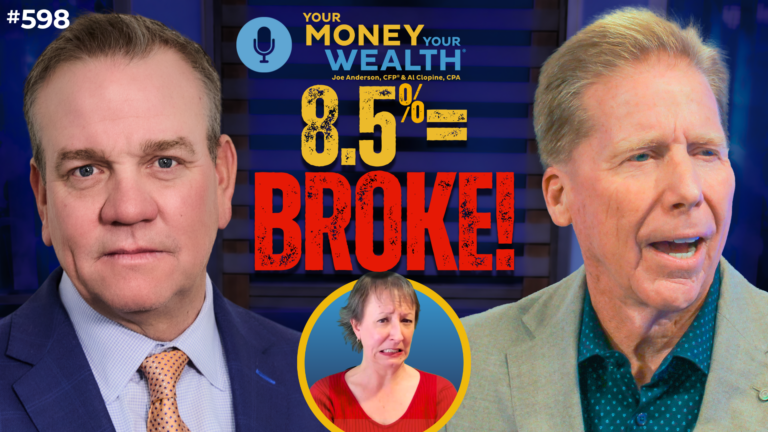
Joe Anderson, CFP® and Big Al Clopine, CPA address something a not-insignificant portion of this audience has been complaining about for years: their so-called ‘absurdly conservative’ safe withdrawal rates for early retirement. Rand and Elayne from Ohio are here to gripe about it directly with a thought experiment: a million bucks at age 36 and a three-year sabbatical in France. When, if ever, would Joe and Big Al say they should cut it short and go back to work if the markets turned ugly? Mike2me17 piles on, with his own SWR take about AUM fees in his Apple Podcasts review. But first, a real-world example: Ron and Harry from Florida are elite performers with a high-risk specialty job. Can they safely pull off moving to Portugal and living on $38,000 a year in their early 40s? If you’re one of the people yelling at your podcast app every time Joe or Al mentions a 2% withdrawal rate, today’s your day.

Show Notes
- 00:00 – Intro: This Week on the YMYW Podcast
- 01:14 – Elite Performers Semi-Retiring at 43 and Moving to Portugal. Can We Pull It Off? (Ron & Harry, FL)
- 16:16 – YMYW Safe Withdrawal Rate Assumptions Are Absurd. At What Point Do You Go Back to Work If Markets Crash? (Rand & Elayne, ID)
- 34:13 – YMW Safe Withdrawal Rates to Protect AUM Fee (Comment from mike2me17, Apple Podcasts)
- 41:46 – Outro: Next Week on the YMYW Podcast
Free Financial Resources:
Withdrawal Strategy Guide – YMYW TV
Financial Blueprint – free, self-guided
Retirement Pop Quiz: 18 Questions to Get You Ready to Retire – YMYW TV
Guides | Blogs | Educational Videos | YMYW Newsletter | Subscribe on YouTube

Watch today’s podcast episode on YouTube

Transcription
(NOTE: Transcriptions are an approximation and may not be entirely correct)
Intro: This Week on the YMYW Podcast
Andi: Today on Your Money, Your Wealth® podcast number 582, Joe and Big Al address something a not-insignificant portion of this audience has been complaining about for years: their so-called ‘absurdly conservative’ safe withdrawal rates for early retirement. Rand and Elayne from Ohio are here to gripe about it directly with a thought experiment: a million bucks at age 36 and a three-year sabbatical in France. When, if ever, would Joe and Big Al say they should cut it short and go back to work if the markets turned ugly? Mike2me17 piles on, with his own SWR take about AUM fees in his Apple Podcasts review. But first, a real world example: Ron and Harry from Florida are elite performers with a high-risk specialty job. Can they safely pull off moving to Portugal and living on $38,000 a year in their early 40s? If you’re one of the people yelling at your podcast app every time Joe or Al mentions a 2% withdrawal rate, today’s your day, and we welcome you to leave more of your thoughts on the topic in Apple Podcasts, YouTube, on Reddit, in our inboxes – like everyone else has. I’m Executive Producer Andi Last, and here are the hosts of Your Money, Your Wealth®, Joe Anderson, CFP® and Big Al Clopine, CPA.
Elite Performers Semi-Retiring at 43 and Moving to Portugal. Can We Pull It Off? (Ron & Harry, FL)
Joe: Hey, Joe, Big Al, Andi. I’m Ron, 38, and my husband is Harry, 35. We are both European, both working in the US since 2020. I found your podcast two years ago, and I listen to it every Tuesday on my way to work.
I am sure we are not your typical listeners. We are elite performers with a high-risk specialty job.” Elite performers, Al. That’s kinda like you and I. Elite. Very elite in our performance.
Al: I’ll put it this way, we try. So what do you think? You think they’re, stunt, stuntmen maybe?
Joe: I don’t know.
High-risk specialty job. If you’re an elite performer, high-risk specialty job. guessing, yes.
Andi: Keep reading. There’s more here. They might give us some clues. Okay.
Joe: Evel, Evel Knievel.
Al: Yeah. Like it.
Joe: “Because we depend entirely on our bodies to do this job, and it’s a very high-risk career, we are stepping down soon.”
Okay. What are they? 38, 35 retiring. Yeah. Okay.
All
right. All right. They must get paid well. They must be famous.
Al: They must be.
Andi: And they’re listening to us. Wow.
Joe: We arrived in the US in 2020, but for ob- obvious reasons, we didn’t work until late 2021. So we’ve been working, intensively-
Andi: Intensively. There you go
Joe: I’m sorry, intensively for almost five years. Before that, we were touring the world doing what we do best.” Okay, interesting. Here’s the numbers.
Andi: Yeah.
Joe: We got a 401(k), 4% match, $230,000 combined, 70% traditional, 30% Roth. Got a brokerage account of 320,000. We got a rental property in Europe that’s paid off, getting $7,000 a year from that.
Got a little side gig, $9,000 a year, for that. And then there’s some W-2 income, $300,000 a year combined. Primary home, value’s $375,000, $150,000 mortgage remaining. We got $200,000 in cash in a high-yield savings account. Yes, I know it’s high, but our job is risky. We are also considering buying another rental.
We got annual spending of $85,000 a year.
Andi: Yeah, I’m leaning towards m- stuntmen. I think they’re Evel Knievels.
Joe: All right. “So here’s the situation. We are stepping down in April 2027. After that, if we become coaches, we expect to earn 30 to 35 bucks an hour. Our plan is to stay in the US for another three to four years, complete the 40 credits required for Social Security.
Then we will move to Portugal.” Have you been to Portugal, Big Al?
Al: I have, about a year and a half ago. It was wonderful, especially Porto. Love Porto.
Joe: Got it. “Where we’ve calculated that we need about $38,000 a year to live comfortably on today’s money, and healthcare will be free for us there. We would work part-time in Portugal, semi-retired at 43, but combined earnings would not exceed $16,000 a year.
I’ll keep my European rental and my side gig.” Here’s the spitball questions. How do you live on $38,000 a year?
Andi: Apparently- I- … Portugal’s got a low cost of living.
Al: It’s, it is lower. I’m not sure it’s that low, but maybe they figured out a way.
Joe: All right. “Should we w- rent the Florida home when we leave, we’d net around $900 a month after the mortgage, or just sell it?
Number two, can we safely withdraw 2 to 3% of our brokerage account at our age without touching the 401(k)? Number three, we know our Social Security payments will be modest, but every little bit helps, right?” More details. Harry drives a 2022 Hyundai Tucson. Is that a Tucson- Tucson or a Tucson?
Al: Tucson.
Andi: Tucson.
Joe: Okay. I know, but, Tucson, but I thought there was a Tucson. Isn’t there, like, a d- a truck called a Tucson? I
Andi: think you made that up, Joe.
Al: I think so, too. that’s your version of Tucson.
Joe: Yes. I know how to spell Tucson, I know how to s- but I thought a Hyundai had a something different.
Al: All right, we’ll go with that.
A Hyundai Tucson. Why not? Okay.
Andi: From now on, on YMYW-
Joe: ‘Cause I drive-
Andi: … it’s the Tucson …
Joe: “He drives a 2019 Ford Edge, both paid off. We are healthy, boring green juice drinkers, though we can be persuaded to buy a cider or Cabernet on special occasions. We have a two-year-old cookie poodle, no kids ever.” “I absolutely love your podcast, and you have generally been a big part of our financial success since we’ve arrived in this country.
You have no idea. P.S. I saw a photo of Joe, and he’s exactly what I imagined. His voice matches the face.” So, I- I- have a- … voice for radio.
Al: He didn’t say that. ”
Joe: Thank you for everything, Ron and Harry, in Florida.”
Al: Okay.
Joe: All right. We’re gonna get these, get these boys retired at 40 years old. Yeah.
Semi-retired at 43, Big Al.
Al: Yeah, So I- I’ve done a little math for you, Joe.
Joe: Okay.
Al: So let’s-
Joe: $40,000 a year. They’re gonna have the side gig of 10,000, and then the rental’s 10,000, so 20,000 roughly is coming in. Yeah, they’re saying- So they need another 20?
Al: They’re- they’re saying salary maybe 16, rental seven, so 23. In three years, that’s, like 42,000, right? So their shortfall’s about 19,000. And at that age, Joe, I- I think I’m all right with a 2.5% distribution rate. That- that’s maybe kind of the upper limit. But, anyway, they would need about 760,000 in their non-qual. And the, that’s a little tricky, ’cause if you take out the HSA, which you can’t really use for living expenses without penalty, they have about 320,000.
But if they sell the Florida home, maybe they have another 200,000. So I’m just saying they got a little over 500,000 to start with, that they have to grow it at 760, for, in three years, and that- that means they’d have to save over 40 grand a year. 44 is what I get at a 6% rate of return. Or if they can eke it out for four years, they need to save about 32,000 a year to get to the, that, non-qual account that will give them a 2.5% distribution, without touching their 401(k). So that- that’s- that’s what I think. I think it’s doable. I’m not sure how much they’re saving now, but, you know, maybe they just-
Joe: they’re making 300. They spend 85.
Al: Yeah.
Joe: So that gives about $100,000 of savings.
Al: Yeah. So if that’s the case, right? Yeah. So anyway, yeah, no, I think it’s doable. and, I think, you know, the- the other question, should we rent or sell the Florida house?
Me, personally, I think it, you could go either way. Me, personally, I’d probably sell if I was gonna go back and live in Europe, not to have the hassle of a foreign, rental, but that, you know, that- that might be me.
Joe: Hold on. And- I- I got a different-
Al: What do, you get?
Joe: I have $28,000 of fixed income when they retire.
Al: Where are you getting that?
Joe: I’m getting $10,000, or call it $11,000 if they rent out the Florida home.
Al: Right.
Joe: I’m getting another $10,000 a year in the side gig, in the freelance. Okay. So that’s 20,000. And then he’s got a rental property in Europe that is generating another $7000 a year, so that’s $27,000 roughly of fixed income at retirement with those three sources.
Al: Right.
Joe: So he needs $10,000 from the portfolio, given age 43, if he doesn’t work.
Al: Right. So- So that’s one… That’s, so, my… Here’s my caution with that, is if they’re making 900,000 a- after paying the mortgage, you and I know there’s more expenses than just the mortgage. There’s vacancies, there’s maintenance, there’s- Sure
there’s insurance. we don’t know if there’s a homeowner’s fee. So, I’m a little bit concerned about the $900, how real that is. But- Got it … that, that is another way to look at it. So it, we don’t know enough to be able to say to, to, sell or turn it to a rental. but what I’m suggesting is if you’re gonna live in Port- Portugal, do you really want a US Florida rental?
Now, I, wouldn’t myself, but maybe some people are okay with that.
Joe: So they got $500,000 in taxable money.
Al: Yeah, but 190 is HSA, so you can’t really-
Joe: High yield savings account. HYSA. HYSA, yeah. HYSA, high yield- Oh … savings account.
Al: I’ve, I dropped the, Y. Okay. 5- 520. So yeah, it, looks better than what I said then.
Joe: Yeah. They can generate 100, probably $20,000 from the taxable account, and then plus everything else. I mean, I think they’re sitting in good shape. But 38,000 is really the number. That, I think that’s the biggest crunch.
Al: Yeah. Can they do-
Joe: But I’ve never been to Portugal, so I don’t know how cheap you can live.
And I guess if you d- drink green juice and work out all day- … right? but they probably gotta eat if they’re elite specialty performers.
Al: Yeah, probably.
Joe: You probably gotta g- get a lot of protein.
Al: And they gotta, they have, to have a good gym membership, so they got some spending here. Okay. that, so you, are right, Joe.
That makes this a little bit better than what I said.
Joe: I think they’re sitting really… But f- but $40,000. How much did you spend when you spent a week in Portugal?
Al: I don’t-
Joe: Did you spend $40,000 that week? Probably.
Andi: Now, come on, vacation’s a lot different than living there.
Al: Yeah. We stayed… Let’s see. We went to Lisbon, we went to the island of Madeira, we went to Porto.
Yeah, we definitely- We spent, not 40 grand, but it was a decent number.
Andi: And these guys say that they are European, so chances are they’ve actually been to Portugal and they’ve done all the sightseeing and all that before.
Al: A- and they know how to do it. Yeah. Yeah.
Joe: Got it. So no healthcare. So if, 38,000’s the number, I, think… But these guys are performers. They travel the world, in front of audiences probably, right? Probably. And it’s like, you’re gonna retire at 40 years old? Wouldn’t you go bored? What, are you gonna do? I think I’m more concerned about what’s the lifestyle? You go to Portugal and you just chill on the beach?
Andi: they said that they’re gonna be coaching potentially, so they’re gonna t- be coaching-
Joe: Okay, coaching
Andi: … younger stunt men
Joe: All right. So that’s fulfilling.
Al: Yeah. Yeah. And may- and maybe they could continue that in Portugal. I don’t know. We don’t really kn- quite know what they do and whether that’s transferable, but maybe. I think I’m starting to change my mind a little bit, Joe, on retiring early. I think that our millennial generation has a different set of values than we do in terms of enjoying life while you’re younger, and then going back to work later if you have to.
Joe: You’re- So- … you’re, jumping on board in the FIRE movement, huh?
Al: I’m jumping on board because I, so I wasn’t FIRE, I’m FI. But I didn’t retire early. And now that I’m FI, I kinda like the freedom. And if, in, the current millennial-
Joe: If you had f- you tried to do it at 50, didn’t you?
Al: Yeah, but I didn’t- How’d that- because of-
Joe: Oh, you weren’t FI well- You just wanted the RI.
Al: I thought-
Andi: RE.
Al: RE. I thought I was ready, but the Great Recession took care of a lot of my real estate equity, so that, that changed that equation. But yeah, no, I, I feel like why not? If you’re healthy, 30, you know, f- 30, late 30s, 40s, whatever, and you wanna take some time off, why not? And then knowing that maybe you’ll have to go back to work someday. I, it’s, I think when we talk about distribution rates, we’re talking about you retire and that’s it, you never work again, right? So I don’t know. Retire at- 40s, late 30s.
Al: Yeah. Ron would be early 40s.
Joe: Yeah.
Andi: Yeah. And they’re saying semi-retired at 43, so th- you know-
Al: Plus-
Andi: That’s where they would move into that coaching position and-
Al: Yeah, plus the other thing, Joe, they say no kids ever.
Andi: So maybe they’ll become European real estate moguls after the coaching career.
Al: Maybe. Yeah, who knows?
Joe: What would you do? Would you sell the house or would you rent it?
Al: I’d sell it, ’cause I don’t want a foreign rental. It just seems-
Joe: No, would you sell the Florida home?
Al: I’d sell the Florida home. Yeah. Because if you didn’t, if you didn’t sell it, you turn it into a rental. I like the f-
Andi: So if you kept it and wanted to rent it out, and you needed to hire a property manager to take care of that stuff for you, how much would that end up costing somebody?
Al: Typically about 10% of the rent. So y- so you got that. They don’t mention maintenance, they don’t mention vacancies, they don’t mention insurance, so that there’s more costs than just the mortgage. Yep.
Joe: Yeah, they could sell it with the 121 exclusion, pay no tax probably. Yeah. So that’s good.
Yeah. I, I- Safely withdraw 2% to 3% on the brokerage account without touching the 401(k). Yeah, I think you’re good there.
Al: Yeah, actually-
Joe: Social Security, even though it’s modest, everything counts. Yeah, you’ll, receive the benefit because you put in the quarters, so I- Yeah … I think they’re sitting good.
Al: Yeah. If we go with your correction for my analysis, which I agree with, so they got 520. If they sell the property, maybe they get, like, another couple hundred thousand. That’s about 720. Remember I said they need about 760? So with probably what they’re saving, yeah, I think they’re sitting good. I think pr-
Joe: Yeah I think probably they can spend more than the 38,000 than they’re thinking.
Al: But you bring up probably the most important question, is what’s the spending really, right? ‘Cause that seems like not very much money.
Joe: Yeah. All right. yeah, thanks for the question and good luck.
Andi: Ron and Harry, you two are ahead of the curve just for knowing your numbers as well as you do. Speaking of knowing your numbers, this week on YMYW TV, Joe and Big Al turned the tables on their audience with an 18-question retirement pop quiz. Stuff like: what percentage of Americans have zero saved for retirement? How much do you actually need to generate $40,000 a year in retirement income? When should you start taking Social Security, and how much will it actually replace? It’s the kind of episode that makes you realize pretty quickly whether you’re on track, or whether you’ve been assuming you’re more ready than you actually are. It’s fast, it’s a little competitive, and you might want to keep score. To see how your retirement plan scores, use our free, self-guided Financial Blueprint tool. You plug in your assets and projected spending, and it’ll calculate your probability of retirement success, along with some actionable steps to help you get there. Watch YMYW TV and calculate your free Financial Blueprint at the links in the episode description.
YMYW Safe Withdrawal Rate Assumptions Are Absurd. At What Point Do You Go Back to Work If Markets Crash? (Rand & Elayne, ID)
Joe: Okay, let’s move on. We got Rand and Elayne. Wheel of Time. What the hell is Wheel of Time?
Andi: It’s a book series.
Joe: It is?
Andi: Are you familiar with it at all?
Joe: As you can tell I am not.
Andi: Rand Al Thor and Elayne Trakand from Wheel of Time series by Robert Jordan. There was 14 books from 1990 to 2013, and Amazon Prime Video adaptation launched in 2021.
Al: All right, Andi, how much of that did you know without looking up?
Andi: Absolutely none of it.
Al: Which is why Joe and I don’t know it either.
Joe: Yeah. Aaron watches it. You like The Wheel of Time? What is it? You spin the wheel and you go to whatever time that the-
Andi: Wow, that is a great concept for a show. Just ask Joe and he’ll spitball what your show concept should be.
Joe: it’s a little time travel?
Al: Yeah, maybe. Back to the Future maybe.
Joe: Got it. All right. So dragons and sorcerers and- … oh, that sounds right, right up my alley. Okay. All right.
Al: that’s our assignment for this week, Joe. We gotta watch an episode.
Joe: Yeah. I, need a new show, so here we go. All right. they’re from Idaho, 36 years old, who are mainly writing to gripe about Joe’s incredibly absurd take on early retirement safe withdrawal rates. you know what? I’m not gonna watch Wheel of Time anymore. I asked it. Most importantly, we drink f- what… We… I don’t have anything that’s incredibly absurd- … take on withdrawal rates, first and foremost. So I’m gonna, I’m gonna correct you here, Rand and Elayne.
Al: I think you kinda went off on it on one of the episodes.
Joe: I don’t think it d-
Al: I do. Okay. I kinda do. I think you went off on it on several episodes.
Joe: All right. Let me continue reading. Let’s see what they’re talking about.
Al: Okay.
Joe: All right. Most importantly, we drink French 75… what are s- French 75s?
Andi: Gin, lemon, m- simple syrup, and champagne.
Joe: Pff. Little French 75s. Okay, that sounds a little hoity-toity. And are distressed-
Andi: We had a show where there was a rash of them, that was their drink, and it, we’re starting to see a whole bunch more of them.
As a matter of fact-
Al: I see
Andi: … there’s another one coming up later.
Al: Okay.
Joe: All right. Little French 75s. And are distressed. You’ve never heard about this before 2025, but happy to hear so many have come out of the woodwork recently. It is also not sweet. Did we talk about a, a, French 75 before? Is that what you said?
Andi: I just got done saying that, Joe. You just have to listen with your ears.
Joe: Y- I’m on a seven-minute delay here. All right? I’m in the studio in San Diego. You’re in Australia and, Big Al’s in Hawaii.
Andi: So yes, we had a number of people write in, all, like, in, within one or two shows, that were all drinking French 75s, and it’s become popular on the show since then.
So yes, we have discussed it before.
Al: Okay. I will say, I asked Annie if she’d ever heard of a French 75, and she said yes, but only in the last six months when she went out with some girlfriends and one of them ordered a French 75.
Andi: It must be getting pushed out, you know, in the marketing or something like that.
Al: I guess.
Andi: And by the way, for listeners and viewers, that was Al’s wife, Annie, not producer Andi.
Al: Yeah, that’s-
Andi: Just to clarify.
Al: Yeah good point. Annie, also known as Anne.
Andi: Yeah.
Joe: Yes. Okay.
Al: Do we have a question?
Joe: yeah, “It’s a wonderful g- gin drink. Aviations are also quite lovely.” All right. “We drive a CRV and a Corolla. We have two lovely daughters, seven and three. Financial deets: a million dollars investable assets, 40% Roth, 25% brokerage, 35% traditional. $150,000 non-childcare current expense. $420,000 of income. Family medicine doc and nurse.” Oh, that’s cool. “In episode 529, you discussed how 2% isn’t low enough for your liking, and it’s upsetting my soul.”
Al: He’s calling you out.
Joe: “We need to have a heart-to-heart. I’m extremely manly and not at all lame financial spreadsheet that projects my current $1 million in assets will grow to 4 to $7 million in 9 to 14 years, allowing for a good start to financial independence retirement at the time for our expenses. Obviously, a million things can change at any time in my spreadsheet, so it’s certain to be wrong.
The goal of my wife and I is to be able to get to a point where we feel comfortable taking a leap and traveling for a few years while we’re still young, and we’re willing to go back to work, and might even want to later on. My question is more of a thought experiment. Let’s pretend you are 45 and have a really easy job to go back to.
We are really employable and fun, and have 4 to 5 million with expenses hitting about a 4% withdrawal rate. You don’t ask Joe or Big Al what they think of your plans and go off to France for three years. At what point would you return and go back to work if the markets were doing poorly, assuming a well-diversified portfolio?
Is it hitting a specific withdrawal rate, a percentage failure on the Monte Carlo, a portfolio loss amount? I think this discussion would be really helpful for our younger folks who wanna take advantage of our youth and the savings to do something really cool early on. Obviously, it may not be a forever traditional retirement, but that’s okay.
I’ll be 45. Thanks for entertaining me while I do the dishes, not in France.” All right. This was a little clustered. I don’t know if it was my reading or if it was the doctor’s writing.
I think a little bit of both here. So he wants to get out, right? So he’s a- he said he’s, there’s- they’re, a family medicine doctor and nurse. Right. So he wants to get out. He’s got a million dollars currently in investable assets. They wanna spend $150,000. They make $420,000 in income today. “In the goal of his wife and I is able to get to a point where we feel comfortable taking a leap and traveling for a few years while they’re still young.”
All right, so they wanna do a little sabbatical, Al.
Al: I think so, and maybe as much as three years, ’cause he mentioned France, three years.
Joe: Okay.
Al: Yeah, and they’re, they already have a million dollars at 36, so presumably in another nine or 10 years they would have 2 million or three maybe. Who knows, right? They’re making a lot of money and they’re saving a lot. So anyway, I don’t know what they’ll have, but yeah, what do you think?
Joe: I don’t understand the point here when he’s like, okay, let’s say you have a really easy job to go back to, okay? So they’re super employable.
Al: Yeah, as doctors.
Joe: Medical doctor, nurse. yeah, right. Really fun, really nice.
Andi: How any of that is fun and easy-
Joe: Bring the French 45
Andi: … I don’t know.
Joe: What’s that?
Andi: I said how that is a fun and easy job being a family doctor, I don’t know, but, or a nurse, both of which… I mean, I’ve been seeing my fair share of doctors and nurses lately.
They don’t have an easy job.
Al: I think he said they’re, it’s, they’re really employable and fun. Yes. I’m not su- I’m not sure he said easy.
Joe: Easy job to go back to.
Al: Yeah, easy to go back to.
Andi: Oh, got it. Okay. Yeah. Not an easy job. It’s easy to get back to, yes.
Al: yeah.
Andi: Yeah, they’re in demand.
Al: Okay, so let’s, so okay, this is kinda like the other one. So millennials wanting to enjoy some of the money they’ve accumulated before they retire. I think that’s, I think, Joe, I’ve got two millennial sons. I feel like that’s gonna be kind of a trend here. What do you think? If you do that, let’s say you got 2 or 3 million. When, do you go back to work, or when should he go back to work?
Joe: I don’t know. If you can’t make $5 million last-
Al: No, 40 years. no, You gotta think about this differently. This is a three-year, and then you go back to work.
Joe: I don’t know. I would… no, I mean, when would you go back to work? Would it be three years, five years, or within the three years?
I mean, I, think you wanna take a close look at w- what the portfolio’s doing and what the withdrawal rate is. If he wants to p- pull 4% out, that’s totally fine at 45.
Al: Yeah.
Joe: But then you just have to take a look at if you have a market downturn for three, four, five years in a row, and that 4 million is now 2 and a half or three depending on how much that you’re taking out of the portfolio- To me, I, like, I, think you have a sleep factor. This is just my personal opinion.
Al: Yeah.
Joe: Get the financials out of the way because I think you have $5 million of liquid assets. You can do a lot of different things and- Sure … and you’ve saved a ton, and I, would think you’re f- you’re financially independent at that point. ‘Cause you can always adjus- sa- adjust your savings, right?
Al: Right. Yeah. Instead of spending 350,000, you spend 150, 200 grand. You’re still living pretty comfortably.
Joe: I, think I would have a number in my mind of where I would want that number to get to. And so maybe if, his number’s $5 million, then I would want to kinda put a range between that. What’s my sleep factor?
If that goes to $2 million, am I, will, I still be able to sleep at night? If, the answer’s no, then I’m going back to work.
Al: Right. Yeah.
Joe: If the, if it never gets to that point, I would continue to stay retired. I think he’s right. He’s very employable. He can always go back to work part-time, half-time, couple hours a week. He could be like Doc Holiday, you know, or Hollywood. Remember that movie?
Al: I do.
Joe: Remember the old doctor? Yep. And I don’t think he worked full-time because Michael J. Fox came in. He did. So he could be that guy, right? Yeah. There you go.
Andi: So he says, “At what point would you return and go back to work if the markets were doing poorly?”
So I kinda take that to mean how long are the market’s doing poorly before I say, “Okay, it’s time to cut bait and, get back to work.”
Joe: I probably- You never know when the markets are gonna do poorly though, right? So you’re, every time the market kinda makes a little bit of a dip, then it’s like, “All right here, I’m getting my resume out”? Yeah. I don’t know if that’s the right answer either.
Al: Yeah. Me personally, how I would approach this is I would have a kind of a somewhat set plan that I could modify. Like, let’s just say I wanna take a three-year sabbatical, okay? Then I’d run some numbers with my financial planner, and it’s like, all right, what if I take, what if the market goes down 10% a year, and where am I at? And I’m, I was still cut- You know, so you have a sleep factor. What if the market stays even? What if the market goes up 8% a year? So you kinda look at different scenarios, and where are you comfortable? And I think you go back to your answer, Joe. When you, when it’s affecting your sleep ’cause you’re worried about running out of money, I think that’s a pretty good clue that you gotta go back to work.
Andi: Something else to take into account that I can speak to from personal experience is the cost of moving countries, because that is substantial.
Al: Yeah. that’s a good point. Probably, I’m guessing if it’s a three-year thing, they’d probably just rent a home there that maybe it was furnished, so I- Yep … I don’t know. But, yeah, I think, gosh, if you really were gonna only take a three-year sabbatical, I think 6% distribution rate or more, right? C- ’cause you’re planning to come back, right? Now, if you- Yeah … if you, ask it differently and say, “I’m thinking of taking three years off, but I may wanna fully retire,” then my answer’s different. Then I’m, gonna go back at 45, 2.5% or 3% distribution rate, which would be a more standard rate if it’s a, if it’s a f- kind of a longterm retirement.
Joe: Yeah. Or, you could just say, “I’m gonna spend a million and a half in three years.” Yeah. And I m- $500,000 a year- Set yourself a budget … over the next three years, and then that’s what my budget is, so I know that I still have this other pool of money that is growing over that time period, right? And then when I go back to work, you know, th- that’s my nest egg for the next 20 years of, my working career. I mean, I mean, there’s a ton of different ways that you could slice this.
Al: Yeah. Yeah. And I think you probably gave one of the best answers, Joe, the sleep factor. When you get to the point where it feels like your money’s slipping away, you know?
Joe: but I think you’ve got, y- there’s a lot of, what is it called? something creep, you know?
Andi: Lifestyle creep.
Al: Oh, l- lifestyle? Yeah.
Joe: Yeah. Yeah. A little fried today, if you can’t tell- … with my brain. Jeez.
Andi: Gotta find that word, lifestyle.
Joe: Yes. Well- So once you accumulate dollars, it’s like, all right, and it seems like, all right, now I got a million, now I got three million, now I got five million, and it’s like, okay, now my number’s 10 million. No one ever really gets satisfied. It seems like, “Hey, c- can I get a little bit more? A little bit more?” And then we s- y- people spend more when they make more. So if he could stay disciplined and say, “Hey, we’re only spending $150,000 a year,” you know, and then, or you wanna spend a little bit more than that, y- you could kinda break up your dollars into different timeframes but it’s the spending that’s gonna drive all of this.
Al: Yeah. and the investments. So if you’re all in cash, you’re not gonna do as well as if you have some in the market. But if you’re in the market could tank, right? So you gotta factor that in. But maybe that’s a good w- good way to do it, Joe, is figure out the spending for a three-year period, and if the market stays the same, goes up, or goes down, are you h- are you okay with where that ends up, and you know, so that you can sleep at night.
And then if the market does great, gosh, maybe I’ll do four years, right? Yeah. Right. You, you-
Joe: Or five years … you got $5 million. As soon as that hits $4 million or below, we’re going back to work.
Al: Yeah, whatever your comfort level is in terms of what you could spend. Yeah. Yeah. What, what-
Andi: And make plans for what you’re gonna do about healthcare if you happen to get sick during those three years or something happens in that respect.
Al: Yeah.
Joe: He’s a doctor.
Al: Yeah, they’ll care- they’ll work on each other.
Joe: I said are you gonna treat himself.
But here’s what I don’t, y- you don’t ask Joe and Big Al what they think of your plans and go off to France for three years. Why don’t you ask us? Didn’t he just ask us? Bec- b-
Andi: No, he’s using this as a thought experiment.
Joe: Because-
Andi: What if somebody just does this without consulting with you first?
Al: okay. The way I read that is, we have often sort of discouraged people at retiring at 45 ’cause you’re gonna be bored. But I just told you, I’m rethinking this. I’m thinking the millennials have a different perspective than we-
Andi: Wow. The listeners have gotten to you, Al.
Al: than… ’cause I have two millennial kids. I’m starting to get on board with this. As long as it’s a temporary retirement. It’s not really a tr- retirement, it’s a sabbatical. maybe that’s a better way to say it. And maybe it’s a one-year to five-year sabbatical, and then I think you would probably think about distribution rates quite a bit differently.
But I will say one thing, Joe, is if you have that sabbatical for three or four years and you go, “You know what? I really don’t wanna work again,” that, that would be a p- problem with that much distribution out of your portfolio to ha- have anything close to continuing.
Joe: Okay. Yeah. I don’t know if I agree with you.
I’m not, sure if I’m, 100% on board with this, “Hey, you know what? While we’re young- I- “… let’s go have fun.”
Al: I think it makes a difference whether you have kids or not. I think if you have kids, this is more difficult. Not impossible.
Andi: And also how likely it is that you are gonna be able to just hop back into a job if you need to reenter the job market.
Yeah, as a doctor, definitely. As a podcast producer, maybe not.
Joe: Right. But I mean, it doesn’t have to do with the economics, dude. So he’s a doctor with a million dollars at 30-something. So sure, yeah, do whatever you want. Who cares? You’re gonna go back to work and be a doctor again. But how about if I have, like, 50 grand to my name and it’s like, “You know what? I want a sabbatical. I’m a millennial.”
Al: no.
Joe: Big Al’s like, “Yeah, I’m on board ’cause I got two millennials myself.”
Al: No, not even close. Right? So, so I’m going, I’m going-
Joe: You’re like, “Go for it, man.” I’m going- But then it’s like, “I’m never going back to work and I’m sleeping on your couch.”
Al: No, I’m going with this, fact scenario, which is a million today.
In 10 years it’s probably 3 or more, right? And then, and employable as a doctor. I’m okay with that. Yeah, you have 50 grand, and you’re not very employable? You gotta find a better job, dude. This is not the time for a sabbatical. So, it depends.
Joe: Got it. All right.
Al: Fair enough.
Andi: A lot of what Rand and Elayne, and Ron and Harry, and so many of you are wrestling with in terms of safe withdrawal rates comes down to the same question: how do you turn a pile of money into a paycheck, and how do you make it last? Nearly 70% of your retirement savings could get eaten up by taxes if you don’t have a robust withdrawal strategy in place. Our free Withdrawal Strategy Guide walks you through how different approaches stack up, like fixed dollar, the 4% rule, and proportional withdrawals. It gets into the tax-smart stuff too: Roth conversions, tax-loss harvesting, and the right order to pull from your accounts so you’re keeping more of what you saved. Grab it for free at the link in the episode description. And when you do, you’ll see a dropdown that asks how you heard about us. Choose podcast.
YMW Safe Withdrawal Rates to Protect AUM Fee (Comment from mike2me17, Apple Podcasts)
Joe: Let’s go to Mike2me17.
Andi: This was from an Apple Podcasts review, and it was on topic, so I thought I’d throw it in here.
Al: Okay.
Andi: Takes a different angle on this withdrawal thing.
Joe: Okay. “Love the model of reviewing real people’s finances, and they do keep it fun.” Yeah. “Hard to agree with less than 2% safe withdrawal rates in an early retirement, especially after listening to many other financial podcasts. I think they have a tough time understanding many people in the real world can be flexible in their spending and may be reducing their proposed safe withdrawal rate in order to account for the 1% fee in their AUM model.” Oh. Okay. When did we ever say less than 2%?
Al: Apparently, it was episode 529.
Andi: And I think it was because somebody had intended an extra-long retirement, and that was the problem.
Joe: Yeah. And they… Who said it? It had to have been Big Al.
Al: No. It was definitely you.
Joe: I would say less than 2%?
Andi: It’s gonna be des- dependent on the assumptions in that particular person’s situation.
Al: Yeah. I would agree with that. And I, I think, like, so this is a sort of a different than the, what we just discussed was a s- a sabbatical.
Now, this is an early retirement, so that’s different, right? So I would say if you wanna retire at 45, I’m, probably good with 2.5, maybe even 3%, but it depends upon how your investments are. If you’re too conservative, then you’re not gonna have enough growth to cover this. But I also think, if you’re the type of person or couple that can be flexible on your spending, you have a much greater chance of this working, right?
So I don’t, I don’t, remember what we said in episode 529, but no, I sort of agree with, with Mike. I, mean, I… It doesn’t… The, By the way, these are just back of the envelope discussion points. On whether you have enough to retire. This is not a retirement plan where you, get to 2% or 2.5%, “Okay, I can retire.” There’s 1,000 variables that could make this work or not work.
Joe: Right.
Andi: Now, let’s talk about the, this thing about taking into account your AUM fee and whether or not that is playing some part in whether you’re saying these people are safe to withdraw that rate or not.
Joe: the 1% fee that you pay any financial advisor should be a value add, not an expense.
If it’s an expense, you should never, ever pay an advisor 1%. So you should have value, you should have more dollars, you should have more income, you should have a better experience by paying anything anyone a fee. If it’s a financial advisor, if it’s a painter, if it’s a carpenter, if it’s a interior de- I- you know what I mean?
So I think, if, there’s no value in what you’re purchasing, then don’t ever do it. So it’s, so does that-
Al: Yeah. Yeah, Joe, Mor- Morningstar did a study a few years ago, and I can’t remember, it was like 2.5% to 3% of value is added by the average inv- advisor for the average person. Now, that’s not true across the board, but if the, if it’s a 1% fee and you’re adding 2.5%, you’re actually to the plus, just like what you’re saying.
Joe: Yeah, I think Vanguard ran a study too, so. Yeah. But I, again, I think the point of any type of safe withdrawal rate that we use on this show is to look at how much money should you have in liquid assets for you to consider retirement. and it’s not like, “All right, take 4% out of your portfolio, or 2%.”
You can have flexible withdrawal rates. You can d- some years spend a lot more, some years you’re probably gonna have to spend a lot less. it’s gonna depend on what you’re doing that year in your overall retirement. Some people go back to work, some people consult, right? it’s kind of a ongoing process.
It’s not like, “All right, it’s set in stone. Once you retire, this is what you have to do.” that’s kind of absurd. But here’s the issue, I think, is that a lot of times most people don’t know how much money that they should have. I think people think about a number. It’s like, all right, is 100,000 enough, or is it 500,000, or is it a million, or whatever the number is.
What we’re trying to do is to help, like, identify, how big of a nest egg should you be shooting for to maintain the same lifestyle that you’re currently accustomed today? Because- If you have $100,000, we s- you know, we see clients that wanna spend, you know, $30,000 out of that portfolio a year. It’s like, you have 100,000.”
yeah, that’s a lot of money. Can’t I spend 30 thou- $30,000? Won’t it last?” A- and, no, it won’t, you know? So some people are really good at this, some people are not. So it’s a back of the envelope spitball of what we’re looking at. But a distribution plan is completely different than, like, an accumulation plan.
So we’re, looking at, “Hey, are you on track, not on track? Are you in the same zip code?” So we use these safe withdrawal rates to, identify, you know, what those liquid assets should look like. and then from there, then you have- then the real work, in my opinion, comes in, where you gotta roll up your sleeves and figure out, how are you gonna create the income?
How are you gonna save money in tax? How are you gonna manage your risk? How are you gonna tax manage the account? How are you gonna be tax diversified? And you have to do this simultaneously as you’re going through retirement. And then when other income sources come in or not come in, or other expenses go up or other expenses go down, you just have to be fluid in the overall strategy that you have, unless you wanna go back to work.
So we talked about these sabbaticals, and if you go back to work, then that’s one thing, but a lot of times most people don’t wa- don’t wanna go back to work, ’cause that’s why they retired.
Al: True. But, I- what I’m suggesting is, that’s, tha- that’s our generation. Now, I’m Baby Boomers. What are you, Generation X or Y?
Andi: We’re both Xers.
Joe: X. Yeah.
Al: You’re Xers. I-
Andi: 65 to 80 is, is s- considered Generation X.
Al: I feel like the Millennials are more likely to wanna take a sabbatical. That doesn’t mean re- necessarily retire forever. I just think, we need to start thinking about this in certain cases. Not the, not, the example you told me, Joe.
The guy’s got 50,000, “I’m, gonna- I don’t wanna work anymore.” That’s a little tricky.
Joe: All right. Alan, when do you get back?
Al: Saturday. Oh, sure. So I’ll be in, I’ll be in next week. Yeah. Short trip. Short trip, yeah.
Joe: you got some, people wanting to stay at your place or something, or-
Al: We do, but we s- we spent the first part of our trip in Berkeley, and I went to Tiburon, then we went to Sonoma County, so we’ve already done a bunch of stuff before here.
So that’s why we couldn’t- Okay … that’s why we didn’t record last week.
Joe: Got it. So now you’re just relaxing and ready to come back.
Al: I’m, relaxing. I’m not trying to-
Andi: I was gonna say, I don’t think he’s ready to come back.
Al: That’s right, I’m quite ready to come back, but, but-
Andi: He works just fine from his lanai.
Al: And we just got some new furniture today, so it’s actually rather exciting.
Joe: Oh, very cool. New couch? New, La-Z-Boy?
Al: New couch. We got a recliner and two side chairs.
Joe: Very cool. Wonderful. All right. That’s it for us. Andi, thank you very much. Thank you, Joe. Al, have a good rest of your time in Hawaii, and, we’ll see you guys next time. The show’s called Your Money, Your Wealth®.

Hawaii: the view from Al’s lanai

Hawaii: Al’s new furniture
Outro: Next Week on the YMYW Podcast
Andi: Next week on YMYW, Walter and Jesse from New Mexico want to unload $1.6 million in company stock without writing the IRS a giant check. Richard from Staten Island has one oil stock that’s 80% of his portfolio, and his financial advisor wants him to sell it. And Drs. “Bones” and “Beverly” are about to inherit a $1.35 million tax bomb with some concentrated stock, and need a spitball before it detonates.
Make sure you’re following the show in your favorite podcast app so you don’t miss a thing, and join the conversation in the comments right now on YouTube.
Your Money, Your Wealth is presented by Pure Financial Advisors. Making the most of your money and your wealth in retirement requires a lot more than a spitball: schedule a free, no pressure, no obligation, comprehensive financial assessment with the experienced professionals on Joe and Big Al’s team at Pure. Click or tap the free financial assessment link in the episode description or call 888-994-6257 to book yours. Meet in person at any of our locations around the country from California to Tennessee. Or you can meet online, right from home. No matter where you are, the Pure team will work with you to create a detailed plan tailored to meet your needs and goals in retirement.
Pure Financial Advisors is a registered investment advisor. This show does not intend to provide personalized investment advice through this podcast and does not represent that the securities or services discussed are suitable for any investor. As rules and regulations change, podcast content may become outdated. Investors are advised not to rely on any information contained in the podcast in the process of making a full and informed investment decision.
_______
Listen to the YMYW podcast:

Amazon Music

AntennaPod

Anytime Player

Apple Podcasts

Audible

Castbox

Castro

Curiocaster

Fountain

Goodpods

iHeartRadio

iVoox

Luminary

Overcast

Player FM

Pocket Casts

Podbean

Podcast Addict

Podcast Index

Podcast Guru

Podcast Republic

Podchaser

Podfriend

PodHero

podStation

Podverse

Podvine

Radio Public

Rephonic

Sonnet

Spotify

Subscribe on Android

Subscribe by Email

RSS feed

YouTube Music
IMPORTANT DISCLOSURES:
Pure Financial Advisors is a registered investment advisor. This show does not intend to provide personalized investment advice through this podcast and does not represent that the securities or services discussed are suitable for any investor. As rules and regulations change, podcast content may become outdated. Investors are advised not to rely on any information contained in the podcast in the process of making a full and informed investment decision.
• Investment Advisory and Financial Planning Services are offered through Pure Financial Advisors, LLC, a Registered Investment Advisor.
• Pure Financial Advisors LLC does not offer tax or legal advice. Consult with your tax advisor or attorney regarding specific situations.
• Opinions expressed are not intended as investment advice or to predict future performance.
• Past performance does not guarantee future results.
• Investing involves risk including the potential loss of principal. No investment strategy can guarantee a profit or protect against loss in periods of declining values.
• All information is believed to be from reliable sources; however, we make no representation as to its completeness or accuracy. As rules and regulations change, content may become outdated.
• Intended for educational purposes only and are not intended as individualized advice or a guarantee that you will achieve a desired result. Before implementing any strategies discussed you should consult your tax and financial advisors.
CFP® – The CERTIFIED FINANCIAL PLANNER® certification is by the CFP Board of Standards, Inc. To attain the right to use the CFP® mark, an individual must satisfactorily fulfill education, experience and ethics requirements as well as pass a comprehensive exam. 30 hours of continuing education is required every 2 years to maintain the certification.
AIF® – Accredited Investment Fiduciary designation is administered by the Center for Fiduciary Studies fi360. To receive the AIF Designation, an individual must meet prerequisite criteria, complete a training program, and pass a comprehensive examination. Six hours of continuing education is required annually to maintain the designation.
CPA – Certified Public Accountant is a license set by the American Institute of Certified Public Accountants and administered by the National Association of State Boards of Accountancy. Eligibility to sit for the Uniform CPA Exam is determined by individual State Boards of Accountancy. Typically, the requirement is a U.S. bachelor’s degree which includes a minimum number of qualifying credit hours in accounting and business administration with an additional one-year study. All CPA candidates must pass the Uniform CPA Examination to qualify for a CPA certificate and license (i.e., permit to practice) to practice public accounting. CPAs are required to take continuing education courses to renew their license, and most states require CPAs to complete an ethics course during every renewal period.