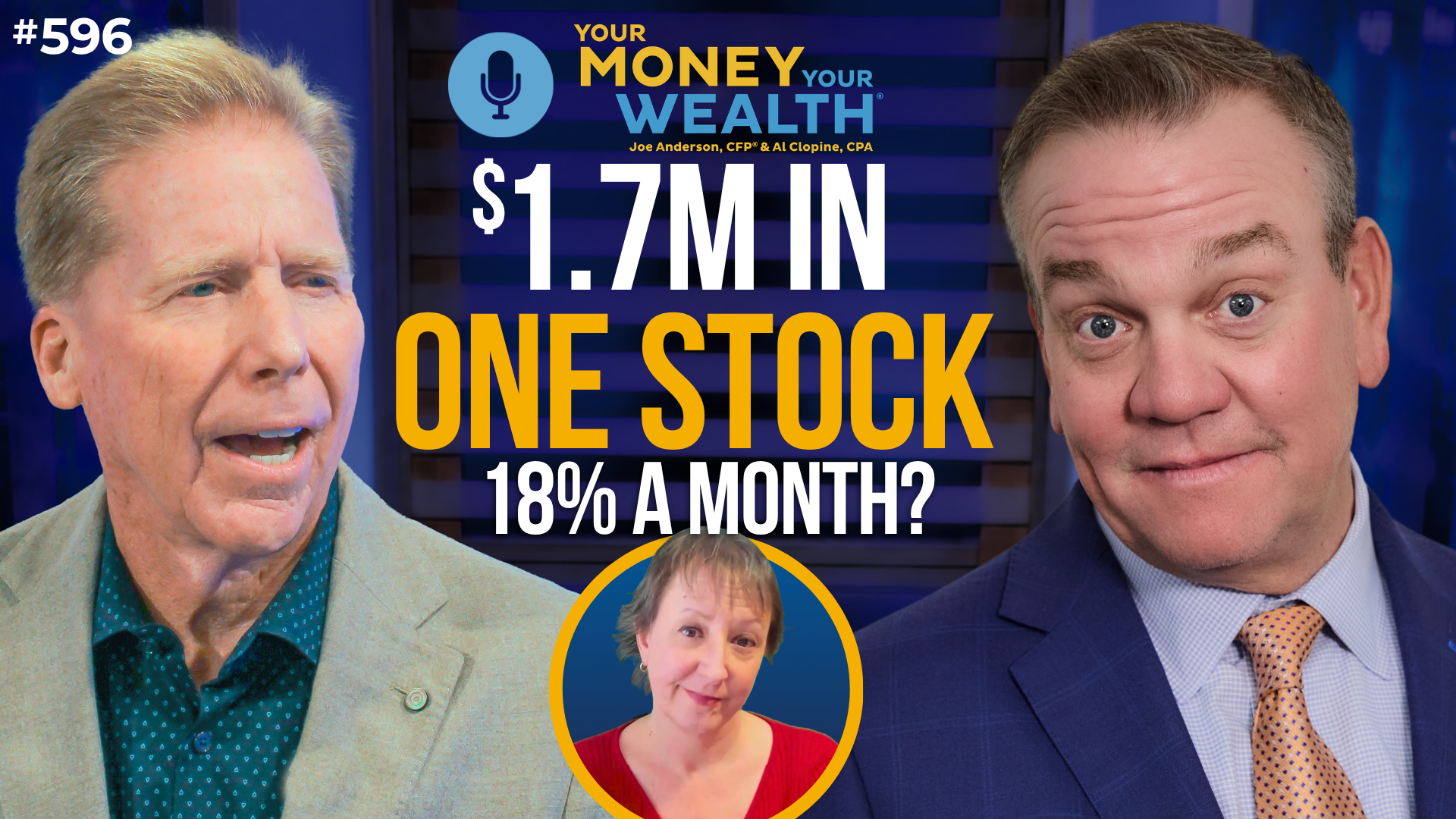
Each of the questions Joe Anderson, CFP® and Big Al Clopine, CPA are spitballing today on Your Money, Your Wealth® podcast 596 has a real retirement risk attached to it. Philip and Elizabeth in DC have $7M. Philip’s dying to quit a job he hates, but he’s loading up on bonds to protect the nest egg. At 56, could playing it too safe be his real risk? Mr. Mojo Risin wants to retire in three years, but $1.7M of his nest egg is riding on one stock, and he needs a good CPA to help defuse it. BB and Shell got pitched a slick new AI crypto investment promising 15% a month. Too good to be true? And Huggy Bear in New Hampshire has $450K in cash value life insurance. Should he grab it now, or wait 20 years until he’s 80?
How can you tell if an investment is too good to be true?
The biggest red flags are a return that’s too high to be realistic, like a guaranteed 15% a month, pressure to recruit other people to earn your payout, and no registration or verifiable track record. Those are the classic signatures of a Ponzi or pyramid scheme. Real investments carry risk and don’t promise fixed monthly returns, so an opportunity that guarantees one is a warning sign. Steering clear of these setups can protect your money, depending on how far in you already are.
Frequently Asked Questions
Q: How much of your retirement savings is too much to keep in one stock?
There’s no legal limit, but advisors often flag a single position above 10 to 15% of a portfolio as concentrated. When one stock holds a large share of your nest egg, its swings drive your whole plan, and a bad stretch right before or during retirement hits harder. Trimming the position can lower that risk, though the right pace depends on your tax situation, since selling appreciated shares can trigger capital gains.
Q: Should you move more money into bonds as you get close to retirement?
Shifting toward bonds lowers short-term volatility, which is why many people do it near retirement. But if you retire in your mid-50s, your money may need to last 35 or 40 years, and holding too much in bonds can leave a portfolio struggling to outpace inflation over that long a stretch. The right mix depends on your time horizon, spending, and risk tolerance, so playing it safe can carry its own long-term cost.
Q: Should you cash out a whole life insurance policy in retirement?
Whole life builds cash value you can access, and cashing out gives you that lump sum, though surrendering the policy ends the death benefit and any gain above what you paid in is taxable. Whether it makes sense depends on whether you still need the coverage and what you’d do with the money. For some retirees, redirecting that cash value into an investment or conversion strategy may do more, depending on their overall plan.
Mechanisms are stated flat (the red flags, the 10 to 15% marker, how surrendering a policy works), and only the outcomes carry the hedges, so these stay crisp for snippets while keeping compliance happy. The direct-answer question doesn’t repeat in any FAQ pair.

Show Notes
- 00:00 – Intro: This Week on the YMYW Podcast
- 01:03 – We Have $7M and I Hate My Job. Why Am I Still Here? (Philip & Elizabeth, Washington DC)
- 10:20 – Retiring in 3 Years, $1.7M in One Stock. Where’s the CPA for This? (Mr. Mojo Risin, GA)
- 19:33 – Is This AI Crypto Investment With 15% Monthly Return Too Good to Be True? (BB & Shell)
- 28:48 – Cash Out $450K in Life Insurance or Wait Until 80? (Huggy Bear, New Hampshire)
- 39:28 – Outro: Next Week on the YMYW Podcast
- 40:58 – The Derails: The Americans, Mr. Mojo Risin
Free Financial Resources:
FINAL DAYS! The 9th Annual YMYW Podcast Survey: US residents, share your opinions and experiences by August 31, 2026 for your chance at a $100 Amazon e-gift card! (password: ymyw)
The Ultimate Investing Guide – free download
Retirement Readiness Guide – free download
Retire at 62: Great Idea or Huge Mistake? – YMYW TV
Guides | Blogs | Educational Videos | YMYW Newsletter | Subscribe on YouTube

Watch today’s podcast episode on YouTube:
Transcription
(NOTE: Transcriptions are an approximation and may not be entirely correct)
Intro: This Week on the YMYW Podcast
Andi: Each of the four questions Joe and Big Al are spitballing today on Your Money, Your Wealth® podcast 596 has a real retirement risk attached to it. First, Philip and Elizabeth in Washington DC are sitting on $7 million. Philip’s dying to quit a job he hates, but he’s loading up on bonds to protect the nest egg. At 56, could playing it too safe be his real risk? Mr. Mojo Risin in Georgia wants to retire in three years, but $1.7 million of his nest egg is riding on one stock, and he needs a good CPA to help defuse it. BB and Shell got pitched a slick new AI crypto investment promising 15% a month. Too good to be true? And Huggy Bear in New Hampshire has $450,000 in cash value life insurance. Should he grab it now, or wait 20 years until he’s 80? You can watch us do the YMYW podcast on Apple Podcasts, Spotify, and YouTube, and you can share your thoughts with us in the YouTube comments, too. I’m Executive Producer Andi Last and here are the hosts of Your Money, Your Wealth®, Joe Anderson, CFP® and Big Al Clopine, CPA.
e Have $7M and I Hate My Job. Why Am I Still Here? (Philip & Elizabeth, Washington DC)
Joe: We got Philip and Elizabeth Jennings from Washington DC.
Al: Okay.
Andi: Has- so have you seen the show The Americans? I was not- Oh, yeah … familiar with it- I love that show … but apparently that’s, where the name Philip and Elizabeth Jennings comes from.
Joe: Yeah.
Al: Oh, okay.
All right. Let’s get back to Philip and Elizabeth.
Al: Okay.
Joe: We have $4 million in non-retirement cash, stocks, bonds, and brokerage. Jesus. $4 million in retirement. SEP, IRAs, Roth IRAs, 401(k)s. Homes, home is worth $2 million. Debt, none whatsoever. Okay. Now we’re getting cocky.
Al: If you’re keeping score, call it 7.1 million with, plus the home.
Joe: Plus the home, but no debt whatsoever. We hate debt.
Al: Yeah,
Joe: How dare you. “Our portfolio is invested with a moderate, medium style risk. Our CFP described it as a balanced barbell.”
Al: Okay.
Joe: Oh, God, I- Yeah … love the balanced barbell strategy.
Al: You remember you used to call it one head, your head’s in the oven and your-
Joe: Your feet in the free-
Al: In the freezer. Yeah …
Joe: yeah, and you’re trying to stay warm. Yeah. Yeah, that’s called death.
Al: Yeah.
Joe: Yeah.
Al: True.
Joe: “With approximately equal weight” … Yeah, because you would see these portfolios- They would just all-
Al: You know? Yeah It’s, it’s- Crazy …
Joe: what are you doing?
Al: Yeah. I’d have a checking account, and then I’d have a single stock in a tech company.
Joe: Yeah. this is moderate risk, right?
Yeah. All right. “They got approximately equal weighting between stock and bond- Yeah … hence the balanced barbell approach.”
Al: Okay. All right.
Joe: “After our meeting last summer, I pushed for a little bit more fixed income for purpose of preservation in protecting that nest egg.” You’re pushing the CFP.
Al: Got it.
Joe: Love it. “Fixed income, no pensions, will rely only on saving as described above, with Social Security max will be $3700 a month if she waits until 70. Husband Social Security max will be $5200 a month if he waits until 70.”
Al: Okay.
Andi: Here’s another set calling themselves husband and wife.
Joe: Yeah, who the hell is writing this?
Andi: Philip and Elizabeth.
Al: Hard to tell
Joe: Yep. It’s the w- wife again. Wife is- Wife … 63, retired two years ago. Husband- The- … is almost 56. It’s like someone is writing this for them.
Al: It’s probably ChatGPT.
Joe: Yeah. Yeah. Let me tell you a story about, Philip and Elizabeth Jennings.
Al: All right.
Andi: The Americans.
Joe: Yeah, they got a pot full of money. All right. Wi- wife is almost 63, retired two years ago. Husband is almost 56, still working. W-2 about $225,000 a year, wants to retire ASAP if possible. Spouse medical insurance estimate is about $700 a month until she qualifies for Medicare. No kids. Current annual budget is $190,000. This includes travel. Estimate annual budget for the first go-go years of retirement with more travel is 230.
Al: Okay.
Joe: What do you think Philip does for a living?
Al: I don’t really have a guess on this one. What do you think?
Joe: I don’t know. There’s some words he’s saying in the email- He-
that’s, like, m- making me lean a little bit towards the old engineer.
Andi: Could be. The next, paragraph he said is he wants to stop working and take that time with his wife to travel and do things they haven’t had, been able to do. After 12, eight to 12 months of that, come home and get a no-pressure job working at a golf course, where he can get free health insurance.
Joe: Ooh.
Al: Got it.
Joe: Husband drinks a Moscow mule. Or a Hendrick’s and tonic with a little cucumber, thank you very much. Wife likes an Aperol Spritz or a red wine that isn’t too fruity Aperol Spritz
Al: Yep
Joe: That’s good.
Al: I don’t like them.
Joe: Yeah, me neither.
Al: I had one in, Sydney.
Joe: Oh.
Al: I couldn’t even finish it.
Joe: I could drink it if they would put it in a rocks glass.
Okay. But not like the wine glass. I just- Gotcha … could never go to the bar and have a, like a Biba. What do they call it? My God. Is it not a Viva glass?
Al: I, haven’t heard that term.
Joe: Oh.
Al: You’re more cultured.
Joe: Yeah. Maybe I just made it up. question.
Al: Okay.
Joe: “If time is our most precious resource, and we’ve supposed to make every day count, what am I still doing working at this job if I don’t want to?
It doesn’t make financial or emotional sense, sense for me to stay. Instead, I wanna stop working and take the time off with my wife and travel and do the things we haven’t otherwise been able to do. After 8 to 12 months of that, come home and get a no-pressure job working at a golf course when I can get free health insurance and have a place to go every day where I can interact with people in quick transactional moments of time.” Okay, who says that?
Andi: Well, so- That’s an engineer wanting to maximize every moment of his time.
Al: Yes. And,
Joe: My wife isn’t sure that we have the financial stability to retire, and I get the feeling from her that the idea of me making this career shift now is unsettling.” “Can you help me with a little spy ball-
or anything else? Thanks. Love the show. Please let me know if you answer this question on your podcast.” Well, guess what?
Al: Yeah, we’re answering it.
Joe: We are answering it right now, my friend.
Al: Okay, well, to Joe, to do a little math here, if they wanna spend $190,000 compared to $7,100,000, it’s a 2.7% distribution rate.
If they want, for the go-go years, spend $230,000, it’s a 3.2% distribution rate, and that’s before Social Security potentially being $100,000 a year. So I think why work in a job you don’t want to? I think it looks fine.
Joe: Yep. I agree.
Al: I also-
Joe: She’s retired, though.
Al: Yeah.
Joe: Well- You know? And she’s like, “Do not retire, Joe.”
Al: Well, ’cause he’s only 56, and- ”
Joe: You keep grinding. Don’t- I- … mess my life up”
Al: … I worked till I was 62. You’re-
Joe: Well, you, no. You gotta work until you’re at least 60.
Al: Then we can talk about it.
Joe: Then we can talk about it. Yes. Yes. And he’s, like, getting all emotional about- Yeah … you gotta live every second- I know … of every day, and I just wanna smother you with my love.
Al: And she’s going, “Maybe that’s a little too much.”
Joe: She’s like, “Give it, come on, Phil.” I don’t need that. I don’t need that right now.
Al: That’s right. I, got my girlfriend-
Joe: Yes … work. We got a good life. It’s not, I, it took me two years just to get acclimated to this. Oh. Yeah. Yeah, $7 million’s not enough. I’m a little nervous. Keep working. Leave the nest egg alone.
Al: Yeah.
Joe: Then we can travel. Yeah. And then you find your job where you can have- At the golf course … a short, what did he say?
Al: Transactional moment … moments with people.
Joe: I cannot wait- … to have short transactional moments.
Al: Can you imagine going into a golf course with somebody like that and-
Joe: I would not wanna have a transactional moment with the guy. I would put my head down, grab my golf balls, and get the hell out of the clubhouse.
Al: Just hand him the credit card- Yeah … and then leave.
Joe: I don’t even know what a transactional moment is.
Al: Well, it’s-
Andi: Obviously it’s something short like, “Hey, can I get my golf clubs please?” Something like that. Well, I- It’s not wanting to get deep with people.
Al: Yeah, that’s exactly right. It’s- Hey, I’ll, I’ll- I’ll never see this person again,” but-
Joe: “How, are the greens rolling?”
Al: Yeah.
Joe: “They’re about a 14. Let me tell you, I blame last…” You know.
Al: And then you’re done. Yeah. Never see him again.
Andi: Superficial conversation.
Joe: It, yeah, it sounds like it. Yeah. I don’t want a transactional.
I wanna have a meaningful-
Al: Yeah … I wanna have a-
Andi: He wants to have deep and meaningful with his wife and transactional at the golf course.
Joe: Yes. I bet you she wants a transactional conversation with him.
Andi: Friendly.
Al: That could be.
Joe: And he can have a meaningful discussions with his colleagues at work, where he’s not gonna retire for another four years.
Well, hell of a job, $7 million. Yeah, the numbers look good, but- Numbers look good … I would have a long discussion with the missus.
Andi: Retire at 62: Great Idea or Huge Mistake? Find out on this week’s Your Money, Your Wealth® TV show, as Joe and Big Al show you how to pin down the number you actually need to walk away, how to turn your savings into income that lasts your whole life, and how to bridge health insurance until Medicare kicks in. That’s one of the things Philip and Elizabeth are trying to solve for. The fellas also break down the biggest risks of quitting early, and how to stress-test your plan against inflation and a market downturn before you pull the trigger. Grab the Retirement Readiness Guide too and you’ve got a clear checklist for timing Social Security, planning for healthcare costs, tightening your tax plan, and protecting what you leave behind. Links to both the YMYW TV show and the Retirement Readiness Guide are waiting for you in the episode description. Do a friend a favor and tell them about the YMYW podcast and all these free financial resources.
Retiring in 3 Years, $1.7M in One Stock. Where’s the CPA for This? (Mr. Mojo Risin, GA)
Joe: Okay. Yep. We got, Mr. Mojo Risin. “Wife and I are 58 and 56. We wanna retire in three and a half years. We have $3 million in both 401(k)s. Wife has $1.7 million in her employer stock.” There’s no parenthesis saying, concentrated risk, so maybe they don’t know. They got some concentrated risk there. That’s big. “We got $80,000 in the backdoor Roth, $30,000 in the HSA, $700,000 in a taxable brokerage account. Social Security at 67 will be $50,000 for each of us. We spend about $150,000 in retirement per year. Favorite drink, Gray Goose and Sprite.” Has to be Gray Goose. Has to be.
Al: Has to be.
Joe: “I have a financial planner who is great. My problem is trying to find a CPA.” “Had one who just did tax prep. Can I find one who offers tax planning, who can work with me and my financial planner? Stressing about finding a good CPA.” Yeah.
Al: They’re all reactive, not proactive.
Joe: No, that’s, how they were trained.
Al: That’s how they were trained.
Joe: Yeah. That’s how you were trained for years.
Al: I was, and then I-
Joe: Don’t be proactive, be reactive
Al: … I broke out of it.
Joe: Look in the review mirror, not the windshield.
Al: That’s what we were told. We- what we also told, “Defer, defer,
Joe: Yeah, why pay the tax today when you can defer tomorrow?
Al: Yeah, cheaper dollars later.
Joe: That… Exactly. okay. Where can… What, what resources can Mojo Risin go to find a good… I mean, the CPA is, like, almost a dying profession, bro.
Al: it’s…
Yeah.
Joe: Like, for tax prep?
Al: Yeah.
Joe: What CPA wants to do tax prep today? They wanna do all sorts of other things that is not like individual 1040s. Because you gotta do a thousand of them.
Al: Yeah, to make a good living.
Joe: Yep.
Al: Yeah. Yeah, it’s true. And it’s… And the ones that are still doing it, they’re booked, they’re full.
Joe: Totally. Yeah. They’re not taking on…
Al: No, there’s no way I’m taking on another client. and the ones that are good at planning, yeah, they’ve been booked years ago.
Joe: Yeah.
Al: So that, that’s a tough one. I, I don’t quite know what to say there. I guess if it were me… Now, this is Georgia. I don’t really know anyone there, but I would go to my friend ChatGPT.
Joe: Oh my God, that’s brilliant.
Al: I would. I would.
Joe: No.
Al: And I would ask all kinds of questions and, see what pops out, like who’s, who are the best CPAs in the region that do tax planning, who is rated well, you know, whatever. Whatever comes
Joe: up. Isn’t there, like a NAPFA for CPAs?
Al: yeah, but y- they’re on the list.
You don’t really know if they’re good or not
Joe: same with ChatGPT doesn’t know either
Al: Oh, ChatGPT has the whole world.
Joe: Oh, okay.
Al: In fr- I call him My wife calls him her.
Joe: Oh, all right.
Al: Anyway, I took this question a little differently. I said, “Okay, can’t find a good CPA, so what should I do?” So let’s help him.
What should he do?
Joe: find the, have his advisor-
Al: Yeah, find a C- but no, I’m just saying, what are the… If he can’t find a good planning CPA, what would we, say to do?
Joe: I think- M- most of the tax planning and strategy and the proactive stuff is all done by the advisor in most cases. And- Yeah
for, us, I mean, we have CPAs on staff that are doing that work, and our, CFPs are really good at doing that work. And I’m not pitching Pure at all. But I’m saying, let’s say his advisor, he loves his advisor- but isn’t his advisor pr- probably doing some of that tax work anyway? And then the CPA just needs to do the compliance on the return?
I mean- And does it really matter? Or what do you think?
Al: not necessarily. You know, I mean, financial advisors are trained to say, “Don’t give tax advice. Talk to your tax advisor.” You know? Sure, sure. I suspect that’s what’s happening.
Joe: Yeah. Maybe the, his advisor’s just maybe focused on the investment.
Al: I’m guessing.
Joe: Yeah. he- Yeah … has to be if he’s looking for a really strong CPA.
Al: so anyway, if, if Mr. Mojo-
Joe: Yep …
Al: came to me, I would do, a, a, couple observations. I would say distribution rate currently is 2.8%. Yep. You can retire now, no problem. I would probably, based upon $3 million in tax-deferred, I would convert, to, to at least the 22% bracket, maybe even do 24% in down years.
And I would push out Social Security for at least husband or wife, to age 70. But h- here’s the bigger thing, Joe, is look at, when it says, “We both have 3- $3 million in both 401(k)s. Wife has $1.7 million in employer stock.” I think I first read that to mean that’s non-qual, but maybe that’s in the 401(k), ’cause it doesn’t really say.
Joe: Yeah, that’s a good point. Because then he goes into backdoor Roths-
Al: Yeah … and then he goes $700,000 in a taxable brokerage.
Joe: Yeah.
Al: So, so I’m thinking there’s two strategies here, depending upon which one it is. S- If it’s in that 401(k), you would look at a NUA, and-
Joe: Or is the 1.7, is he calling that, like, RSUs that are vested-
Al: I don’t know
Joe: later?
Al: Yeah. We don’t have enough information. But-
Joe: But, what do you rank… It- I don’t wanna step on anyone’s toes, but I’m gonna do it anyway just because this is a podcast. What do you, if you were going to grade Mr. Mojo’s advisor- he’s 58 and 56. They wanna retire in three and a half years.
Al: Yeah.
Joe: Okay? So let’s just assume they got $3 million in retirement accounts.
Al: Yeah,
Joe: Wife has $1.7 million in one stock.
Al: One stock. And for now we’ll assume it’s, outside of retirement.
Joe: Okay. And then I don’t see what they have in… He’s got $80,000 in a backdoor Roth.
Al: and another $700,000 in a brokerage.
Joe: Yep. So- Is he getting good advice?
Al: based upon none of these things that were brought up that I just mentioned, perhaps not.
Joe: Maybe not. I don’t know. I mean, w- like, I don’t know, $1.7 million in a, company stock when you wanna retire in a couple of years?
That’s a little aggressive.
Al: I mean, I would-
Andi: So if that’s in IR- sorry, if that’s in 401(k)versus if it’s in brokerage, what is the strategy different there for diversifying?
Al: if it’s in a 401(k), you would look at a net unrealized appreciation strategy. that’s where you pull the money out of the 401(k), you put it into your brokerage account. You pay ordinary income tax on what you, what your cost basis is.
Joe: What you bought it for.
Al: What you bought it for, right? but all that gain gets taxed at capital gain when you sell the stock, which doesn’t necessarily have to be immediately.
Joe: Yeah, tomorrow. Yeah.
Al: It could be, it could be any time, right? And so then you would come up with a strategy, like as you said, you know, maybe you do direct indexing and, sell off different portions, or maybe you do an option strategy. So you, it kinda locks in the value, but you sell off capital gains as you can afford it, something like that.
Now, if, i- if it’s in a, if it’s in a brokerage account, I would at least consider it a charitable remainder unit trust, ’cause it’s probably almost all gain. Yeah. Maybe that works for them, maybe it doesn’t. Yeah, but I’d at least look into that as a potential strategy.
Joe: Yep. I, don’t know, there’s a lot of different things here.
I know he’s lookin’… I could see why he’s looking for a CPA. There’s a lot of tax- There’s a lot here. Yeah … yes, he’s got, he’s, he built a tax time bomb. He’s now starting to do these, these, backdoor Roths, or maybe he has been, but he only has $80,000 in $5.5 million of liquid net worth in the Roth. What, what percentage is that? 2, 2%?
Al: Yeah.
Joe: Yeah. So right from a tax diversification perspective, it’s not there. It’s not there. Concentrated risk in a individual security is- all over the place.
Al: Yep.
Joe: if it’s NUA, he didn’t mention it, so maybe he doesn’t know about it. We don’t know if it’s in the 401(k)or not.
So- If it, if it- … then it’s a, a conversion- It could- … strategy prepare …
Al: it could be RSU too. We, just don’t know.
Joe: He wants this… Or it could be options. It could be a lot of different things.
Al: Yeah,
Joe: but- Yeah … yeah, sorry Mr. Mojo, You’ve done a great job of saving money. It’s- Accumulation-
Al: Fantastic
Joe: again, like, you know, a lot of our listeners and, callers and people that write us these wonderful emails, they’ve done a really good job of saving money.
Al: yeah.
Joe: and I think we’re, the- they’re all worried or have questions or have concerns, or where the gaps are is like, “Okay, now I made it here.
How do I get from here to there?” I mean, it’s a- totally different type of planning. It’s a totally different strategy. Different discipline, mindset. So- Yeah,
Al: yeah …
Joe: making sure that, you know, you have all of your professionals sitting around the table with you I think is key. So he’s asking the right questions.
Yep, yep. so wish you all the best. Keep writing in if you have more tax questions. Big Al will answer.
Is This AI Crypto Investment With 15% Monthly Return Too Good to Be True? (BB & Shell)
Joe: All right. We got BB and Shell.
Al: I don’t know what that’s from.
Andi: We’ve had them before, and I think it’s just their, that’s the names that they’ve chosen, and I think they, it means, like, literally a BB, like a BB gun.
Joe: Got it.
Andi: Maybe it’s a BB- Yeah … gun shell.
Al: Oh, okay. Cool.
Joe: Oh, wow. That’s way out there. I didn’t even come close to even putting those two together.
Al: Thinking that? Yeah.
Joe: I thought Shell was, like, for Shelly.
Al: Well- Yeah … and, I went to the beach.
Joe: The beach. Shell.
Andi: And it totally could be. I’m guessing, too.
Joe: I don’t know. Bubba Brown. “Dear Podcast Gurus, a lifelong friend of ours, Freddy-
Al: Freddy, okay …
Joe: has told us about an investment opportunity that sounds too good to be true.” Of course, red flag.
Al: Yes.
Joe: “We trust his motives, but feel skeptical about the validity of this opportunity. He recommends that we invest $10,000 in a company that uses AI technology to trade
cryptocurrency.” Man, gotta get my hands on that. “The company is called ARUM.”
Al: In caps. A- A-R-U-
Joe: A-U-R- A-U-R-
Al: Yeah.
Joe: ARUM Foundation.
Al: That was… Oh.
Joe: Did we look this up, anyone? Did we ask-
Andi: DeFi and crypto trading platform.
Joe: Bet. DeFi, okay.
Al: Yeah.
Joe: “Freddy tells us that he consistently earns anywhere from 15 to 18% a month, and has accumulated approximately $200,000 in profit, much of which he has been able to withdraw from the investment linked to the account.
The company has very slick promotional video on YouTube, and admittedly states that any invested funds may be a risk of loss. We may be wrong, but we think Freddy is a high level, is in a high level of a pyramid scheme.”
Pyramid scheme. Yeah. So isn’t that like a Ponzi scheme?
Al: Yeah.
Joe: It- Is it- No, a Ponzi and a pyramid scheme are two different things, aren’t they?
Al: I thought they were the same.
Joe: Maybe they are Like, pyramid scheme kinda reminds me of, like, Avon or- not-
Al: No, that’s multi-level marketing.
Andi: That’s- Well, isn’t that type of pyramid scheme? Okay. Ponzi scheme is a central operator running a scheme by taking money from new investors and using it to pay off earlier investors- And they’re paying them forever
creating the- Yes … illusion of legitimate profitable investments. A pyramid scheme is where pres- participants make money primarily by recruiting others to join- Y- yes … rather than through selling genuine products.
Joe: Yeah. Avon.
Al: Got it. It’s- But they-
Joe: Multi-level marketing is a pyramid.
Al: Got it
Joe: Because you’re at top and you gotta get more people.
Al: Under you to make-
Joe: Yeah m- To make money … yeah, get more people under you.
Al: Yeah, yeah. Sell it, but they still have to-
Joe: Like Primerica …
Al: they still have to sell product.
Joe: Oh, sure. but Ponzi-
Al: Okay.
Joe: Yeah … is that I’m gonna take from everyone, but- Got it … Andi needs her money, so I’m gonna sell to you- Yeah … take your money, and pay off Andi.
Al: So I think he meant Ponzi. Yeah, ’cause-
Joe: Okay. “We can afford to invest $10,000 without significant derailing one of us. BB’s retired at the end of the year, but we don’t want to invest in something that doesn’t make any sense. Please tell us what you think. We appreciate it. BB and Chelle.” 10 grand turns to 200,000?
I’d do that all day. I don’t know. I don’t know anything about Arum Foundation. it’s a platform that trades cryptocurrency. AI is doing the trading. That all sounds interesting. to make 15% to 18% a month?
Sounds a- a little rich.
Al: it might take you only six months to get your money back.
Joe: Yeah, I, don’t know. For 10 grand, would you do… No. I know they respect, they love Freddy.
Al: No, I wouldn’t do it. I, wr- I wrote down two words, walk away.
Joe: Walk away. I don’t know.
Al: Now, if, now he said it wouldn’t derail us. Now, I wasn’t, significantly derail one of us. If, he had said, “This is pocket change,” I would say, if you want to,” I wouldn’t-
Joe: If you have $10,000 to lose-
Al: Yeah, it just, that’s just pocket change
do it.
Joe: It’s like a gamble, right? It’s probably gonna hit more on, black when you pick red.
Al: I, m- me personally, I would not do it.
Joe: I would, I don’t know. I think if, depends on Freddy. Freddy’s a standup guy. I, it’s got slick marketing now.
Al: It’s, that’s amazing.
Joe: Come on. That brochure, dude, just draws you in.
I mean, that’s a problem. It looks legit. It looks really good. I don’t know. It could be legit. It could. I mean, you get in, some, of these little startups, some of this stuff, early.
Al: My, my experience,
Joe: no. And that’s how you make a lot of money, is having concentrated risk very early in companies that perform very well.
But what percentage of companies- Not- … are that?
Al: Not like this. y- yes, I-
Joe: Seeing like this, but I’m saying in general. Oh, I- It’s how you make- Oh, I agree … that’s how you get rich.
Al: I agree.
Joe: But I don’t know, on AI technology, trading cryptocurrency, I, don’t know if that’s the right profile.
Al: Yeah,
Andi: I don’t know.
There was apparently one in, in 2016 to 2018 called BitConnect. Did, does that sound familiar to either of you?
Joe: Yeah. Ponzi.
Al: No. Nope.
Andi: Yes. Ponzi scheme, o- open source cryptocurrency, with a high-yield investment program, a type of Ponzi scheme, and, after platform administrators closed the earning platform on January 16th of 2018 and refunded the users’ investments in BCC following a 92% coin value crash, confidence was lost, and the value of the coin plummeted to below $1 from a previous high of nearly $525.
Joe: Wow. Okay.
What, who’s-
Andi: And investors lost billions, obviously. let me-
Joe: who’s that guy that just went to jail, that had that huge… man, God, he had three names.
Al: Three names?
Joe: And he’s, he was a young
Andi: guy. Oh, yeah.
Joe: And,
Al: Yeah, that sounds vaguely familiar
Joe: … like it was a whole brokerage ex- exchange on crypto.
Andi: Sam Bankman-Fried.
Joe: Sam, yeah, what’s his name again? Sam Bankman- FTX. Yeah, FTX.
Andi: Bankman-Fried or Fried.
Joe: Yeah, Fried. Oh, okay. Fried.
Al: There you go.
Joe: That kinda sounds like this.
Al: let me ask you, the, let me ask it a different way.
Joe: Okay. Please do.
Al: Have you ever seen-
Joe: You wanna ask me in the- E- voice of E- Eeyore?
Al: You know what? Not really.
Joe: Okay.
Well- I-
Al: That was- I’ve never seen an investment pay anything like this. I don’t think it’s real.
Joe: I don’t think so either. I don’t think so either, brother.
Andi: Thank you, Eeyore.
Al: You’re very welcome.
Joe: Yeah. No, I’ve never seen an investment in,
Al: That was my, that was gonna be my question. Have you- 20- … ever seen one of these ever be real?
Joe: 27 years almost in this business, no.
Al: Yeah, and me too, and I’ve been in it longer than you.
Joe: I
know. About another 20.
Al: About another 20, almost. 17, to be exact.
Joe: Yep. So, but yeah, it’s fun to talk about.
Al: Yeah.
No, it’s-
Joe: Look, I, like looking at those brochures. Yeah, Just- And dream about getting 18% a month.
Yeah.
But no, I wouldn’t do it. Not a chance. but that’s not to say, you know, if people are approached with business opportunities-
Al: Yeah …
Joe: n- not to investigate, not to take a look- Oh, yeah … not to do their due diligence. No, I agree. You know, calling into or, like, writing in to, a podcast to ask, to say, “Hey, does this, you know, should I do this?”
is probably not the due diligence you wanna do.
Al: Not really. ‘Cause, ’cause we know nothing about it.
Joe: Because I think we spent 30 seconds. I think Andi looked it up and told us the real name. That’s- Yeah … that’s the due diligence that you and I did.
Al: Yeah, that’s all we did.
Joe: So it could be legit. It could absolutely, but we’re just gonna go off the numbers here and with our experience and say, you know, this doesn’t- I mean, I-
this sounds a little bit too good to be-
Al: I go off with the fact that we’ve never seen this actually be true, s- this, this scenario.
Joe: Correct. So all right.
Al: Okay.
Joe: good luck. I wonder if they did it. I don’t know. You know, hopefully they write back in and say, “Yeah, we did it and we made 18% a month. You guys are idiots.”
Al: This, yeah, this was a recent one, so I don’t know.
Andi: Have you ever been pitched an investment that sounded too good to pass up? We’ve got a brand new resource that can help you tell the real thing from a trap. For the first time on the podcast, we’re giving away our Ultimate Investing Guide — this is our most comprehensive investing resource yet. It walks you through what actually belongs in your portfolio, where to hold your assets for the best tax treatment, how to protect yourself in a downturn, and how to keep your emotions from wrecking your returns. BB and Shell just found out the hard way what a 15% a month promise usually turns out to be, so their timing is perfect. Our Ultimate Investing Guide is free, and the link is in the episode description. When you request it, choose “podcast” in the “how did you hear about us” dropdown.
Cash Out $450K in Life Insurance or Wait Until 80? (Huggy Bear, New Hampshire)
Joe: Let’s see. Whole life. This is… We’ll end this with a little bang.
Al: Ooh, okay. Well, y- this’ll be your question.
Joe: Okay, let’s see.
Question… All right. You can call me Huggy Bear from New Hampshire. All right. Starsky-
Andi: You remember that from Starsky and Hutch, right?
Joe: Yep, yep, yep. First things first, drink of choice, Moscow mule- Okay … on a summer day. All right. That’s a double whammy this, this show.
Andi: Yep.
Joe: Kentucky mule in a cold winter day.
I drive a 2021 BMW X3 paid off. Currently no pets, and we lost a lab, a corgi, and a cat over the summer. Oh. Oh, man. Yeah.
Al: Wow, rough year.
Joe: Okay. Yeah, that’s what he said. Rough year. “I turn 60 this year and will retire at year’s end. My spouse is younger and will work for several more years, and I’ll be covered on her health insurance until my Medicare years.
Outside of her income, I’m expecting to spend $10,000 per month from my retirement assets. Towards this, at age 65, a pension stream will kick in, providing $32,000 a year. Social Security will add another $3,000 to $5,000 per month, depending on when I start. Haven’t decided that yet. I got assets. I got $1,700,000 in a 401(k), 400 grand in Roth, $300,000 in my brokerage account.
I’m not a fan of whole life insurance, but was provided a million dollar face value policy paid for by my employer as a perk.” It now has a death benefit of $1.3 million and a cash value near 450 grand. I’m not concerned about the death benefit providing for my heirs, and was looking to see how I could tap into this policy to aid my financial plan.
I could surrender the policy and take the $450,000, and with my brokerage account, live off that for seven years, allowing the Roth and 401(k)to grow untouched. One third of the brokerage account is taxable for capital gains, but this strategy, I could stay in the 12% tax bracket, pay 0% capital gains, and start converting some of my 401(k)to the Roth at the 12% tax bracket Okay.
But with this strategy, using the life insurance. Is that what he’s saying?
Al: I think so.
Joe: “The insurance advisor suggests waiting. I can stop paying premiums, and the policy will still grow cash value. His suggested scenario, keep the policy and the death benefit, and start taking loans at age 80.” at 80? Okay.
“I might conceivably get $100,000 per year tax-free for nine to 10 years without terminating the policy. It’s an option, but I lose some st- some ability to stay in the lower tax bracket and new conversions for the next seven to eight years, as I have to tap into my 401(k)earlier. Thoughts? I’m not a fan of paying the life insurance company loan interest to borrow against my own cash, and I’m not a fan of whole life overall.
Running the numbers, taking the 450 now and doing my conversion makes me better off than waiting for 900K to a million dollars between the ages of 80 and 90.”
Al: Oh, wow. We are ending with a bang.
Joe: What is this? Huggy Bear. Let’s see. Okay, you’re 60. He’s got $450,000 in a whole life policy.
Al: Mm-hmm.
Joe: He never paid a premium into the whole life policy.
What is the basis, though? Of the $450,000, because it, there could be a tax consequence of the money coming out of the life insurance if he pulls it out, depending on what the cost basis is. Sure. Or if the premiums paid was more than the 450, then that would be tax-free. So that’s one thing. I would wanna look at the tax to get…
What, does he net? But to leave it in the life insurance policy and until age 80?
Al: Up to 80, I, wouldn’t do that.
Joe: Interesting.
Al: But yeah, you do have to figure out the tax consequence. Fortunately, he’s older than 59 and a half, so he
Joe: doesn’t- So it doesn’t matter in the life insurance.
Al: Oh, y-
Joe: Because the $450,000 he has is cash value.
Al: Oh, what am I thinking? I’m thinking- Your- … annuity.
Joe: Your… Yeah, yes. yeah. You’re thinking annuity.
Al: Yeah, Okay.
Joe: yeah, cash value life insurance. Okay. So I don’t know. So he could pull the 450… If he keeps it in the policy, here’s the rules, that you could take dollars out of the life insurance policy tax-free.
Al: Mm-hmm.
Joe: Basically, you’re taking a loan, and the IRS does not consider a loan a taxable event, and so… And sometimes those loans net out.
So let’s say the insurance company charges you X but also pays you Y. So it could be a zero net cost loan, so you would wanna look at the policy a little bit more. W- what is that rate?
Because the loan interest rate inside the policy is gonna be cheaper than the taxes potentially. So you’re just comparing taxes to the loan value, right? So that- that’s what the first kind of thing I would be thinking about. Second thing I’d be thinking about, how much of the $450,000 can I get out to keep the policy in force if you wanted to use the money now to stay in that 12% tax bracket and do some conversions?
I don’t know, waiting till age 80, another 20 years, to keep the money into the policy and then take it out at age 8- well, I mean, I don’t know. Unless he’s in really good shape and you’re gonna be, like, spending millions. I think he wants to utilize the, cash now.
Al: Yeah.
Joe: if he spends the money now and he keeps it in the policy, you just gotta be careful there of how big of a death benefit that you have because the policy, if it ever lapses on him, then all of that could be taxable income.
So there’s some, some tax benefits of having cash value in a life insurance policy, especially if he didn’t put the money in.
Aaron: Mm-hmm.
Joe: So I would wanna understand the makeup of it. But he already talked to the advisor, and the advisor was like, “No, why don’t you just keep it and let it grow for another 20 years, and then you could take out about $100,000 a year at age 80 and keep the policy in force?”
And then would the death benefit still be a million-something that would go to the heirs? I don’t know.
Al: Well, and I’d wanna know what rate of return the agent was using for the calculation.
Joe: Yeah. Well, yeah, what are they looking at in, in regards to the… Yeah. It’s, tough. Whole life cash value plays.
Sometimes it works, most cases it doesn’t.
Al: Well, you and I have talked about this before. I mean, we don’t see it work too many times.
Joe: Very seldom. Very-
Al: I mean, that’s our experience.
Joe: Very seldom.
Al: Not, to say it can’t work, but that’s not what we’ve seen.
Joe: Yes.
Al: Hence we don’t-
Joe: You have to be careful because it’s super complex.
Al: Correct. And if you make some mistakes here, you know, then it just blows up the entire policy.
Andi: What would be the reason that the insurance advisor would suggest this? Is the in- is the insurance agent, like, continuing to, get commissions off of him paying-
Joe: No
Andi: … the premiums or anything?
Joe: I, don’t think so.
there’s no way. I don’t think… If he would’ve s- if, the, agent said, “Hey, put another million dollars into the policy,” then I’d be like, “Okay, no, don’t put any more dollars in the policy.” He never put any money of his own in, into the policy. Y- this is… Remember those 12H- Yes.
Al: Yeah …
Joe: C, 14Is?
Al: Yeah, with weird letters.
But yeah, that, that got in trouble.
Joe: Yeah. Al and I knew all about these plans- … about 20 years ago.
Al: Yeah.
Andi: So why would the insurance advisor suggest this?
Joe: Well, I think the insurance advisor is telling him, “All right, you could potentially s-” Life insurance is, insuring on death.
Al: Yeah. That’s what it should be for.
Joe: so he’s got a death benefit, and he’s like, “All right, well, why don’t… Y- you wanna die with a death benefit.” Most insurance doesn’t pay out a death because the policy lapses or it’s a term policy and they live beyond the term of the policy and so on and so forth. That’s why insurance companies make all the money that they have, because they’re very smart and they have very smart actuaries and so on and so forth.
So the advisor’s probably saying, “Hey, you know, you have a death benefit here. you don’t necessarily need the 450. you’ve done a good job of saving some other dollars. Why don’t you just leave the policy alone, let the 450,000 continue to grow? The death benefit will grow with you, or maybe the death benefit stays the same.
It’s paid up. You don’t have to put any more dollars into the overall policy.” “Just don’t touch it. if you were to die from now until 80, of course the heirs get $1.7 million tax-free or whatever the, or $1 million tax-free.”
Or you know what? If you wait till 80, now you can have access to a lot of this cash value by keeping the policy in force.
So you could pull another $100,000 out a year, and the policy will still be in force at age 90. Maybe you die at 90, well, then the heirs still get the million dollars. So you can maximize the policy. But at age 80, that’s just seems like- Yeah … Huggy Bear wants a little huggy muggy now.
Al: I mean, and that’s, presuming the policy doesn’t lapse and-
Joe: Well, he-
all those kind- Yeah, if he doesn’t touch the cash value, I don’t think there’s any chance of lapse because it’s 50% of the value. Like, he- there’s a ton of cash value there. The corridor’s only a half a million dollars. We’ve seen policy that lapse where the cash value is a lot smaller than the death benefit- Mm-hmm
and there’s not enough cash to continue to pay the premiums. Got it. Or the interest that the, the… Because it’s whole life, it’s a fixed payment.
Al: Mm-hmm.
Joe: The interest, is gonna pay the, probably the, the premiums. So I’d like the advice actually of the, the advisor, but I don’t think it goes inside with Huggy Bear’s plans.
Al: Mm-hmm.
Joe: It’s 450. Take the 450 and do your strategy.
Al: That’s what I would do.
Joe: Yeah.
Al: And I think you would, too.
Joe: I think I would, too.
Al: Yeah. Yep.
Joe: But I didn’t wanna blow it up too bad.
Al: Yeah. you were restrained. That was good.
Joe: Yeah. it wasn’t bad. It wasn’t- Yeah … I, was just waiting for it just to be really bad, but-
Al: Yeah
Joe: the, the, advice was actually okay.
Al: Good. Good.
Joe: All right. great. Thank you, Andi. Thank you, Aaron. Thank you. Wonderful job. and, yeah, keep the questions coming. We’ll get to them sometime. We’ll keep rolling. We’ll see you next time. The show’s called Your Money, Your Wealth®.
Outro: Next Week on the YMYW Podcast
Andi: Next week on YMYW, John, Jonathan and Jennifer, J and C in Hawaii, and Bonnie and Clyde all want to know if a Roth conversion is the smart move in their situation, or an expensive mistake. Follow us wherever you’re catching this right now so you don’t miss it. You’ve only got a few days left to answer the Your Money, Your Wealth listener survey. It closes August 31st, and we’ll announce the winner on the podcast the next day. US residents, find the survey link in the episode description, use the password ymyw, all lower case, to access it. Then tell us what would make YMYW your top, best, most favorite personal finance podcast for your chance to win a $100 Amazon e-gift card. It’s that easy. Did you notice that every answer today came down to having a plan built expressly for the people asking the questions? Get that kind of clarity for your own retirement. The experienced professionals on Joe and Big Al’s team at Pure Financial Advisors will sit down with you, either in person at one of our 13 nationwide offices, or online from anywhere, and they’ll map it out with you for free. Just click the free assessment link in the episode description to get started, or call 888-994-6257. Pure Financial Advisors is a registered investment advisor. This show does not intend to provide personalized investment advice through this podcast and does not represent that the securities or services discussed are suitable for any investor. As rules and regulations change, podcast content may become outdated. Investors are advised not to rely on any information contained in the podcast in the process of making a full and informed investment decision.
The Derails: The Americans, Mr. Mojo Risin
Andi: Has- so have you seen the show The Americans? I was not- Oh, yeah … familiar with it- I love that show … but apparently that’s, where the name Philip and Elizabeth Jennings comes from.
Joe: Yeah.
Al: Oh, okay.
Joe: That was a great show. That was, they’re Russian spies.
Al: Are they? Okay.
Joe: Yeah.
Al: That I haven’t seen.
Andi: It’s got that kinda dark look, so.
Al: Yep. Oh, that’s- Yeah … that’s your kinda show, dark.
Joe: Dark. Yeah, it’s, Now, I watched this movie last night, Al, and I thought of you. I was like, man- Like a- … Al would absolutely-
Al: Like a, some rom-com or something …
Joe: just hate this movie.
Al: oh, the other way.
Joe: Yeah,
Al: A really dark one.
Joe: It was, yeah, it was with Ryan Reynolds and Samuel Jackson.
Al: Okay. I know both of them.
Joe: It was like, The Hitman’s Bodyguard. I’m telling you, I’ve never seen so much violence in my life in-
Al: Why? And did you like it?
Joe: I did. I loved it.
Al: And why do you like that stuff?
Joe: I don’t know, because it’s like, it’s, so much that, you know, it’s kinda-
Al: You know it’s not real
Joe: yeah. Yeah. And I like Ryan Reynolds. It-
Al: I do, too …
Joe: I could take him in small doses, you know? I don’t know if I could binge-watch a bunch of movies ’cause- Yeah … he kinda plays the same character in every movie.
Yeah … but I like him. Samuel Jackson, he’s a- Yeah, he’s good … he’s a gem.
Al: Yep.
Joe: he’s a peach, man.
So yeah, and, So- … it was probably, I don’t know-
Al: How many deaths? …
Joe: 500,000.
Andi: Oh, my gosh. So it was basically-
Al: All right
Andi: … a movie about war.
Joe: It was… No, it wasn’t that many, but it- Yeah … was, like, I don’t, just… Yeah.
Al: Yeah.
Joe: It was a lot.
Al: Usually the movies I watch, there’s very few deaths.
Joe: Yes. And when they die, it’s when they’re 95. Yeah, It, it- In, their sleep.
Andi: Or it’s like some- … Romeo and Juliet thing where it’s part of the plot and, you know, yeah.
Al: Or it’s like kind of a Walt Disney where there was a death early on and there’s all this trouble.
Joe: Yeah.
Al: And, and then, and there’s-
Joe: Every Disney movie have, like, their dad dead at like 30.
Al: There, there’s a conflict or, some big problem. Yes. That, was their formula. And then it gets solved.
Joe: Yeah. It’s like every Disney movie- … a parent is, the, the, child’s always getting raised by a single parent.
And it’s usually the-
Al: Or the grandparents …
Joe: or, yeah, the old man died.
Al: Yeah.
Joe: Okay. Five-year-old. I’m like, man. The Americans, I would, I highly recommend. Aaron’s probably seen it. You like it, Aaron?
Aaron: No, I watched Riddick last night.
Joe: Riddick. Oh, that’s a good one, too. Yeah, Vin Diesel. That’s, like, getting popular on Netflix. It’s showing up on my feed, too. Yeah, it is. what’s the sequel to that? Black Matter or something? Pitch Black. Pitch Black, yeah. Pitch Black.
Andi: You know that one, right?
Joe: It’s a song.
Andi: It’s actually Jim Morrison, his name rearranged. It’s the letters of Jim Morrison. And yes, it’s in the song, LA Woman.
Al: Oh, okay.
Joe: Was he on peyote?
Andi: I would imagine that yes, there was probably some drugs involved.
Al: It could’ve been that or several other things.
Joe: Mojo risin. Killed it.
Al: You rock.
Joe: Not as good as your Oscar, nominee,
Al: Any time you need to Eeyore, just call me in.
_______
Listen to the YMYW podcast:

Amazon Music

AntennaPod

Anytime Player

Apple Podcasts

Audible

Castbox

Castro

Curiocaster

Fountain

Goodpods

iHeartRadio

iVoox

Luminary

Overcast

Player FM

Pocket Casts

Podbean

Podcast Addict

Podcast Index

Podcast Guru

Podcast Republic

Podchaser

Podfriend

PodHero

podStation

Podverse

Podvine

Radio Public

Rephonic

Sonnet

Spotify

Subscribe on Android

Subscribe by Email

RSS feed

YouTube Music
IMPORTANT DISCLOSURES:
Pure Financial Advisors is a registered investment advisor. This show does not intend to provide personalized investment advice through this podcast and does not represent that the securities or services discussed are suitable for any investor. As rules and regulations change, podcast content may become outdated. Investors are advised not to rely on any information contained in the podcast in the process of making a full and informed investment decision.
• Investment Advisory and Financial Planning Services are offered through Pure Financial Advisors, LLC, a Registered Investment Advisor.
• Pure Financial Advisors LLC does not offer tax or legal advice. Consult with your tax advisor or attorney regarding specific situations.
• Opinions expressed are not intended as investment advice or to predict future performance.
• Past performance does not guarantee future results.
• Investing involves risk including the potential loss of principal. No investment strategy can guarantee a profit or protect against loss in periods of declining values.
• All information is believed to be from reliable sources; however, we make no representation as to its completeness or accuracy. As rules and regulations change, content may become outdated.
• Intended for educational purposes only and are not intended as individualized advice or a guarantee that you will achieve a desired result. Before implementing any strategies discussed you should consult your tax and financial advisors.
CFP® – The CERTIFIED FINANCIAL PLANNER® certification is by the CFP Board of Standards, Inc. To attain the right to use the CFP® mark, an individual must satisfactorily fulfill education, experience and ethics requirements as well as pass a comprehensive exam. 30 hours of continuing education is required every 2 years to maintain the certification.
AIF® – Accredited Investment Fiduciary designation is administered by the Center for Fiduciary Studies fi360. To receive the AIF Designation, an individual must meet prerequisite criteria, complete a training program, and pass a comprehensive examination. Six hours of continuing education is required annually to maintain the designation.
CPA – Certified Public Accountant is a license set by the American Institute of Certified Public Accountants and administered by the National Association of State Boards of Accountancy. Eligibility to sit for the Uniform CPA Exam is determined by individual State Boards of Accountancy. Typically, the requirement is a U.S. bachelor’s degree which includes a minimum number of qualifying credit hours in accounting and business administration with an additional one-year study. All CPA candidates must pass the Uniform CPA Examination to qualify for a CPA certificate and license (i.e., permit to practice) to practice public accounting. CPAs are required to take continuing education courses to renew their license, and most states require CPAs to complete an ethics course during every renewal period.