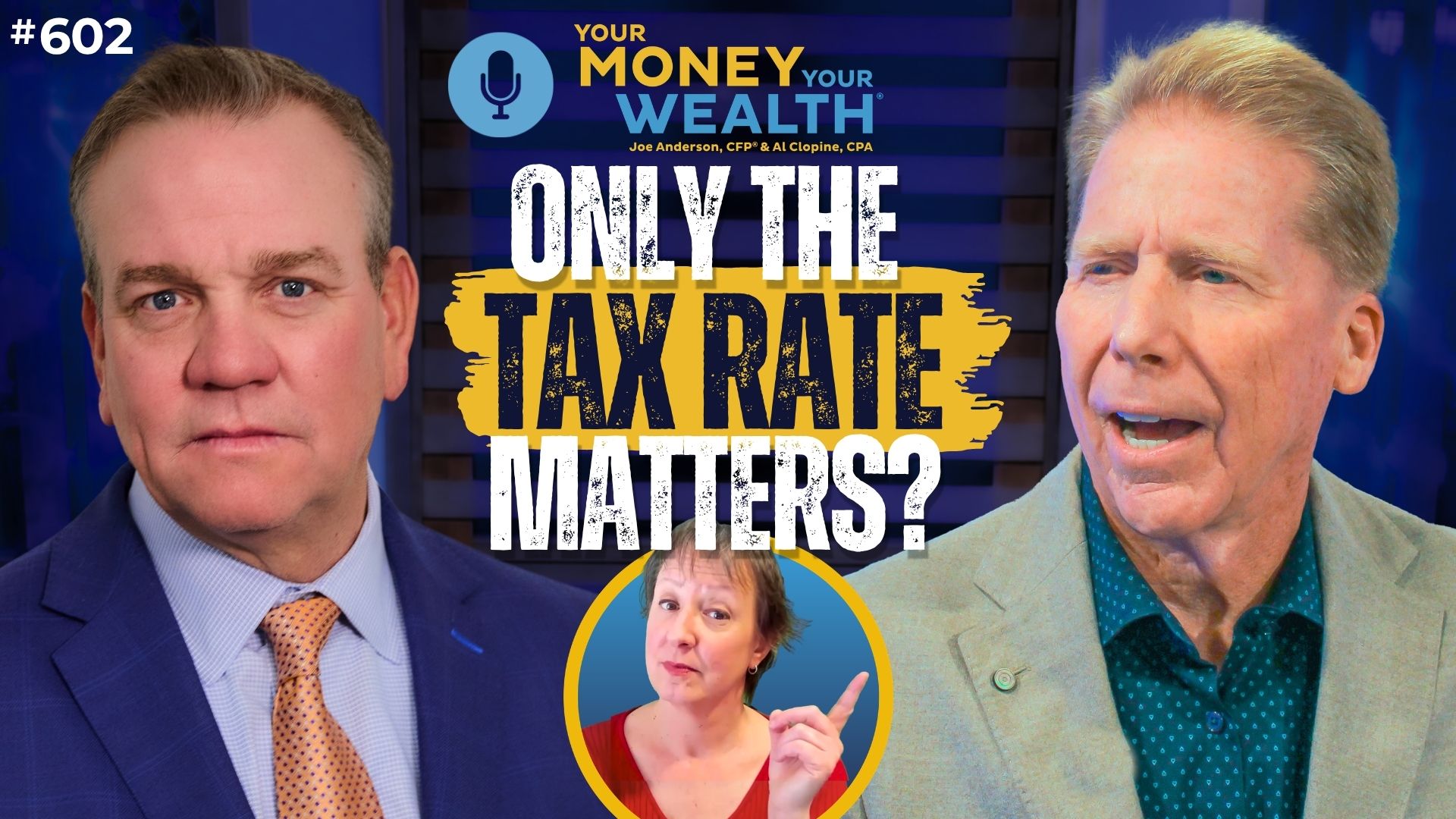
Joe Anderson, CFP® and Big Al Clopine, CPA are spitballing on whether Roth conversions actually pay off, today on Your Money, Your Wealth® podcast number 602. “Ozzie and Harriet” in Lafayette, Louisiana are 67, and Ozzie’s spreadsheet says converting from their $7 million IRA costs more than just taking the RMDs. He challenges the fellas to change his mind. They also address BondBeer’s many YouTube comments telling them that their favorite guidance, to convert when the market drops, is flat wrong. Finally, Alan on Daufuskie Island, South Carolina asks for clarification on “paying the tax to pay the tax” when you pull money from an IRA, and whether it matters if the tax comes out of the account or out of your brokerage.
Is a market downturn a good time to do a Roth conversion?
A market downturn can be a good time for a Roth conversion because the same shares are worth less, so the converted amount and the tax bill are smaller. Any recovery then happens inside the Roth, where it can grow tax-free. Whether it fits depends on your tax bracket, your timing, and how you plan to pay the tax.
Frequently Asked Questions
What does “pay the tax to pay the tax” mean?
It describes what happens when an IRA is the only money available to cover a tax bill. Every dollar pulled from a pre-tax IRA is taxed as ordinary income, so withdrawing extra to pay the tax creates more taxable income, which creates more tax. Paying from a separate account, like a brokerage account, avoids that loop. For a plain withdrawal, withholding the tax or paying it from a brokerage account can leave you in a similar spot.
Should the tax on a Roth conversion come from the IRA or from a brokerage account?
Paying from a brokerage account keeps the full converted amount inside the Roth. Withholding the tax from the conversion sends less money into the Roth. Selling investments to cover the tax can trigger capital gains tax, so it’s worth running the numbers with experienced professionals.
Why do some people say only the tax rate matters in a Roth conversion?
Converting a set dollar amount costs the same tax whether the market is up or down, and a market drop already shrinks the future required minimum distributions on a traditional IRA. The counterpoint is that a conversion also builds tax diversification, which can give you more control over your taxes throughout retirement.
Can a Roth conversion make sense if your tax bracket stays the same?
On a spreadsheet, staying in one bracket for life can make a conversion look like a wash. Other factors can still favor it: removing the uncertainty of future tax rates, avoiding a higher bracket for a surviving spouse who files as single, leaving tax-free money to heirs, and having a tax-free pool to draw from for large expenses.
How big can required minimum distributions get on a large IRA?
Required minimum distributions are annual withdrawals from pre-tax accounts that start at 73 or 75, depending on your birth year, and the amount grows with the balance. A multi-million dollar IRA can produce a distribution large enough to push income into the top tax bracket, especially when Social Security is added on top.

Show Notes
- 00:00 – Intro: This Week on the YMYW Podcast
- 01:04 – Do Roth Conversions Actually Lose You Money? (Ozzie & Harriet, Lafayette, LA)
- 12:08 – Is a Market Downturn Really the Best Time for a Roth Conversion? (bondbeer, YouTube)
- 23:00 – Do You Pay Tax on the Tax? Roth Withdrawals vs. Roth Conversions Clarified (Alan, Daufuskie Island, SC)
- 28:04 – Outro: Next Week on the YMYW Podcast
Free Financial Resources:
Retirement Accounts Guide – free download
Financial Blueprint – free, self-guided
5 Years From Retirement? Do These Things Now – YMYW TV
Guides | Blogs | Educational Videos | YMYW Newsletter | Subscribe on YouTube

Watch today’s podcast episode on YouTube
Transcription
(NOTE: Transcriptions are an approximation and may not be entirely correct)
Intro: This Week on the YMYW Podcast
Andi: Joe and Big Al are spitballing on whether Roth conversions actually pay off, today on Your Money, Your Wealth® podcast number 602. “Ozzie and Harriet” in Lafayette, Louisiana are 67, and Ozzie’s spreadsheet says converting from their $7 million IRA costs more than just taking the RMDs. He challenges the fellas to change his mind. They also address BondBeer’s many YouTube comments telling them that their favorite guidance to convert when the market drops is flat wrong. Finally, Alan on Daufuskie Island, South Carolina asks for clarification on paying the tax to pay the tax when you pull money from an IRA, and whether it matters if the tax comes out of the account or out of your brokerage. (And yes, all three of us pronounce Daufuskie wrong in the spitball, which is why I’m pronouncing it correctly now.) Quick favor before we start: if you like what you see and hear, tell a friend, and leave your honest rating and review in Apple Podcasts to help others find us. I’m Executive Producer Andi Last and here are the hosts of Your Money, Your Wealth®, Joe Anderson, CFP® and Big Al Clopine, CPA.
Do Roth Conversions Actually Lose You Money? (Ozzie & Harriet, Lafayette, LA)
Joe: “Are conversions actually net positive when you account for time, value, and investment returns?”
Al: Okay.
Joe: That’s a good BLUF, Andi. Yeah. Thank you. That’s real good.
Andi: Thank you very much.
Joe: Real good. All right. “Dear YMYW, Ozzie and Harriet here. We live in Lafayette, Louisiana.”
Al: Okay.
Joe: You ever been to Lafayette?
Al: I have not. I’ve been to New Orleans.
Joe: New Orleans.
Al: And that’s it.
Joe: NOLA.
Al: NOLA.
Joe: Lafayette. No, I’ve never been to Lafayette. That’s where, the University of… Isn’t that where… Where’s LSU?
Andi: Baton Rouge.
Joe: Oh, yeah. Baton Rouge.
Al: Oh,
Joe: Baton Rouge.
Al: There you go.
Joe: Joe’s so bad at meme. SEC, too. all right. Okay. I drive a 2009 Honda Accord in a little white wine. Okay. Harriet drives a 2017 Honda CRV and likes a little red wine.
Al: Okay.
Joe: We’re 67 years old. Harriet makes about $200,000 in a business, and I’m, full disclosure, retired engineer.
Al: Ooh.
Joe: And I like to solve math problems-
Al: Oh.
Joe: …for fun. We both take Social Security for a combined $6,000 a month. We have about $7 million in IRAs, two and a half million dollars in a brokerage account, $500,000 in Roths. All right. My hypothesis, oh, God- … is that Roth conversion taxes can have a higher present value of taxes than the base case RMDs.
Al: Wow. Okay, we’re going deep here now.
Joe: Let’s go. Get your HP 12C ready.
Al: Okay. All right.
Joe: For example, for me to convert $100,000, we would have to pay $28,250 in state and federal tax, $3,400 in IRMAA, and about $5,000 capital gain tax in the brokerage money to use to pay the tax for $36,700 to convert 100 grand.
Al: Okay.
Joe: The benefit of the conversion starts in 2031 with RMDs that are lower by about $2,000 per year initially, ramping up to about $4,000 per year when I’m 90.
Of an average of $3,100 tax savings per year, when I run the present value of the taxes of the conversion case at 9%, brokerage is almost all stock, it’s higher than just eating the RMD of the base case. It’s basically a question, would you take $36,700 today or a stream of cash, $2,000 to $4,000, starting five years in the future, running for 16 years?
I’ll take the $36,700 now and invest it. Change my mind.
Al: Do you want to change his mind?
Joe: I don’t think
Al: so. I didn’t mean to-
Joe: My brain hurts- … just reading this.
Al: So he’s put up a little challenge for us.
Joe: All right. So here’s what- Again, he’s got $7 million in a tax-deferred account
Al: Correct, at 67.
Joe: At 67 years old.
Al: So eight years from now, he’ll be taking his RMDs.
Joe: All right. And then, and it, doesn’t look like he’s pulling any money from the account because Harriet makes $200,000 a year.
Al: And they spend 150.
Joe: And, I didn’t get that. Okay. So, oh Yeah, yeah. They spend $150,000. Yep. So n- nothing’s coming out of the accounts.
No. Harriet wants to work for a couple more years so that 7 million is gonna be what, ballgame
Al: maybe? Let- let’s call it 12. Yeah,
Joe: it’s the same problem.
Al: Yeah,
Joe: So the RMD’s $400,000.
Al: Yeah, maybe, yeah, 600,000 almost.
Joe: Yeah.
Al: No, five- 500,000. 500 grand-
Joe: Yeah … plus, the Social Security.
so let’s call that another 72 plus in- pl- you know, he’s- he’s pushing $700,000 of income.
Al: Correct.
Joe: All right.
Al: And that’s, that would be the highest tax bracket.
Joe: Okay. So again, this is kind of a bet. If you run… So you could run your spreadsheets until you’re blue in the face. Here’s the benefit of putting money into a Roth- Yeah … is that you take the uncertainty of taxes off the table. If you think tax rates are gonna go up, it doesn’t matter, you already paid the tax.
All of that growth will grow 100% tax-free. If you take on more risk in the Roth, so you said you’re all in stocks and you’re using a 9% growth rate or discount rate, however that you’re running your present value calculation, is that what you probably wanna take more risk in the overall Roth IRA. You’re never gonna touch the account.
It’d probably be to parlay to the kids or the grandkids a- and take more risk. So you could potentially earn a higher expected rate of return over the next 30 years than nine if you take more risk in that overall account. So you would probably wanna put that in your spreadsheet. If you die, Harriet dies, then you got the widow tax.
So it’s like, it, again, you’re fine. I don’t like having $7 million in a retirement account that you don’t necessarily need the money, and if you’re just kinda playing with numbers to justify, “Hey, you know what?” This guy’s the opposite. He’s like, “I don’t wanna pay the tax- I don’t want to … I think that I would rather invest that 36,700 because the RMD is gonna kick me up, and I don’t know what he’s running his RMDs at.
how much conversion did he say he wants to do?
Al: he’s, he, just-
Joe: Or is he just running it at a 36% growth- Yeah … or a 36.7% tax rate?
Al: he just used an example, right? And so his tax is, yeah-
Joe: 36, 36,700 on 100,000. So he- Yeah … he’s saying, “Hey, I gotta pay a little bit of capital gains to pay the tax to take it out- the brokerage account.”
Al: Correct.
Joe: and then plus the ordinary income tax on the conversion.
Al: and he doesn’t think it’s worth it. and, you know, when, you run it this way, you could make that argument.
Joe: Oh, for sure.
Al: Yeah, sure, there- nothing wrong with the argument, but the problem is it never works out like your spreadsheet.
Joe: Totally. It’s wrong the next day.
Al: So it, here- here’s the thing, and you’ve already said a couple of these, Joe, that- You pass away or your wife passes away, all of a sudden you’re in a higher b- tax bracket and your spreadsheets don’t even make sense anymore. Secondly, you convert and you put your highest expected rate of return assets in that Roth account, and therefore, over time, get higher growth in that account.
It works out better. You’re g- you’re guarding against taxes going up potentially in the future. If you don’t think they’re gonna go up, you think they’re gonna go down, then- Don’t do it … don’t do it. that’s per- personal choice, right?
Joe: But- Yeah, I would look at it, too. Here’s a percentage, 36.7%, and he’s going to be in, depending on what happens with the market, right?
So you could assume the market is flat and he still has $7 million. it probably doesn’t make sense, but if it grows, he might have a larger RMD that puts him in the 37% tax bracket. And if you think the 37% tax bracket might go up, or th- are you including, you know, y- all the other phase outs that happen when you have higher income.
So the, the spreadsheets give you, like, maybe a sense of direction, but you, don’t know- for sure what’s gonna happen. You gotta make the assumptions, and whatever assumptions that you make, I can make assumptions on either side of the equation here- Yeah … make either case look, look- That, that’s right
look really good.
Al: And I don’t think they, they didn’t, he didn’t mention kids, did he?
Joe: No kids.
Al: So, so that, you know, so that’s a, would be another reason to do a Roth conversion, Joe, is when you have kids and you get the money to them tax-free. that’s a good thing to think about. But even if you don’t have kids, here’s still why you consider it, because-
Joe: But if it goes to charity, then don’t do it.
Well- Because he’d still get about $100,000 as a QCD out of the RMD.
Al: I know, but the fact if the RMD really is 500,000, the reason why you do this has nothing to do with the kids. that’s my point. But y- yeah. it has to do with saving taxes yourself, right? And so I guess the other way to think about this is when you have a, when you really are sort of against Roth conversions and, you know, y- you have $10 million, you do whatever you want.
it doesn’t really matter that much. You’re gonna be great either way. But when you’ve got that much money, or that much money in a, retirement account, at least when the market collapses, and we’re gonna have a 20% correction at some point, that’s the year where you do a big conversion and let that recovery happen in the Roth.
Now your spreadsheets don’t even make sense. this will work out way better.
Joe: Yeah.
Al: So just be diligent about the market, and if you don’t really like the conversions ’cause you gotta pay the tax now, I get it. but go ahead and do it in down years and get that recovery in the Roth, and you’ll end up in a better spot.
Joe: w- with his spreadsheet, he’s stating that- The RMDs are gonna go up instead of, and it’s going to take him five years to
I’m, just trying to visualize his spreadsheet and what his RMD is- … and what, w- what, is that the additional tax?
Al: I think so.
Joe: And it’s, then he’s doing a breakeven, and then he’s just taking a, a present value of that extra tax over a 16-year time period and bringing it back today, and it’s less than 36,700?
Al: Yeah. I wonder if he’s- So- I wonder if he’s accounting for the Roth money comes out tax-free.
Joe: Yeah. I would wanna see the math.
Al: Yeah, me too.
Joe: But, he does it for fun.
Al: Yeah. He likes to solve math problems. A- anyway, you know, mathematically, if you, if, Joe, if, they stay in the same tax bracket their whole life, mathematically it doesn’t matter.
Joe: It doesn’t. The, the, ancillary benefits is that you take- … the uncertainty of higher taxes. If there’s a, a instance where you need a lot more cash, that you have a place that you can pull it and not worry about tax. It’s- It- … passing the wealth to, to kids or grandkids without any tax. It, it’s- If you have one die pre- premature, you save the widow tax.
Al: it’s doing a little bit better when you t- your higher performing asset’s in the Roth. So there’s reasons you do it, even same tax bracket.
Joe: Yeah. If it’s the same tax bracket, you still do it because of th- those benefits.
Al: Yep, exactly.
Joe: So- Yep. All right.
Andi: Five years from retirement? What you do in that final stretch can shape the lifestyle you enjoy once you punch the clock for the last time. That includes when you claim Social Security, how you structure your savings and spending, and even the order you pull money from your retirement accounts. This week on Your Money, Your Wealth TV, Joe and Big Al count you down to retirement with the must-do preparations. Watch “5 Years From Retirement? Do These Things Now” on YMYW TV. The link is in the episode description. Next, find out if you’re on track with our free Financial Blueprint. Enter your income, savings, investments, debt, expenses, and goals, and our free, self-guided tool analyzes your cash flow, your assets, and your projected retirement spending. You get a detailed report on what you can do now to move forward those goals. Minimize stress. Maximize life. Click or tap the Financial Blueprint link in the episode description and start taking control of your retirement.
Is a Market Downturn Really the Best Time for a Roth Conversion? (bondbeer, YouTube)
Andi: Every single podcast that we have talked about, do your Roth conversions when there is a decline in the market, one of our YouTube, viewers, Bond Beer, who actually emailed us a long time ago, he’s a good friend of the show. He messages us on YouTube, always has an argument against that, and if there’s time later I’d like to address that.
Joe: Let’s go. Oh, you got m- you got-
Andi: It’s, really long. Do you want the whole thing?
Joe: Sure. You got, you got- You just want the f- I, you got- I got an itch here.
Al: Let me get this in. But you can summarize it, right? We need a BLUF.
Joe: Yeah, a BLUF.
Andi: He says, “Newsflash, it is not a better time when there’s a downturn in the market. The only, only the tax rate matters. Number one, if you convert 100K to Roth, you pay the exact same tax and have the same Roth balance, whether the market is up or down or sideways.
The reason to convert to Roth is to pay the lower tax today versus future RMDs, and by converting you’re reducing the RMD size. If the market drops 25%, the RMD size just got smaller on its own, similar to had you converted 25% of the account. A conversion can still be beneficial, but it saves less tax, not more.
Some point to the Roth capturing the con- recovery tax-free, which assumes perfect timing of the bottom. Someone that smart should just go 100% stocks since they are able to see into the future. If tax rates are the same, it’s irrelevant anyway since your portion of the traditional IRA captures the same recovery.
Some, not you, point to the silly notion that there is the benefit of converting more shares. This is totally irrelevant as 10 shares at $100 and 100 shares at $100 are the same. Only dollars matter, not shares. In fact, there is nowhere on the tax form where you list the number of shares when converting because ding-dong, it’s irrelevant.
Final proof, if you do an analysis and determine Roth is optimal and the market drops 25% and you recalculate, Roth may still be better now. It may have switched to deferring due to the lower balance, lower RMD. It never goes the other way. So if deferring is optimal, you don’t need to recalculate, as it will still be optimal 100% of the time after a downturn.”
Did that make sense to you?
Joe: He’s looking at-
Al: Yeah …
Joe: in a total vacuum, in a bubble.
Al: Yeah. I, so agreed.
Joe: It, was, his argument is based on future tax rate, current tax rates and RMDs, or the tax on an RMD. I look at Roth conversions as tax diversification giving me control of the taxes throughout retirement.
So part of the control of taxes in retirement is also controlling your RMDs, but that’s, again, only one component of this.
Al: If you… So I, and I’ll say it this way. I, will say if you, let’s say you have $200,000 in a retirement account and you convert today, convert the whole thing.
Joe: 200 grand.
Al: And you pay the tax on that, whatever your tax rate is.
50 grand. Yeah, whatever, Yeah, call it 50 grand, whatever. It doesn’t really matter, right? Or let’s say the market has a period where it goes up quite a bit, maybe it gets to 300,000, and you convert at that point. you’re gonna be paying a higher tax because it’s now worth 300,000, versus what if the market went down from 200,000 to 150?
I’d sort of rather convert the whole thing when it’s worth 150, with the assumption that the market’s gonna recover. If you don’t think the market’s gonna recover, our whole argument is not valid. But if, but the market, over the last 100 years, Joe, has recovered every downturn. So with that assumption, I’d rather pay taxes on my IRA when it’s worth 150 instead of 200 or 300.
That, that’s the whole point.
Joe: It’s, it depends on a lot of different things because what he’s saying, he, if I convert, the market drops 20%, my RMD just dropped 20%.
Al: It’s, that’s a true statement.
Joe: Exactly. If it doesn’t recover, if it just stays down at 20% and it’s flat until your RMD happens.
Al: Yeah, exactly.
Joe: But let’s say your 200,000 drops to 150. The next year the market recovers, and you’re back to 200, and you didn’t do anything.
You didn’t take action.
Al: You had that opportunity and-
Joe: You had the opportunity to convert at 150,000 versus 200,000. It’s the same shares. It’s the same account.
But now the market recovered, and it’s back to 200. Guess what? Your RMDs went back up 20%.
So if I would’ve converted in that point of time, when it was down 20%, I converted the 150,000 versus 200,000, so that’s less tax out of my pocket. But now when I look at the balance of my Roth IRA, I have 200,000 versus 150.
I also reduced it, the RMD, because it would’ve grew back to 200,000 if I kept it in the IRA. Yeah. The longer I keep the money in the IRA, the more taxes I’m going to pay. The faster I can get the money out of the IRA, the less taxes I’m going to pay. If I do a straight line spreadsheet on Excel and have Claude and ChatGPT help me-
then you’re gonna come up with that answer- Yeah … because you’re looking at it in a bubble, but life doesn’t work that way.
Al: Yeah. I think, case in point, Joe, is remember the COVID year?
Joe: I do remember that.
Al: And so let’s say you had a $200,000 IRA at that point, and it went down to 150, which is exactly what happened, and then by end of the year it was back to 200.
Would you rather convert at the beginning of the year at 200, the end of the year 200, or 150? I’d rather convert when it’s 150 ’cause I’m gonna pay less tax. That’s the whole argument. That’s-
Joe: It’s not like we’re timing it perfectly at the- No … the bottom. It’s like, all right, when the market corrects- People freak out.
They either go to cash- or they put their head in the sand. I think what we’re saying is that if you have money in a brokerage account, then you want a tax loss harvest. It’s almost the same concept in a sense- yeah … is that you’re selling losers and you’re buying something similar to take the capital loss, and then when the market recovers, you have these losses to offset gains.
You’re not eliminating the tax, you’re deferring the tax. It’s a tax strategy as you’re thinking about taking distributions from your retirement account. The same thing with a Roth IRA is that you want diversity. You want diversification. I want money in a Roth, I want money in a brokerage account, and I want money in an IRA, and I wanna have some sort of equal balance.
Most people have most of their dollars in a retirement account, very little dollars in a Roth account, and a couple of bucks in a brokerage account. So I think the concept with him is like, all right, no, I’m just looking at it today, what’s the tax rate or what’s the tax rate in the future of my RMDs?
But how about if I’m spending more than my RMD? Do you know what I mean?
Al: Yeah.
Joe: where’s the other pools of money? How about if I, w- wanna go on a, a s- a six-week-long trip- … and see 17 different countries?
Al: Got it.
Joe: I, need a couple of extra, you know-
Al: You’re looking at me when you say that.
Joe: But right. So there’s things that happen. This, all this, all tax diversification, does is give you a, a lot more control over your taxes as you go through your retirement. I would much rather have the control of how much tax that I pay, or try to control as, the tax that I pay as much as I can, versus being stuck to saying everything is gonna come out of my retirement account and I’m stuck with a, an ordinary income bill.
Al: Yeah. Yeah. the other thing, Joe, that we know is the markets tend to have the best rates of return after a crash.
Joe: Yeah, a year after the crash.
Al: Now, not immediately.
Joe: Are you predicting that?
Al: No. I- What, what-
Joe: Are you damping this?
Al: No, I’m saying, let me finish. So a crash happens. It may take a year or two, but we do know that the markets tend to recover.
The, the rates of return tend to be higher when you look out another two or three years after a crash, and that, you, can’t factor that into this kind of analysis. I mean, that, that’s why you do this, is you’re paying less tax for the, basically what’s in your IRA.
Joe: I, I do financial planning for a living.
Al: I know you do.
Joe: And so we run these spreadsheets- Yeah … and analysis- Yeah … and all sorts of different things. It’s like, it’s not gospel. I mean, the, the stuff is wrong the next day. You run assumptions and you make your best guess of like, w- but you have to constantly look at it and zig and zag as life happens, as markets happen, as tax law changes, as everything else.
So- Yeah … if I’m looking at in a bubble to say, “Here’s the tax rate today. Here’s what my assumed RMD is gonna be in 10 years- Yeah … and it doesn’t make sense for me to do a conversion right now because, or when the market goes down or up,” I, I- Yeah … don’t think you would wanna do planning that way.
Al: You remember when we interviewed Ed Slott.
Yep. And he, during the Great Recession, when the markets went down quite a lot, as you recall, he converted everything. The whole thing, And while the accounts were lower, and then the recovery happened after that, we had a 12, 14-year bull run, which we’re kinda still in.
Maybe 16 year.
I’ve lost track by now, it’s, been such a good market. So anyway, the-
Joe: He, made out quite well.
Al: He did, and, all his retirements in a, in, in a Roth. Yeah.
Joe: Yeah. Yeah, so I think y- you’re gonna forget about the tax you paid like three years later anyway if you look at that balance in your Roth- Sure
and it’s like a big, fat, juicy balance.
Al: Yeah.
Joe: So anyway.
Al: Yep. Okay. I’m-
Andi: Thank you for addressing that. Appreciate it.
Joe: Yeah. Beer Bob? Bob Beer? What’s his name?
Andi: Bond Beer. Yes.
Al: Bond Beer. Okay. Yes.
Joe: As in beer, as in something like a Coors Light beer? Or-
Andi: Yeah. Yeah, I think he actually named his channel that after he, actually he, after he got his copy of Ed Slott’s book from us.
Al: Oh, okay.
Joe: Oh, Bond Beer.
Al: Okay. Yeah.
Joe: All right. Okay. Thanks, Bond Beer.
Al: All right.
Andi: As we just heard, whether a Roth conversion pays off comes down to a number of different factors, including your tax bracket. For a thorough overview of different retirement account types and how they work in conjunction with each other for your benefit, all one place, download our free Retirement Accounts Guide. Learn how traditional and Roth accounts are taxed, when a conversion may make sense — including after big losses in your IRA — and the pitfalls that can bump you into a higher tax bracket. It also illustrates how tax diversification can give you more control over your taxes in retirement. That is, having a strategy for your taxable brokerage accounts, your tax-deferred 401(k)s and IRAs, and your tax-free Roth accounts, for example. Click or tap the link in the episode description to grab your copy of the Retirement Accounts Guide. When the form asks how you heard about us, choose podcast.
Do You Pay Tax on the Tax? Roth Withdrawals vs. Roth Conversions Clarified (Alan, Daufuskie Island, SC)
Joe: Okay. last one is Alan from Daufuskie.
Andi: I think it’s Daufuskie.
Joe: Dauf-
Al: Daufuskie.
Joe: Dafuskie? Daufuskie.
Al: Daufuskie.
Joe: Daufuskie. Daufuskie Island, South Carolina.
Andi: It is a sea island near Hilton Head, reachable only by boat. Okay. There is no bridge to the mainland.
It is why golf carts are the default way to get around. It’s a historically a Gullah Geechee community, descendants of enslaved West Africans who developed a distinct culture and language along the Lowcountry sea islands. The population is- small, about a few hundred people year-round.
Al: Oh, okay.
Joe: So Alan lives there.
Andi: Apparently so.
Al: Okay. he, that’s what he says.
Joe: All right. “I know you’ve answered this, but I still am not seeing it clearly.” “I wanna take a $10,000 withdrawal from my traditional pre-tax IRA. I can either have my custodian withhold the tax or I can pay them from my brokerage account. Please review the you have to pay tax on the amount withdrawn to pay the tax idea.
Thank you.” “Been listening, since 2021. Drive a Star EV golf cart-
Al: There you go, Andi …
Joe: and lately really enjoy a long drink.” Long drink What’s… I don’t know I don’t know. It’s a b- better than a short drink Got a little more alcohol
Andi: A long drink, is the Finnish drink called the Finnish long drink or Longero.
It’s gin and grapefruit soda. It was created in 1952 for the Hel- Helsinki Olympics to serve visitors quickly, and canned versions have grown fast in the US market over the last several years
Al: Oh, okay.
Andi: Huh So gin and grapefruit
Joe: Okay. It’s Finnish
Al: Finnish, yeah
Joe: All right.
Andi: For the Helsinki Olympics in 1952
Al: Okay.
Joe: “Still noodling my immediate previous question. Does the pay tax on the tax you need to make the withdrawal only comes into play when it is a traditional to Roth conversion? Please use two example, $100,000 withdrawal versus $100,000 converted. Thank you very much.” Yes.
Andi: It says $10,000 withdrawn- Oh
versus converted.
Joe: Okay, 10,000. Yeah. Yes. Close enough. You are the Click and Clack and the Tappet Brothers of investment podcasts. Well- Love the show.
Al: thank you.
Joe: Click and Clack-
Al: Yeah …
Joe: the Tappet Brothers. I never heard of Click and Clack.
Al: Yeah. That’s the car guys. you know
Andi: them. That’s Car Talk on MTO, N- NPR, nationally- That’s it
syndicated from 1987 until they stopped recording in 2012.
Al: Anyone that compares us to Click and Clack is, that’s quite a compliment.
Joe: Oh, yeah, Click and Clack. Yeah. Hang in there. As long as we have fun together. Okay. Cheers. okay. Pay tax upon tax upon- … the tax upon the tax.
Al: let me, maybe let me explain where that comment came from.
Joe: Okay.
Al: you brought it up, Joe, years ago.
Joe: Oh, yes, I did.
Al: Yeah. And the concept, as I recall, was you got a, a mortgage of 300,000 and you got 300,000 in your IRA. And you retire, you go, “You know what? I’m just gonna pull the money out to pay the tax. I mean, to pay the mortgage,” right? and then next year you get your tax bill, you gotta pay tax on the 300,000.
Now, if you got a little bit more in the IRA, you gotta pull that out again to pay last year’s tax, which then requires you to pull more out to pay this year’s tax to pay the tax. That, that’s where that comment came from. In this particular case, it doesn’t matter. You, pay, you, you can have them withhold it.
You can pay it yourself. The reason why we like you to h- to pay the Roth tax yourself is because-
Joe: You maximize the money …
Al: you maximize the Roth conversion, right? Exactly.
Joe: You don’t wanna withhold the money to do the conversion because you’re going to have less money in the Roth.
Al: In, the Roth. So when you’re doing a Roth conversion, much better to pay it out of your brokerage account.
When you’re just pulling money out for yourself, I don’t care. Yeah. You pay-
Joe: It’s the same … you pay ordinary income tax. But when people make mistakes-
Al: Yeah …
Joe: and the only liquidity that they have is in their retirement account-
Al: Yeah …
Joe: the more dollars that you pull out of the retirement account, the more taxes that you will pay.
Al: Yeah.
Joe: And so you have to pull dollars out of the retirement account, let’s say to pay an unnecessary or a, a tax- Yeah … that was, you know, out of the blue or by a mistake.
You’re pulling more money out of the account to pay the tax, but then you have to pay tax on the dollars that you paid the tax, so you’re paying tax to pay the tax to pay the tax.
Al: That, that’s where that comment came from.
Joe: Yeah.
Al: Yeah. Yep.
Joe: All right. That’s it for us today.
Andi: Thank you for taking the time .
Joe: Anything else you’d like to discuss?
Andi: No, I think we’re all good.
Al: Yeah.
Joe: Aaron, anything from you? I’m confused.
Al: Yeah, he’s con-
Joe: Pay the tax,
Al: Aaron said he’s confused.
Joe: Don’t, don’t pay the tax,
Al: We’ll have to go over it privately.
Joe: All right. That’s it for us. For Alan Clopine, Andi Last, I’m Joe Anderson. We’ll see you next time
Outro: Next Week on the YMYW Podcast
Andi: Should you do your big Roth conversions while you’re still earning, or wait until the paychecks stop? Next week on YMYW, should George and Louise and Cher and Sonny get spitballs on that very subject. Michelle just took on a brand-new mortgage but she wants out of her job. What do Joe and Big Al suggest? They also spitball on whether an annuity should cover your fixed expenses for our friend Marion in Fresno.
Your Money, Your Wealth® is presented by Pure Financial Advisors. To really learn how to make the most of your money and your wealth in retirement, you need more than a spitball: schedule a no-cost, no obligation, comprehensive financial assessment with the experienced professionals on Joe and Big Al’s team at Pure. Click the link in the podcast show notes to schedule yours, or call 888-994-6257. You can meet in person at any of our locations around the country, or online, right from your couch. No matter where you are, the Pure team will work with you to create a detailed plan that’s tailored to meet your retirement needs and goals.
Pure Financial Advisors is a registered investment advisor. This show does not intend to provide personalized investment advice through this podcast and does not represent that the securities or services discussed are suitable for any investor. As rules and regulations change, podcast content may become outdated. Investors are advised not to rely on any information contained in the podcast in the process of making a full and informed investment decision.
_______
Listen to the YMYW podcast:

Amazon Music

AntennaPod

Anytime Player

Apple Podcasts

Audible

Castbox

Castro

Curiocaster

Fountain

Goodpods

iHeartRadio

iVoox

Luminary

Overcast

Player FM

Pocket Casts

Podbean

Podcast Addict

Podcast Index

Podcast Guru

Podcast Republic

Podchaser

Podfriend

PodHero

podStation

Podverse

Podvine

Radio Public

Rephonic

Sonnet

Spotify

Subscribe on Android

Subscribe by Email

RSS feed

YouTube Music
IMPORTANT DISCLOSURES:
Pure Financial Advisors is a registered investment advisor. This show does not intend to provide personalized investment advice through this podcast and does not represent that the securities or services discussed are suitable for any investor. As rules and regulations change, podcast content may become outdated. Investors are advised not to rely on any information contained in the podcast in the process of making a full and informed investment decision.
• Investment Advisory and Financial Planning Services are offered through Pure Financial Advisors, LLC, a Registered Investment Advisor.
• Pure Financial Advisors LLC does not offer tax or legal advice. Consult with your tax advisor or attorney regarding specific situations.
• Opinions expressed are not intended as investment advice or to predict future performance.
• Past performance does not guarantee future results.
• Investing involves risk including the potential loss of principal. No investment strategy can guarantee a profit or protect against loss in periods of declining values.
• All information is believed to be from reliable sources; however, we make no representation as to its completeness or accuracy. As rules and regulations change, content may become outdated.
• Intended for educational purposes only and are not intended as individualized advice or a guarantee that you will achieve a desired result. Before implementing any strategies discussed you should consult your tax and financial advisors.
CFP® – The CERTIFIED FINANCIAL PLANNER® certification is by the CFP Board of Standards, Inc. To attain the right to use the CFP® mark, an individual must satisfactorily fulfill education, experience and ethics requirements as well as pass a comprehensive exam. 30 hours of continuing education is required every 2 years to maintain the certification.
AIF® – Accredited Investment Fiduciary designation is administered by the Center for Fiduciary Studies fi360. To receive the AIF Designation, an individual must meet prerequisite criteria, complete a training program, and pass a comprehensive examination. Six hours of continuing education is required annually to maintain the designation.
CPA – Certified Public Accountant is a license set by the American Institute of Certified Public Accountants and administered by the National Association of State Boards of Accountancy. Eligibility to sit for the Uniform CPA Exam is determined by individual State Boards of Accountancy. Typically, the requirement is a U.S. bachelor’s degree which includes a minimum number of qualifying credit hours in accounting and business administration with an additional one-year study. All CPA candidates must pass the Uniform CPA Examination to qualify for a CPA certificate and license (i.e., permit to practice) to practice public accounting. CPAs are required to take continuing education courses to renew their license, and most states require CPAs to complete an ethics course during every renewal period.