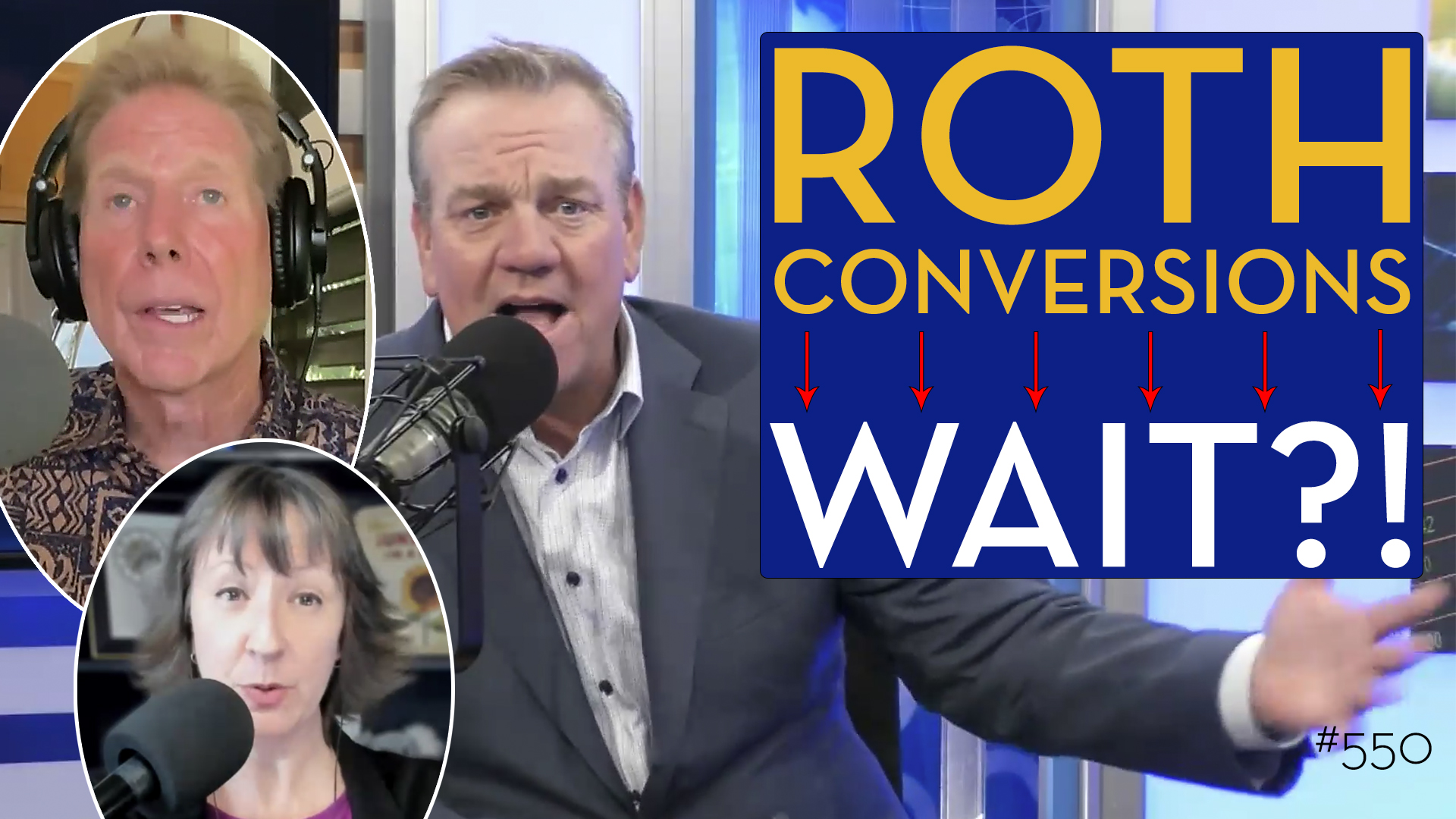
Joe and Big Al spitball on how to avoid screwing up the timing of your Roth conversions: Barrie from New York is 62 and single, and she’s been diligently converting pre-tax money each year for lifetime tax-free Roth growth. Should she continue after she retires next year? “Jerry and Elaine” want to retire in the next six years and still leave the kids an inheritance. When should they start Roth conversions? Alex in Pennsylvania is a 31-year-old software engineer. Should he convert his IRA to Roth all at once? Plus, how can he transition into a career as a financial planner? A clarification from one of our YouTube viewers on the age plus 20 rule of thumb for retirement contributions is very un-clarified for Joe, and the fellas let Lisa in San Diego know whether she can use her rental real estate income to fund a Roth 401(k).

Show Notes
- 00:00 – Intro: This Week on the YMYW Podcast
- 00:55 – Should I Keep Converting $20K a Year in Retirement? (Barrie, NY)
- 07:17 – Can We Retire at 62 and Still Leave an Inheritance? Roth Conversion Strategies for Big Accounts (Jerry & Elaine, KS)
- 17:05 – I’m 31. Should I Convert $57K Now or Spread It Out? How to Become a Financial Planner? (Alex, PA)
- 29:12 – Roth Conversion Timing Before Retirement (Mike, Philly Suburbs)
- 36:49 – Confused About Roth Withdrawal Rules at 60 (Lisa, Omaha NE)
- 40:05 – Clarification on the Age + 20 Rule of Thumb for Contributions (Matt, YouTube)
- 45:40 – Can My Rental Property Income Fund a Roth 401(k)? (Lisa, San Diego)
- 47:24 – Outro: Next Week on the YMYW Podcast
Free Financial Resources:
- 6 Signs You Truly Have Enough for Retirement – YMYW TV
- Download the Ultimate Guide to Roth IRAs
- Calculate Your Financial Blueprint
Guides | Blogs | Educational Videos | YMYW Newsletter | Subscribe on YouTube

Watch today’s podcast episode on YouTube
Transcription
(NOTE: Transcriptions are an approximation and may not be entirely correct)
Intro: This Week on the YMYW Podcast
Andi: Joe and Big Al spitball on how to avoid screwing up the timing of your Roth conversions, today on Your Money, Your Wealth® podcast number 550. Barrie from New York is 62 and single, and she’s been diligently converting pre-tax money each year for lifetime tax-free Roth growth. Should she continue after she retires next year? “Jerry and Elaine” want to retire in the next six years and still leave the kids an inheritance. When should they start Roth conversions? Alex in Pennsylvania is a 31-year-old software engineer. Should he convert his IRA to Roth all at once? Plus, how can he transition into a career as a financial planner? A clarification on the age plus 20 rule of thumb from one of our YouTube viewers is very un-clarified for Joe, and the fellas let Lisa in San Diego know whether she can use her rental real estate income to fund a Roth 401(k). I’m Executive Producer Andi Last, and here are the hosts of Your Money, Your Wealth®, Joe Anderson, CFP® and Big Al Clopine, CPA.
Should I Keep Converting $20K a Year in Retirement? (Barrie, NY)
Joe: We got, let’s go to Barrie from New York. Thank you for taking my question. I’m Barrie, a single female, just turned 62 in August, 2025 with plans to retire in December, 2026 at the age of 63. I listen to Apple Podcasts. Drive a 2018 Honda Civic, XEXT, and I love a great sangria. Here are my four things. Four things, Big Al, you ready?
Al: Okay, let’s do it.
Joe: I’m primarily looking for your thoughts on a Roth conversion plan. My retirement savings are Roth IRAs of $450,000 rollover IRA of 400,000 and after tax of $100,000, I’m currently saving $35,000 a year in my Roth 401(k). Plan to do that for 2025 and 2026. I am also building up my after-tax for conversion taxes. I currently earn $135,000 subject to federal and state income taxes, and I’m also collecting a pension of, $50,000, which is only subject to federal income tax. It has a Diet Cola Aha. Diet COLA.
Al: Yeah. So that means a cost of living adjustment, but it’s very light, apparently on the first $18,000 only, I don’t know.
Joe: Diet COLA on the first $18,000 linked to inflation, my Social Security benefits will be around $50,000 at age 70. I currently spend $40-$50,000 a year and plan to spend about $60,000 a year. In retirement, I’ve been converting $20,000 per year in the 24% tax bracket. There’s no New York State income taxes on the first $20,000 of IRA distributions after 59 and a half. I have retiree health insurance through age 65 for $500 a year. At 65, I’ll enroll in Medicare. And their retiree plan will become secondary. I think I’ll be able to file for SSA 44 in 2028 due to the retirement, which means I’ll be constrained to 2028 a GI for my 2028 premiums. I’m considering large conversions after retirement and wondering. The following, should I continue to convert $20,000 per year through 2026? Should I continue converting after 2026? Should I convert above the $20,000 per year, maybe up to Irma or the first year or higher? I appreciate you taking my question. Wow. I mean, this person does their homework.
Al: They do. And, first of all, I would say, Barrie from New York, your situation looks fantastic. So you’ve done a good job and the retirement looks good. Now it’s a matter of minimizing taxes. So what do you think, Joe? Does she keep doing the $20,000 conversion?
Joe: I don’t think it hurts. I don’t know, she doesn’t ha- I mean, she’s got $400,000 in a retirement account. She’s 62 years old, so her income today is $100- plus the 60 or $50,000.
Al: Yeah, it’s, yeah.
Joe: So $185,000. As a single taxpayer. So she’s doing $20,000 a year. The top of the 24% tax bracket. It’s 197.
Al: Yeah. 197. So call it 200.
Joe: Yep. So take the standard deduction and then, so she’s going to the top of the 24, $20,000. So she’s gonna plan on retiring in 2026. At 2026, she still has the $50,000 pension. Should she convert in 2026? I would say why not? let’s see. She’s 62 years old. Let’s say she’s got 400, 10 years from now, that’s 800. Call it 900. I don’t know what, her RMDs are gonna be $30,000?
Al: Yeah, 35, something like that on top of her other stuff. It definitely pushes her into the 22% bracket I think. I think Joe, at least if it were me. I probably wouldn’t convert over the next two years just ’cause of the higher salary, but 2027, if I’m retiring in December, 2026, I think I’m converting in 2027 and 20 28, 29, 30, 31.
I think that’s what I’m doing. Trying to stay in a slightly lower bracket,
Joe: I think. Yeah, because she, I mean, it, only if tax rates go up, because it looks like her RMD will be in the 22% tax bracket. Yeah. She doesn’t need the income, and she still has plenty of years to continue to convert $20,000 a year out, or even to the top of the 22 max out that bracket. She could minimize her RMDs over that 10 year period or, you know, eight, eight year period.
Al: So that’s, yeah, that’s what I would do too. I like the idea of continuing con conversions though, after retirement, because just like you already said, between the pension and the Social Security and the RMD, she’s gonna be in a high enough bracket and in fact, the RMD income with the other two income is gonna push her into the Irma, past the Irma limits, and she might wanna stay outta that. So, yeah, I would, go ahead and do that, but probably start in 2027.
Joe: She doesn’t pay state tax on the first $20,000 on distribution. I’m not familiar with that law in New York. I wonder if that is also true with conversions. Sometimes conversions are not necessarily classified as a distribution.
Al: Yeah, I don’t know. And I, I hadn’t heard of that rule either, and that would be a reason potentially to not convert all of it, because, you know, the first 20 grand’s tax-free in the state. So anyway. There’s different ways.
Joe: Would you want to convert $20,000 because you’re not paying tax on it? You’re still in a higher bracket.
Al: Yeah. I wanna convert enough to make sure it was always below 20,000, I guess is what I’m saying, when I hit RMDs.
Joe: Yeah. I think you could convert enough out and your RMDs are gonna be under $20,000 because if she doesn’t do anything, her RMDs are probably 35, you know?
Al: Yeah.
Joe: Given a pretty aggressive growth rate.
Al: Yep. Me too.
Joe: All right. Cool. Cool. Barrie is kind of a cool name.
Al: Yeah. Like it.
Andi: It’s like Andi.
Joe: Yeah.
Retire at 62 and Still Leave an Inheritance? Roth Conversion Strategies for Big Accounts (Jerry & Elaine, KS)
Yes. Let’s go to Jerry in Elaine. Oh, little Seinfeld.
Andi: Yeah. Did you watch that show, Joe?
Joe: I did watch that show.
Andi: You liked it?
Joe: Yeah.
Andi: I would think there wouldn’t be enough violence for you.
Joe: Yeah, but I mean, I haven’t wa- I don’t watch a lot of comedies today. But I think back then, yeah, the mood-
Andi: It just seems better for violence now than it did back then?
Joe: I don’t know. Yeah. I dunno. It’s like I haven’t watched a comedy movie, romcom, anything in, I can’t tell you how long.
Al: Wow. You used to be like, I don’t know. More carefree, huh? And you could get into that, and now it’s like. It’s like, so, so my son Ryan goes to the gym all the time and he listens to Metal.
Andi: Oh, wow.
Joe: Yeah.
Al: And, he tells me, ’cause that’s how you get into it. Maybe the, so you like the violent shows because-
Joe: I don’t know why, but I like drama I guess I’m not, I mean, not all the shows I watch are crazy violence, but I don’t like-
Andi: Name one that doesn’t, Joe.
Joe: Huh?
Andi: Name a show that you watch that doesn’t have violence.
Joe: Land Man. Land Man’s one of my favorite shows that has zero violence.
Andi: Cool. Excellent. Okay, good.
Joe: I mean, there’s a couple people died, but, they didn’t get- well, did they get stabbed? And I guess there was a few gunshots, a few, you know, but it was, it’s not-
Andi: I don’t think anybody ever got shot on Seinfeld. I could be wrong, but-
Joe: Yeah, very true. Very true.
Al: Yeah.
Joe: Yeah. yeah, then no, I’d like to, that was. I’ve seen a few of those episodes that in Friends, right? Wasn’t it Seinfeld and Friends and then like Melrose Place or something? That was in like the Thursday night lineup.
Andi: Might have been, yeah.
Al: I, yeah, I don’t, yeah, I remember, Friends and Seinfeld and before that Cheers. I think those were all Thursday shows, if I recall.
Joe: Oh, yeah.
Andi: I never got into the Melrose Place or the 90210 or any of that kinda stuff that-
Al: Me neither. You were younger, Joe. So maybe you got into that.
Joe: Oh yeah. Brandon, Dylan, come on.
Al: Is that what brought you up to California?
Joe: Yeah, exactly.
Al: Okay. That’s what I thought.
Joe: I wanted that zip so bad. All right, let’s go back to Jerry and Elaine. Can I retire in six years or can I retire at age 62 and still have money to leave to my kids? All right, and when should I start? Roth conversions, ages B 56, Y 55. We currently spend about $120,000 a year. It will likely stay the same even after our mortgage is paid off $2,000 a month. Our yearly income is $300,000. Current savings, a couple million bucks, $1.9 million in deferred, and $150,000 in Roth cash is 150 grand. All righty. So far so good. Jerry Elaine. Saving $80,000 a year, $40,000 into the 401(k) and $40,000 to a brokerage account in a high-yield savings account until retirement. Then it will drop down about 40,000 until my wife retires at 65. Whole mortgage is. 200 grand at 2.75 is worth eight 50. It would be paid off in eight years. Wife will continue to work until 65 to cover health insurance. Combined Social Security at age 71 70 is $8,500 a month. I enjoy a little vodka tonic and my wife drinks white wine. I don’t know enough about wine to describe it in any more detail than that. It is white and it comes out of a wine bottle.
Al: Okay. Usually it’s more clear, but we’ll go with that.
Joe: Very good. I started listening to the show approximately two months ago, and it came across as a podcast suggestion. I greatly enjoyed the financial information and your self-deprecating humor.
Andi: All right. Good job on deprecating Joe.
Joe: Yes. That’s a big, that’s a big word. See, I could spell it. I mean, I couldn’t spell it. I couldn’t read it.
Al: You can say it there. You can read it. You can say it.
Joe: Yeah. I need like spell check for that one. Yeah. alright, so, congratulations. You’ve done a hell of a job and the question was, I totally forgot.
Al: The question was can I retire in six years at age 62 and still have money to leave to my kids?
Joe: Yeah, at $120,000 a year, they have two and a half million dollars saving $80,000 a year. And she’s gonna, yeah. Still work.
Al: Andshe’ll keep working. So I just ran six years, only, I just said six years, two and a half million, 6%, 80,000 ad per year. They end up about 3.7 million, even if wife isn’t working. I just took three and a half percent distribution rate at age. Whatever, 62, I get 130,000 available. He wants to spend one 20 that’s before Social Security and that’s without her salary. I think this whole thing looks amazing. Yeah. So I’m not, concerned at all about that.
Andi: So when should they convert to Roth? That’s the next question they ask.
Joe: They’re making $300,000 a year. I don’t know. Is it split evenly? 150 150? At 150,000, they’re in the 22% tax bracket. They got a ton of money sitting deferred accounts. She’s gonna continue to work though, and I’m guessing that her salary is probably enough to maintain their living expenses.
Al: I’m thinking that too. Yeah.
Joe: If I were to, if I was, guessing, man, and so that $2.2 million in retirement accounts is probably not gonna be touched until she retires.
Al: Probably so there’s many more years of growth.
Joe: Yep. There’s many more years of growth and there’s a ton of savings going into that account. The answer is that they could be pretty giant and your RMDs are probably gonna pop you in a bracket that you’re not going to enjoy. So trying to even out that, for sure. Without knowing more specifics on her income, what tax rates are gonna be. Yes. I think you should be thinking about a conversion strategy.
Al: You know when you think of it this way, Joe, she’s at 55 and RMD age is 75 at that age. So 20 years. 20 years. Rule of 72 7%, it could double twice, and that’s without even adding more to it so that it could be 4 million to 8 million.
Andi: Yeah.
Al: And so that could be a pretty large RMD, so I’d be trying to convert as much as I could. The challenge is to have enough money to pay the taxes, but right now that’s, they probably have enough income to do that and then after, Jerry retires, maybe there’s a little bit less income, but they’ll be in a lower bracket and I think they continue. So yeah, I think this is a perfect case for a textbook case for doing Roth conversions.
Joe: Yep. You know, if you think about it. All right. Would you, would you tell ’em not to save as much and pay some tax on the conversion?
Al: Maybe o only because you got 2 million in tax deferred at age 55. That’s a lot before you have to start pulling that out.
Joe: So he is got $40,000, that’s going into the brokerage. How much money does he have in the brokerage account? He’s got 150,000 in a high yield savings account. Yeah. Or is that his brokerage? A brokerage?
Andi: He says he’s saving 40,000 a year to his brokerage, but he doesn’t tell us how much is in there.
Al: Yeah. So we’re assuming it’s not very much, but maybe there’s a bunch. Hard to, know. But he didn’t specifically. he’s got
Joe: $150,000 in cash. And is he saving that $40,000 in the per year into that cash account?
Andi: But yeah, he says 40,000 to brokerage and HYSA. So hard to know.
Al: Okay. Yeah, so I, I’m gonna presume there’s not a big brokerage account ’cause it’s mostly in retirement.
So that, that would be the only caveat here is you gotta have enough money to be able to pay the tax on, on, on the conversion. But currently there’s seems like if they’re really spending one 20, there’s plenty of income. Plenty of cash, current cash to go ahead and pay the taxes. And they’ll be in the 24% bracket, which is still a very good bracket if you fast-forward 20 years and their RMDs are 300,000 plus Social Security. Yeah. You gotta think of it that way. Yeah.
Joe: Yeah. if, you think tax rates are gonna stay the same or go up in 20 years. Yeah. then you just take the uncertainty of tax off the table and get that into a Roth and it’s gonna compound forever tax free. And they got so much time too. And the compounding effect of that tax free, getting it outta the retirement account, that’s gonna compound a hundred percent ordinary income. so it, I mean it’s, you’re, making assumptions here with any conversion strategy, right? We talk about converting all the time, but it’s like the, assumption is.
If you’re gonna be in the same bracket or higher than convert, but we don’t know what tax rates are gonna do. They could go lower. It could be a flat tax, it could be a you know, there, there’s multiple different scenarios down the road, that could happen. That could, you know, there, there’s a percentage that you’re making a wrong move by doing a Roth conversion. But I’m willing to take that bet all day, every day just to take the uncertainty off the table.
Al: Yeah, me and my own.
Joe: Yeah.
Al: Yep. Makes sense.
Andi: If you’re wrestling with Roth conversion timing like Barrie and Jerry and Elaine, and Alex and Mike coming up, save yourself some trouble: grab our Ultimate Guide to Roth IRAs. It’s got a side-by-side look at Roth vs Traditional IRAs, so you know so you know whether it makes sense to stay Traditional or go Roth. It’s got rules on Roth contribution limits and withdrawals, a walkthrough of backdoor Roth conversions, the differences between Roth IRAs and Roth 401(k)s, and a deep dive into how to build tax diversification, so you’re not putting all your eggs in one tax basket. Click or tap the link in the episode description, download the guide for free, and keep it open while we finish the rest of this episode so you too can make your next Roth move with conviction.
I’m 31. Should I Convert $57K Now or Spread It Out? How to Become a Financial Planner? (Alex, PA)
Joe: Let’s see. We got Alex in Pennsylvania. Hello, Joe and Big Al. I’m a software engineer making about $150,000 a year, and I’m 31 years old. All right, Alex. My home is basically paid off and I have about $250,000 in retirement. That split is one third Roth in the rest pre-tax. I just started maxing out my Roth and I’m planning on converting my pre-tax IRA of $57,000 into the Roth as well. My goal is to have a 50/50 split. Would you go ahead and do that conversion or would you just let the new contributions kept up?
Keep up to the Roth, to the pretax. My employer contributes 8% year, so once the two are balanced, I’m gonna lower my Roth at 8% and start working on my brokerage side. Question, how, okay. how would you recommend going about transitioning into a career working at a fiduciary financial planning firm? Oh, I have time to do all the learning, but curious what the minimum requirement is and what is the recommend, recommended to be hire-able hireable. What? Hireable. You gotta learn how to read.
Al: Apparently. That’s not a requirement. Yeah, no, that’s not qualification.
Joe: You have to be able to do math, hire-able, hireable, whatever. I mean, you put a dash in there. Got it. Kind of threw me off.
Al: It does. It does say hire-able. Usually that’s a single word, but whatever.
Joe: Hireable.
Al: Yeah.
Joe: All right.
Al: Yeah.
Joe: Okay, so let’s answer well. I’m not sure if I understand why he wants a 50 50 split. I think you probably want to do a little bit more math, but I think if that’s where he is, he’s going, it’s fine. It’s better than a hundred percent all pre-tax. But you probably want to look at, you know, some forecasting here again, to, make probably better decisions. Just kind of a rule of thumb of 50 50.
Al: Yes, I agree with that. And, whether he should convert the pre-tax IRA, 57,000.
Joe: at $150,000 in income.
Al: Yeah, I would be inclined to do that, and I’ll tell you why. It’s because the top of the 24% bracket, single tax payers, about $200,000 plus, you get the standard deduction of, call it 15. So you can make two 15, which would be inclusive of your Roth conversion. And your salary and still say in that 24% bracket, I’m thinking at age 31, your salary’s probably gonna only go up from there, probably be in higher brackets later. So it seems like it’d be a good time just to go ahead and do it. So that’s probably how I might think about it.
Joe: I don’t know. I would slowly do this. That’s 20 grand in tax.
Al: Yeah. we don’t know what his brokerage account or cash reserves are.
Joe: He’s making $150,000 a year. He’s got 250 in retirement at 31, which is a hell of a job.
Al: It is. It’s, amazing.
Joe: So you got 250,000, I would heat, you’d like the compounding effect. I would just do conversions. But I don’t know if I would bite the bullet all at once at, that age, at 31, making $150,000 a year in cutting a $20,000 check to the IRS. I think if you do the math, it’s gonna work out as the CPA is just illustrated. But I think real life, I don’t know. That would be hard. That’s, I mean, that, those are a lot of Coors Lights, right? Those are a lot of rounds of golf. Those are a lot of different things that you could potentially still have a little bit of fun with. It’s not like he’s lacking retirement savings as I think, you know, as he continues to, grow his overall portfolio. I mean, at 31 years old, you could slowly get a lot of that out and not have such a huge tax bite, but I think if you ran the numbers, it makes sense to convert it all and pay the tax and, move on. But I dunno, just cutting that check to the IRS at 31, that large.
Al: You, bring up a good point. And I don’t necessarily disagree with that. It does, it kind of depends upon if he’s got the resources to pay the tax and how he feels about it. If he wants to be an advisor and he likes what we talk about with Roth conversions, put your money where your mouth is and go ahead and do it. But
Joe: wow, look at that. Look at that. How about that? Huh? Push your money where your mouth is, Alex. Yeah. all right, so let’s give them how do you start your career in this crazy field of financial planning?
Al: Yeah, good question.
Joe: What would your suggestion be Big Al?
Al: Me? I think I would start thinking about the gold standard of, financial advisors, which is a CERTIFIED FINANCIAL PLANNER®. So I would take the required courses that you need to take the exam. I’d take the review course, and I would try to pass the exam, in the meantime. I would just start talking to as many friends as I had, or friends of friends that are in the industry and start talking to different people, different firms, different approaches. How, did people get hired as advisors? How do you get started? I mean, in our firm. you kind of need to be a CFP® or a CFP® candidate, first of all, and have an interest in financial planning. and typically in a firm like ours, you start out in the financial planning department and it may take years to become an advisor, but every firm’s a little bit different. So I think I would just start talking to people and see what’s gonna be the best path for you.
Andi: You also need to be really ethical. I think that’s something that doesn’t get discussed a lot. Is that, that in order to have that certified financial planning certification and, to, you know, have that gold standard, you have to have the ethics to actually be willing to do it.
Al: Yeah, that’s a good point too. What do you, have to add, Joe?
Joe: If I was 31 looking to make a career change and, getting into this field there, there’s a lot of different avenues that people can go, down and, unfortunately the, public and people that interview, you know, a lot of you walk into a firm and it’s like, all right, yeah, we’re all financial advisors. And then you start, and next thing you know, you’re like an insurance salesman. You know, it’s like, oh my God, what did I get myself into? Everyone looks the part, they act the part, they, say the right things, said, Hey, we’re helping all these people. But then all of a sudden you got sales quotas there, there’s no help on, you know, getting in, in, front of clients to actually help them with their financial goals. And you’re not getting paid all that much, and so you have to sell product to, to make a living. That’s kind of a lot of the industry still. So I would interview. What I would do is I would go to like napa.com, or.org, any, the National Association of Personal Financial Advisors. So that’s a fee only organization, or those are all advisory firms or individual advisors, in the fee only world. So you don’t sell product. You’re acting, very ethical, fiduciary standard, and most of those individuals, or a lot of them have the CERTIFIED FINANCIAL PLANNER® designation.
I would start looking in Pennsylvania or wherever you live, Alex, close to your house to say, all right, here, can I, you know, come in and, talk to the principal of that firm. For 15 minutes, buy ’em a cup of coffee or lunch or, whatever the case may be. And you’re right, I think you, there’s a lot of different firms with a lot of different flavors that will help younger advisors get into the career. Some, will not. so you just have to identify, all right, if I really like financial planning, that’s great. And I really like to help people and I love to get into the numbers and I like to work with clients and everything else. But coming into the business with no clients, it’s like, all right, are they gonna help me get clients? Are they already have a bunch of clients that I can work with another advisor and help? Is there a training program? I’m gonna come in cold. What, how do, I learn the craft?
I mean, but you’re right. I would start getting my CERTIFIED FINANCIAL PLANNER® designation as long as you have a bachelor’s degree you can go to the CFP® board and get the curriculum. That’s where I would start. It might take you a year or two to, get through the, all of the testing that needs to be done. So you might wanna start investigating that now. And then as you’re, you know, studying for that exam, you know, talk to as many advisory firms in the neighborhood as you possibly can. I would start with like, RIAs, registered investment advisors, you know, so you’re not gonna get stuck saying, all right, here you got quotas, or you gotta sell this or that. Maybe you start out as a paraplanner. Maybe you start as a client service associate. A client services associate will help with paperwork and understand and learn how to work with the custodians like Charles Schwab or Fidelity. And then you’re working with the advisor and you’re understanding account types like Roth IRA’s, 401(k)s to trust accounts. Then understanding like distributions and, you know, cash management.
And then from there, as you’re learning the basics from there, as you’re still studying, then maybe you move up to a paraplanner. And then from there, a full financial planner and then there a client facing advisor. So, I mean, there’s all sorts of different career paths, that you could potentially take. But I would do the research first to look at where the firms are in your neighborhood and then. You know, start studying because you could still work at your existing job and, study for the CFP® so you still have cash or paycheck coming in and then, you know, meet the people that will take care of you and take care of clients because it’s all about culture too.
I mean, this is a challenging career in the beginning. And so you wanna make sure that you have the support you need to make sure that you’re successful. So, you know, when I got in the business, I didn’t know what the hell I was doing. It was like I thought, all right, I’m gonna start helping people. This is gonna be great. I’m gonna learn all sorts of stuff about the markets and taxes and you know, alright, here you go. Here’s the white pages and here’s the telephone. And then, by the way, you know. Get your friends and family in here and start selling a product. but times have changed quite a bit. but still, you know, that’s still a big part of the overall business. I mean, the training programs are almost non-existent. The big wirehouses Merrill Lynchs of the world, UBS, Wells Fargo, they would have these broker training programs, you know, so you could get hired right out of college. it was a lot of hard work, but you could actually get in the door there. a lot of people didn’t necessarily make it. just because they didn’t get in front of enough people to get us clients. And there’s certain quotas that those, firms have, but those are non-existent. So then now it’s like, all right, how the, how, do you get in?
And then you look at the industry itself. Is that it’s an aging industry. I would say what 30% of advisors are over the age of 65 and looking to retire at some point. so it’s a phenomenal career. It’s a phenomenal industry if you really want to help people and solve complex problems. The, problem with the industry is that, you know, everyone kind of looks and feels the same to the, consumer until they get into, you know, the process. and then also, you know, from someone coming into the, industry as an advisor, you know, all the offices and everyone looks the same and feels the same, and it’s like, alright, great. And then, you realize, wait a minute, I’m, not doing financial planning at all. I’m, selling. Stuff to, make a living. So, but I dunno if that’s my 2 cents. Maybe that was a little bit more than 2 cents. That was like a buck 50.
Al: That’s, I was trying to jot it all down. I got six pages.
Roth Conversion Timing Before Retirement (Mike, Philly Suburbs)
Joe: All right. Let’s go to Mike, in the suburbs of Philly. Typing slowly for Joe. Love it. Thank you for typing slowly, Mike. you have spitball for me in the past and I have another specific question I wanted to kick around. B 58 and a half Y 54 total assets tax deferred, 2.6 million, tax free 750, and we got a brokerage account of 850,000.
I am still working with plans to retire in the next year or so. And by the way, I’m like reading Stellar right now. I know. you’re like perfect. You’re, it’s like, I mean, I’m my next, next, as soon as somebody challenges you, you’re on. It’s audible. I’m gonna start reading books even though
Al: Yeah, you should. You killing it. You only missed one word so far. That was Doctor,
Joe: go on. Yeah, I, currently have $2 million in tax report IRA and I’m curious on your thoughts on how to execute my Roth conversions. I’ve been converting over $50,000 a year, but I’m beginning to wonder if there’s enough one runway to get enough of my money converted before taxes start to punish me.
My current expected, my current expectation is that taxes will be significantly higher in the future to cover the debt burden that the country has accumulated. Got it. Okay. Two questions that, Mike from Philly has. Would you ever consider using some of the conversion dollars to pay you the tax? Is there a rule of thumb here?
All right. Number two, would you ever consider spending withdrawing early from the deferred account? Then requi, then required to blunt the future tax consequence in an effort to draw the balance down and smooth the taxes out over time. Take it easy on me. We’re easy on people. Are we? Totally. I’m driving a Toyota Sienna till it dies and I’m, and I currently don’t drink, that’s why he’s typing so slowly.
But we’ll consider taking it back up depending on the answers of these questions. Best financial podcast running. Wow. Oh, that’s nice. Shoot that mic from Mike. One or one other financial podcasts. He listens to.
Andi: the ones on running,
Al: I love it when people say it’s my favorite financial podcast. Like, the bar isn’t too high.
I mean, what do they listen to?
Joe: About eight of them. I mean, oh, the other ones are,
Al: I’m waiting for the day when someone says, this is my all time favorite podcast. Not financial, just podcast.
Joe: But that hasn’t, that will never be the day. Never be the date. All right, so he’s got two and a half million dollars in a retirement account. He’s married, he’s only 58. His wife’s 54, so 2.6. So he’s like, all right. Does it ever make sense to cover the taxes with the conversion itself? yes, but in very few circumstances is what I’m gonna throw out there.
Al: Yeah. So. The word that came to my mind is rarely, but not never, rarely. I, think it make, it can make sense is if you have a really large IRA or 401(k) balance without any other assets outside of retirement.
And there’s no way to pay the tax, but you’re, gonna be in the highest of brackets because the RMD and you’re in lower brackets right now. Yeah. I’m okay with that. But in this case, no.
Joe: Like, I mean, if you put it into terms like this, let’s say you’re in the 24% tax bracket, but when the RMD hits, you’re gonna be in the 32 or 35.
Al: Yeah. Let’s say what you put in your, your, 401(k) just went through Apple stock. Let’s say it went through the moon and you got 10 million, right? Or whatever the numbers. It’s a crazy, we’ve seen crazy numbers before.
Joe: two and a half million dollars. I don’t know. I don’t think it’s worth enough, to, to pay the tax out of the, retirement account to do the conversion in, in that amount because the, and he’s got plenty of time to, to take distributions because Yeah.
the second question he has is like, Hey, would you ever consider spending or withdrawing early from the deferred account than required? Absolutely. Yeah, you bet. So you either take the distribution from it. Or you convert it before your required distribution. So you look at today, I mean, you could start doing conversions today, Mike. I don’t know how much his income is today.
Al: Depends on his income.
Joe: But, he could, and so it sounds like he, his thought process was, I’m gonna wait and defer this until I. Required to take distributions or does it make sense to even out the taxes over the long term? Yeah, so it’s all about your distribution strategy of how much money that you’re taking outta your retirement account, your Roth account, and your brokerage account.
you’re either taking the dollars out to spend and paying the tax or you’re taking the dollars out and converting them into a Roth if you don’t necessarily need to spend them. But yeah, you absolutely want to get the money out of there. Either way, you’re con converting or spending it to even out those taxes over.
The long term to keep that RMD as long as you can. Yeah.
Al: And in this case, he’s got 850,000, so there’s a lot to work with in terms of paying taxes. I’d actually rather get more money into the Roth. And pay the tax with non-qualified money if I have a choice, which is the case here.
But Joe, the question’s a good one because I mean, he’s 58, she’s 54, so this is. Between the two of them, almost 20 years between now and when they have to take required minimum distributions and 7% rate of return. The 2.6 could double twice. It could be $10 million. It could be a big number, it could be 400,000 as an RMD.
So the question is, a good one and appropriate. And and yeah, you wanna get as much converted as you possibly can, but you also, can use that money to live off of as well. it’s kind of either or.
Joe: Yeah, the, there’s so many unknowns. Is he retired? What is his fixed income? What tax bracket is he in today?
You know, what forecast do you want? Yeah, there’s a lot we don’t know, but, but paying taxes outta the retirement account, do you wanna do that? Rarely. Yeah, when there’s no other choice, then you got a giant 401(k) or I I’d much rather take debt and pay the taxes out of a home equity line than, pay the tax outta the retirement account.
’cause you’re taking money outta the retirement account to pay the tax. To pay the tax. So you’re paying tax to pay the tax to pay the tax. No. You see that cycle there, so you rarely want to do that. You’re, you wanna leverage the amount of money that goes into the Roth and have that dollars that is already after taxed to pay it.
So, but be careful with that strategy. You don’t wanna get too much debt. No. you gotta be responsible. Yep. In moderation. Yep. Do the appropriate planning and That’s right. Okay. Talk to your financial advisor. Got it. But that was my opinion. Yes. I would take out debt versus taking money outta the return or don’t do it at all.
Or don’t do it. Yeah, if you didn’t have any choice. Yeah. Okay.
Andi: Think you’re actually ready to retire, or are you just ready to quit? Watch 6 Signs You Truly Have Enough for Retirement on a brand-new episode of YMYW TV. Do you really know your retirement number, do you have a withdrawal strategy that’ll last, and the right timing for Social Security? Are your healthcare costs planned for, your budget realistic, and are you mentally ready to make the leap? Joe and Big Al help you find the answers to these questions, and they’ll show you how tax planning, portfolio design, RMDs, and an estate plan all factor in. Click or tap the link in the episode description to watch YMYW TV. To pressure-test yourself against all six signs, take the next step: run your numbers with our Financial Blueprint. It’s free, self-guided, and walks you through your savings, spending, taxes, and withdrawals so you know where you stand and what to do next. You’ll find both links in the episode description. Then why not share the show and the Financial Blueprint with a friend?
Confused About Roth Withdrawal Rules at 60 (Lisa, Omaha NE)
Joe: Okay, here we go. We got Omaha, Nebraska, Lisa. Wow. Hello Andi, Al and Team.
Al: Are you team?
Andi: Oh wow. Reduced to team.
Al: Team, so that’s you and Aaron.
Joe: Oh my gosh. This is
Andi: high five, Al.
Joe: This is already starting out. I’ve never, never been so hurt in my life.
Al: Remember when people used to call you Joel?
Joe: Joel? Yeah. I’d much rather be called Joel than team.
Andi: I don’t know if we’ve come across it yet, but there’s somebody in here in these 50 pages of email that we have that called you John. That’s one I haven’t seen before. It says John and Big Al.
Al: All right.
Joe: Oh, Okay, Johnny? Yeah. all right. And team. Perfect. I have $50,000 in an old 401(k) or old Roth. Okay. $10,000 in contributions. 20 plus years ago. In the past two years, I did some Roth conversions, $42,000 each year. I’m 60 years old and want some cash. How do distributions work? Based on my understanding of Roth withdrawals, orders of operation Of the five-year rule on conversions, it sounds like a withdrawal above 10,000 would be taxable. That seems a little weird as I could have withdrawn that $50,000 tax free had I not done the conversion. Please tell me I’m wrong. I drive 2018. Subaru Forester Have two dogs. 400 cats. I figured I’ll drink.
Andi: Wow. Joe. Shoot. Shots fired there.
Al: I think the word is a, I have a cat. Oh, a cat. But you read 400 so that works.
Joe: Don’t drink anything but prefer bourbon. I’ve been a fan of y’all for seven years. I’m grateful for what you do. Thank you. Several for several years.
Al: You caught your own mistake. Okay.
Joe: She’s grateful for several years. That’s, it’s like seven. That’s more than five. Andi Al and team. All right. let’s see. Okay. What? no, so it, she’s, looking at the five year rule. She did. She’s 60 years old. She did the conversions. Everything’s fine.
Al: I agree.
Joe: So you’re wrong.
Al: You’re, okay. You get to take the money out. It’s all tax free. So, so basically one, so couple five-year clocks. It’s confusing. I understand that. But, so the first clock is that you gotta start a Roth. And so once you start a Roth, the year you started contribution or conversion, it goes back to January 1st of that year.
That starts the clock. Then you gotta wait five years or 59 and a half, whichever is longer to pull that money out. So that’s the, first rule. And yeah, she’s passed that. She did this decade, a couple decades ago, so no problem. And then once you do a conversion, if you’re under 59 and a half, those conversions have their own special rule that you gotta wait five years or 59 and a half, or 59 and a half, exactly. She’s 60. So that second five year rule doesn’t apply anymore. Take away Roths as much as you want. There’s no taxation.
Clarification on the Age + 20 Rule of Thumb for Contributions (Matt, YouTube)
Joe: All right. Let’s go to Matt. We have another, YouTube, someone that wants to argue with us?
Andi: Yes, exactly.
Al: Got it. I would just say comment, not, necessarily arguing. okay. We’ll see.
Andi: He’s just filling you in.
Joe: Got it. Scott Cederberg’s early research on pre-tax contribution rates was related to the risk of tax rate changes. I don’t know who Scott Cederberg is.
Andi: He’s the one that came up with the age, with 20 age plus 20 rule.
Joe: When did we ever talk about the age plus 20 rule? How long ago?
Andi: in podcast number 496. So it was a while ago.
Joe: What are we on now?
Andi: Like 550 or so, something like that.
Al: it only feels like it.
Joe: Okay, so the age plus 20 rule of thumb is the max contribution to a pre-tax retirement plan. The research shows that regardless of country, as you approach retirement and get older, the risk of drastic tax rate changes decreases since the time horizon is shorter. Cedarburg said. Has said in interviews that people in the US in the 10 and 12% tax bracket should probably be a hundred percent Roth due to historical low rates. Obviously with the caveat that it’s not specific rate or investment advice.
Andi: So back in 496, somebody had asked what do you guys think of the age plus 20 rule? And, Joe, you said, I just think that it’s really bad. And Al said, I don’t know who would’ve come up with that. So now that you’ve got a little bit more information?
Joe: what is the age plus 20 rule though? I don’t even know what it means. And so you take your age plus 20 then, so you get a number. What does that number represent?
Andi: So if you’re at age 54, allocate your 401(k) contributions as 74% in regular, 26% in Roth and adjust each year. The basic idea is that as you get further along in your career, you need more tax savings rather than gaming it out on a spreadsheet.
Joe: Okay. That I, we should have preface this what the rule of 20 is. So it’s, the rule of 20 is saying how much money you should have in tax free accounts versus tax deferred accounts. Correct.
Al: I think that’s the contribution, right? The contribution, yes. Current. Your current, your contribution,
Joe: as he says, the max contribution to your, the higher pretax return, higher number, Roth, or the lower number is Roth.
Al: The higher number is pretax or no? Yeah. Pretax
Andi: 401(k) contributions would be 74% if you’re 54 and 26% to Roth, and then adjust each year.
Al: The, I guess the theory, Joe, is that you’re closer to retirement, so the risk of tax changes is lower than maybe if you were in your twenties. I guess that’s the, that so, so you and I don’t particularly care for that because you’re completely ignoring the most important thing is like, what tax bracket are you in today versus what tax bracket are you going to be in when your required minimum distributions kick in.
That’s really helps you determine what, you should contribute to the Roth side or not really.
Joe: Yeah. Blew up 20.
Al: It’s still stupid. the rule of it, it’s the age plus 20 rule.
Joe: Plus
Al: 20 rule.
Joe: Yes. Oh, age of.
Al: Yeah, All right. You, don’t like it still?
Joe: No.
Andi: Still not a fan of Rules of Thumb.
Joe: Still don’t like that one? I don’t know who makes it up. It’s, Scott, I guess. Scott.
Andi: Scott Seaberg and, David Brown, I believe, was the other author.
Joe: What is Scott Berg? What I mean, is this, is he a PhD from Yale or is this guy a, a, I don’t know. What’s the source. I’ve never heard of Scott Cedarburg.
Andi: Scott Berg is, professor of Finance, and the Thomas C. Moses has endowed chair of finance at the Eller College of Management.
Joe: What school is that?
Andi: good question. Let’s see. University of Ado, Arizona,
Joe: Wildcat.
Andi: That’s how you’re gonna make your decision on how he is financially?
Joe: No, I’m sure he is a really smart guy and they probably did a lot of different research there, but I don’t know how you would even, that’s just, I suppose if you’re in the 10 or 12% tax bracket, a hundred percent Roth, if you’re in the 22 or 24% tax bracket, you probably want to be diversified. Maybe this rule of thumb kind of helps people. At least start moving money into Roth because most people don’t have a lot of money in a Roth. they don’t understand it, they don’t think they qualify or you know, they, just kind of set it and forget it in the, traditional. So, I don’t know. I guess it’s fine if, you could get people to move more diversified from a tax perspective. I’m all for that. But I dunno,
Al: that rule of thumb, just, remember how it used to be a hundred minus your age.
Joe: And then those were annuity salesmen.
Al: I know, but it was out there a lot. So a hundred minus. So let’s say you’re 60, so a hundred minus, your age is 40. So you’re supposed to be 40% in stocks and 60% in bonds. 70. Then it’s 30 70.
Joe: And that, now’s 70% in safe money. Red money and green money. Yeah. Yeah. Is what they say. Red. Red money. Red green is, yeah, that’s a fixed annuity.
Al: Green money is, Loaded mutual funds. Got it. And, then remember as we started living longer, they changed it to one 20 minus series. Yeah. One 20.
Andi: Yeah. Uhhuh.
Al: And I remember commenting with you probably 10, 15 years ago, and we said, I, guess if you don’t do any financial planning at all, at least it’s something, but it’s not what we’d recommend. Yeah. And maybe this is, I’m 60. Maybe this is similar. Yeah.
Can My Rental Property Income Fund a Roth 401(k)? (Lisa, San Diego)
Joe: all right. We got Lisa from San Diego. I’m 65 years old and retired. I have a rental property in Missouri being managed by a property manager. Am I qualified to open up a Roth 401(k) for myself? the answer of that’s your only income, and the answer is no, Lisa.
Al: That’s correct. You have to have earned income to open up a, 401(k) earned income being, if it’s your own 401(k), it needs to be earned income from your own business. And yes, this is a business, but the income from this is considered passive income. It’s rental property. It’s not earned income. You don’t pay Social Security taxes on it, so you’re not allowed to do a retirement plan on this per se. And that’s, really. Joe, that’s kind of the dividing line if you have, if you’re paying Social Security taxes. It means you’re employed probably, and if your employer has a 401(k), you’re eligible. If you have your own business, you’re paying self-employment taxes. That’s the same as, earned income. If you’re paying self-employment taxes or Social Security, you’re, you can do the 401(k), you can also do IRAs, but you have to have earned income to do that, and, rental property income doesn’t count.
Joe: Got it. Very good. Thank you, Al.
Al: I thought you were gonna say, I could have said that in one sentence and I It was perfect.
Joe: You stretched that thing out. I said
Al: it in about 25 sentences.
Outro: Next Week on the YMYW Podcast
Andi: Next week on YMYW, should you take money from your IRA or taxable accounts first? Joe and Big Al spitball on the sequence of retirement withdrawals for Retired G-Man and Nurse Ratched. Plus, whether “how much to convert to Roth and when” is really the most important question for Mike and Carol in Florida, what Mike in Utah should do with his 90 year old Mom’s big annuity, and the pros and cons of gifting appreciated assets to Doc McMuffin’s parents. Join us, won’t you please?
Your Money, Your Wealth® is your podcast—we just make it for you. Your questions, your honest reviews, and your YouTube comments keep us making fun of finance. Thanks for being part of YMYW.
And look, if you’ve saved millions for retirement, you know money management isn’t a hobby, it’s a full-time job. Or it should be! Tax laws, market volatility, planning for the long-term – this is complex stuff, and there’s no one-size-fits-all solution. Let Joe and Big Al’s experienced team of professionals at Pure Financial Advisors give you more than just a spitball. A free financial assessment with Pure is a comprehensive review of your taxes, investments, and your plan for retirement income, designed to protect and maintain your wealth for the long run. Meet in person at one of our 14 nationwide offices, or on Zoom, whatever works best for you. Book your free assessment now. Click or tap the link in the episode description, or call 888-994-6257. And tell ‘em you heard about it on the Your Money, Your Wealth podcast.
Pure Financial Advisors is a registered investment advisor. This show does not intend to provide personalized investment advice through this podcast and does not represent that the securities or services discussed are suitable for any investor. As rules and regulations change, podcast content may become outdated. Investors are advised not to rely on any information contained in the podcast in the process of making a full and informed investment decision.
_______
Listen to the YMYW podcast:

Amazon Music

AntennaPod

Anytime Player

Apple Podcasts

Audible

Castbox

Castro

Curiocaster

Fountain

Goodpods

iHeartRadio

iVoox

Luminary

Overcast

Player FM

Pocket Casts

Podbean

Podcast Addict

Podcast Index

Podcast Guru

Podcast Republic

Podchaser

Podfriend

PodHero

podStation

Podverse

Podvine

Radio Public

Rephonic

Sonnet

Spotify

Subscribe on Android

Subscribe by Email

RSS feed

YouTube Music
IMPORTANT DISCLOSURES:
Pure Financial Advisors is a registered investment advisor. This show does not intend to provide personalized investment advice through this podcast and does not represent that the securities or services discussed are suitable for any investor. As rules and regulations change, podcast content may become outdated. Investors are advised not to rely on any information contained in the podcast in the process of making a full and informed investment decision.
• Investment Advisory and Financial Planning Services are offered through Pure Financial Advisors, LLC, a Registered Investment Advisor.
• Pure Financial Advisors LLC does not offer tax or legal advice. Consult with your tax advisor or attorney regarding specific situations.
• Opinions expressed are not intended as investment advice or to predict future performance.
• Past performance does not guarantee future results.
• Investing involves risk including the potential loss of principal. No investment strategy can guarantee a profit or protect against loss in periods of declining values.
• All information is believed to be from reliable sources; however, we make no representation as to its completeness or accuracy. As rules and regulations change, content may become outdated.
• Intended for educational purposes only and are not intended as individualized advice or a guarantee that you will achieve a desired result. Before implementing any strategies discussed you should consult your tax and financial advisors.
CFP® – The CERTIFIED FINANCIAL PLANNER® certification is by the CFP Board of Standards, Inc. To attain the right to use the CFP® mark, an individual must satisfactorily fulfill education, experience and ethics requirements as well as pass a comprehensive exam. 30 hours of continuing education is required every 2 years to maintain the certification.
AIF® – Accredited Investment Fiduciary designation is administered by the Center for Fiduciary Studies fi360. To receive the AIF Designation, an individual must meet prerequisite criteria, complete a training program, and pass a comprehensive examination. Six hours of continuing education is required annually to maintain the designation.
CPA – Certified Public Accountant is a license set by the American Institute of Certified Public Accountants and administered by the National Association of State Boards of Accountancy. Eligibility to sit for the Uniform CPA Exam is determined by individual State Boards of Accountancy. Typically, the requirement is a U.S. bachelor’s degree which includes a minimum number of qualifying credit hours in accounting and business administration with an additional one-year study. All CPA candidates must pass the Uniform CPA Examination to qualify for a CPA certificate and license (i.e., permit to practice) to practice public accounting. CPAs are required to take continuing education courses to renew their license, and most states require CPAs to complete an ethics course during every renewal period.