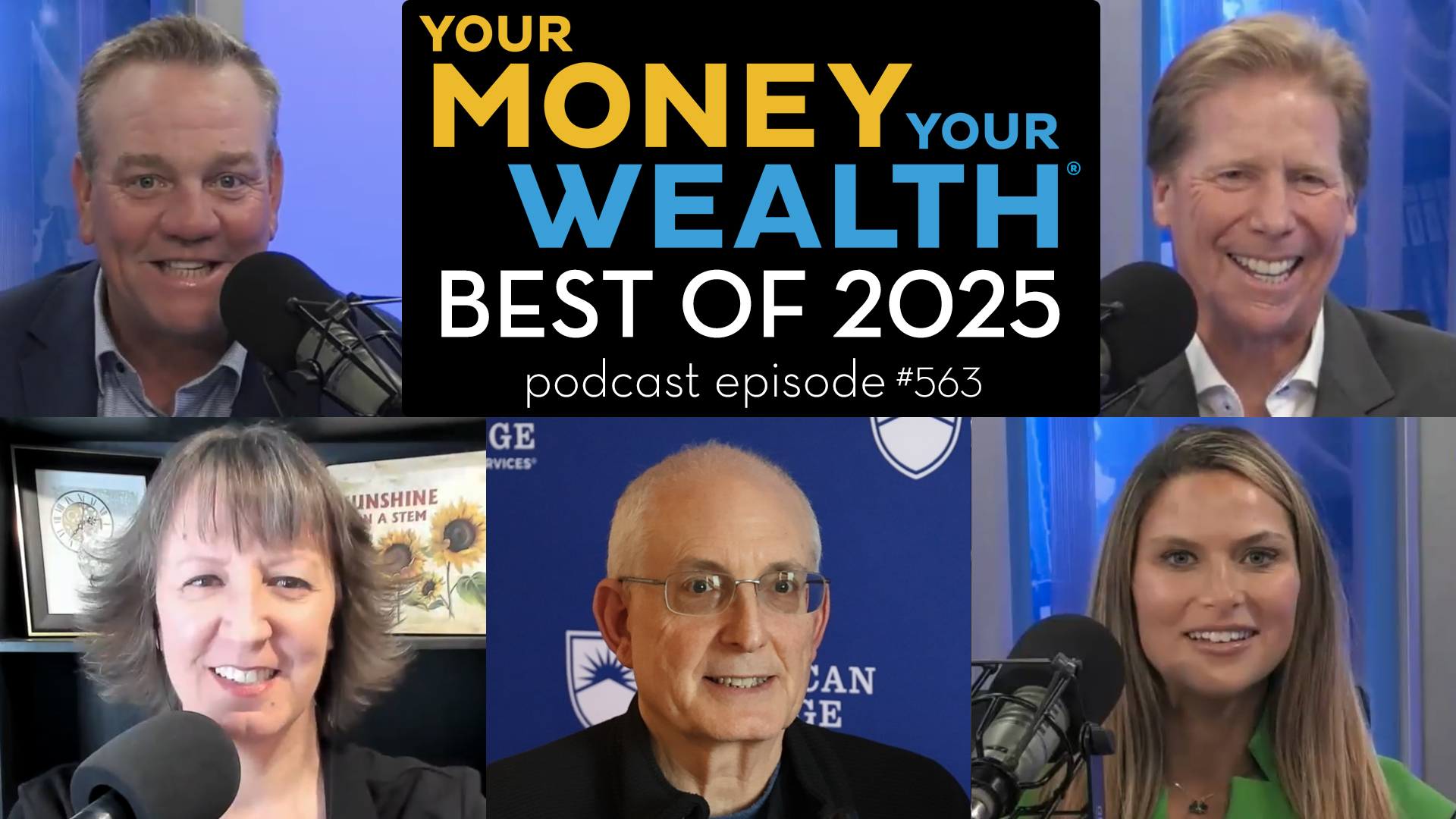
What actually mattered most to the YMYW audience in 2025? It turns out to be tax-free gains on investments, retirement timing, and claiming Social Security. In this Best of 2025 episode, Joe and Big Al break down the smartest tax moves, the biggest Roth mistakes to avoid, and how real people solve real retirement problems – with the help of some special guests. Find out when Roth conversions help or hurt, how to lower lifetime taxes for you and your heirs, what it really takes to retire confidently, even without a massive portfolio, and more. Watch or listen and steal the financial strategies that made YMYW’s most popular episodes of the year.

Show Notes
- 00:00 – Intro: This Week on the YMYW Podcast
- 00:54 – Roth IRA is “The Greatest Account Ever” Per Ed Slott. But Why?
- from ep. 526: YMYW most listeners and plays in 2025 on Apple Podcasts, YMYW most downloaded in 2025 across all podcast platforms
- 20:46 – Is There a Point Where Roth Conversions No Longer Make Sense? (Jerry, Phoenix, AZ)
- from ep. 535: YMYW most views, watch time, and new subscribers in 2025 on YouTube, most engaged listeners in 2025 on Apple Podcasts
- 32:13 – Roth Conversions vs. Taking Advantage of Zero Percent Cap Gains (Skipper, CA)
- from ep. 517: YMYW most consumed episode in 2025 on Apple Podcasts
- 43:06 – We’re in Our Early 40s with $795K Saved. Can We Retire at 55? (Mr Buckeye, OH)
- 55:12 – Is My Husband Eligible for Spousal Social Security Benefits Now that WEP and GPO Are Gone? (Cherilyn, El Cajon, CA)
- 59:53 – Outro: 2025 Stats and Next Week on the YMYW Podcast
Free financial resources:
The Complete Roth Papers Package – 3 free downloads in one!
Don’t Let These 10 Risks Break Your Retirement – YMYW TV
EASIRetirement.com – retirement calculator (self-guided)
Financial Blueprint – calculate your likelihood of retirement success (self-guided)
LISTEN to the Best of the YMYW Podcast 2021, 2022, 2023, 2024
LISTEN to the Top Funniest Moments from the YMYW Podcast Vol. 1, Vol. 2
Guides | Blogs | Educational Videos | YMYW Newsletter | Subscribe on YouTube

Watch today’s podcast episode on YouTube
Transcription
(NOTE: Transcriptions are an approximation and may not be entirely correct)
Intro: This Week on the YMYW Podcast
Andi: YMYW friends, welcome to 2026. Today on Your Money, Your Wealth® podcast number 563, we’re revisiting your favorite topics of 2025 as Joe and Big Al spitball on when NOT to do Roth conversions, Roth conversions vs. zero percent capital gains tax rates, and how much is enough for retirement. Plus, Al talks Social Security, pensions, and Roths with a couple special guests. I’m Executive Producer Andi Last with the hosts of Your Money, Your Wealth®, Joe Anderson, CFP® and Big Al Clopine, CPA. We’ll kick off the best of 2025 with the single YMYW episode that was the most downloaded all year, across all podcast platforms – as well as having the most listeners and the most plays all year in Apple Podcasts – Big Al dishing on why Roth IRAs are the greatest account ever with the IRA guru, Ed Slott, CPA.
Roth IRA is “The Greatest Account Ever” Per Ed Slott. But Why?
Al: You know, we were just talking about how when we have a tax issue, we are much more likely to go to your website than the IRS website because your answers are written in English, clear and concise, understandable. And the IRS is not quite so much that way.
Ed: Well, they’re rigid. They have to stick to the, you know, this is code section 40189 and this and that, and it’s regs and this. And some people just wanna know, can I do this or not?
Al: Right. Right. Yeah. So let’s talk about, you and I have talked about Roth IRAs, Roth conversions. Yeah. I know you’re very big proponent in that, but let’s talk about, let’s talk about what they are, what a Roth IRA is and why do people want to get money in the Roth?
Ed: Roth IRA is a miracle. It’s the greatest account ever created because everything- it is, there’s no question it’s the greatest account to have. Because everything in there grows income tax-free for the rest of your life. And even under the new rules, under the SECURE Act, 10 years beyond to your beneficiaries. Imagine getting a statement in the mail and saying, this is my Roth IRA balance and this is all mine. I don’t have to share it with the government. I don’t have to share it with Uncle Sam. I mean, it’s unbelievable. So it’s a great account. The only question is how much are you willing to pay to get it, right?
Al: Right. Because I mean, and-
Ed: That’s the catch.
Al: That’s the catch. And I think it was 1997 where it first came into play from Senator Roth.
Ed: Yes.
Al: And you know way-
Ed: August 5th, ’97.
Al: Oh, see. There you go.
Ed: Happened to be my birthday. I wasn’t born that day, but that was my birthday.
Al: That was your birthday. So, yeah. So thinking about Roth, I mean, you could do Roth-
Ed: I actually have the plaque up in my office, the Wall Street Journal. I happened to be in the article that day it was passed, but not ’cause of the Roth. Most people didn’t even know that was in there. Yeah. Until it came out. Right. It was some homeowner provision that they made a tax benefit.
Al: Right. Right, right, right. Oh, that’s great. So thinking about the Roth IRA, I mean, you can do Roth contributions, which is kind of a smaller amount, or you can do a Roth provision in a 401(k) or 403(b) if your company or organization has it, you can get more in that way. But a Roth conversion, that’s that-
Ed: That’s the big one.
Al: That’s the big one. That’s where you take money that you’ve already- you haven’t paid tax on yet. You got a tax deduction, you know, 401(k), IRA, and you convert it. And I think a lot of people don’t realize there’s no limitations on conversions. There’s limits on how much you can contribute to an IRA or a 401(k). Roth conversion, you can convert any amount you want. You don’t have to be working. It’s just what makes sense for you.
Ed: Right. The only limitation is your own pain threshold for how much tax you’re willing to pay in one year.
Al: Right. Right. Yeah, I think, that’s well said. So let’s talk about how should people be thinking about Roth conversions and tax brackets and how do you think about that?
Ed: Well, what you just hit is the fundamental principle to always paying the least amount in taxes, which is what everybody wants to do. And I call it one of my core always rules, and it’s so simple to save money in taxes, always pay taxes at the lowest rates. That’s it. Right? Right. If you can always get your money out, like out of your IRA tax-deferred accounts at the lowest rate, you’ll always end up with more. And that’s what this is moving money from an IRA, a taxable tax-deferred account. Yeah. And paying tax. If you can get the money out at the low rates and convert to a Roth, you’ll be a winner in almost every case. But. You have to use the brackets. And the brackets are great now. We have the lowest rates historically in history and giant brackets. A good at 12%, 22%, right? 24%. Sure hundreds of thousands of dollars can pass through those brackets and still be in these unbelievably low historic rates. Everybody complains about taxes, but these are the good old days, ’cause I think taxes are gonna go up. I mean, I don’t see any way they’ll ever go down.
Al: Right. And I think that’s right. I mean, the past several years with the Tax cut and Jobs Act. Yeah. We’ve had these lower rates and they’re set to sunset this year.
Ed: I don’t think that’s gonna happen.
Al: Yeah. So I wanted to ask you about that.
Ed: No, I think it’s-
Al: Tell me why.
Ed: It’s, well, because the congress, the senate, you know, house, Senate, the administration, they’re all, they’re all Republican, so it’s gonna pass and that’s great. They’ll extend the tax cuts probably for a few more years. I don’t know how many more years. Yeah. But every year they extend these tax cuts, that’s more years you can use these low brackets and take advantage and start bringing down this taxable IRA and bringing up tax-free accounts, tax-free savings in your Roth. Plus to leave a Roth to beneficiaries. Imagine beneficiaries getting it and they don’t have to pay tax on it for 10 years after death.
Al: Have you ever heard this question or this statement from people, which is, I don’t wanna put money in a Roth IRA, because- Yeah, they’re just gonna tax it later someday. Just like Social Security. They told us they weren’t gonna tax it. Now they tax it.
Ed: Yeah, I’ve heard it, but not as nice as you’ve said. I, that’s the number one question I get at all these consumer programs. I did them around the country and they don’t say it as nice as you, but mostly the version is, I talk about the Roth, just like we’re talking they- somebody will always stand up and say, but can I trust the government to keep their word, that they won’t tax it in the future? And these are people just like you said, that can’t let the whole Social Security thing go from 30 or 40 years ago. Right. You know, they said that would never be taxed and they lied and I don’t trust them.
Al: Right, right.
Ed: So the question is, can I trust the government to keep its word that Roth IRAs will always be income tax-free, and the answer is absolutely not. You can’t trust the government as far as you can throw them. And as a CPA, we have an old saying, tax laws are written in pencil, right? And they change. But I’m gonna tell you a secret here, just between us. Okay. You know what Benjamin Franklin said about secrets?
Al: Let’s hear.
Ed: 3 people can keep a secret if two of them are dead.
Al: Got it. Okay.
Ed: So here’s the secret. Lucky for all of us. I’ll say it quietly. Okay. Lucky for all of us. Congress are the worst financial planners on earth. They’re so shortsighted. And that works to our favor. Yeah. They secretly- don’t say it too loud- Love. Love, love, addicted to love- Roth IRAs. Why? Because they’re so shortsighted. They only look at the money that comes in upfront.
Al: They’d look at what they can see right in front of ’em.
Ed: The budgets, the 10 years, the two-year budget cycles, right? The only money that can get into a Roth is already taxed money. And that’s why since the Roth were created and the big shift started in 2010. If you remember before 2010, you couldn’t convert to a Roth IRA if your income exceeded $100,000.
Al: That’s right.
Ed: Back then, just like now, Congress needed money and they eliminated that provision and that brought in the floodgates of money, including mine. I converted everything then because they gave people the deal of the century. Right? Do you remember that deal?
Al: Yeah. You could pay the tax over 4 years.
Ed: No, two year. That was the original call.
Al: Oh, that was the original deal.
Ed: I converted everything. Yeah. A matter of fact, just in a session to the American College here a few hours ago, I said to the group of advisors, I guess I didn’t remember. I said, I converted everything. I begged you guys to take that deal when you were at my seminars.
Al: Right.
Ed: I took my own advice. I converted everything in 2010 and I threw out to the group, how much tax did I pay? And some people say, well, you didn’t tell us the rates and this, I paid nothing. Zero. It was a deal of the century. And they’re thinking, how did I miss this?
Al: Right.
Ed: It was, the deal was you paid nothing. In 2010. Yeah. Half and 11 and half and 12. That’s right. Yeah. But in essence, the government gave everyone an interest free loan to build a tax-free savings account. Right. It was unbelievable. So, and obviously I didn’t know about the, can you imagine the growth in that Roth from 2010 to where we are now?
Al: Right. Right. 15 years later.
Ed: So Congress saw the boatload of money that came in and they said, Ooh, this is good. Not realizing, you know, they’re not getting any of that revenue ever again. Yeah. So then they kept expanding Roth 401(k)s. Yeah. And then in SECURE 2.0. They went Rothamania crazy. SEP Roth IRAs, simple Roth IRAs, 529 to Roth, matching contribution Roth, catch up contribution Roth. Roth. Roth. Because they wanted the money up front. They love Roth IRAs ’cause they’re so shortsighted. So sure. I would say don’t worry about it. Because Congress, they may trim around the edges, but if they do anything that kills the golden goose. Yeah. There goes their revenue source that they’re counting on to fund every tax bill.
Al: Do you think someday some congress down the road will figure this out and realize we’re in trouble.
Ed: No, they keep kicking the can down the road, and I still believe they’re gonna have to because as a CPA and accountant, I have to believe in math. And I look at these deficit and debt levels. I don’t even know what the debt is. It was last I saw $38, $39 trillion. All I know is if you have to round up to the nearest trillion, that’s a problem.
Al: It’s a problem. Right?
Ed: Yeah. So we have the highest debt levels ever. The lowest revenue from taxes ever. Yeah. I don’t know how long this can go on before they’re going to lower the boom and tax people on money in their IRAs. Right. I think tax-deferred accounts, IRAs, 401(k)s are a sitting ducks for future tax increases. They’re the low hanging fruit for Congress. Right. And I don’t want to have a large IRA when the music stops on this stuff.
Al: You know, you think about money in a IRA, 401(k), and it hasn’t been taxed yet. Yeah, and you think about the Roth IRA, which they’ve already paid taxes on it, but then it’s like, what’s gonna happen in the future and the way things are going, eventually- I would tend to agree with you. Eventually it seems like tax rates have to come up because how do we afford everything we’re trying to pay for?
Ed: I don’t know how it’s possible. And if tax rates do go up, you’re a big winner with the Roth, right? That’s even if they stay the same, so then it’s a wash. Right? And the odds of tax rates going down are nil. So the Roth is just a big bet on where we are today, tax rates today versus tax rates in the future, and I think that’s a pretty good bet. Imagine you were making a bet like, in Las Vegas or something, a blackjack, right? And the dealer showed you all his cards. That’s a pretty good bet.
Al: Yeah, that’s a pretty good bet. So, okay, so let’s pivot a little bit. Yeah. Let’s talk about the SECURE Act. Okay. 2.0. And the death of the Stretch IRA for most people, right? I mean, there’s a 10-year period and a few people can still do it, but most can’t, so they’ve gotta get the money out within 10 years. And what are, how do you think about that? What, strategies or what, how do you, what do you, how do you tell people to plan for that?
Ed: That was a game changer, ’cause the plans people had before that, and when I was doing programs all, all over the country before the SECURE Act, I said, oh, the Stretch IRAs are great because they can go out 30, 40, 50 years. And you’re talking about a massive deferral. Yeah. That all ended. Why? Congress needed money. Right. Here’s a little something, another secret about Congress. Okay. After studying tax law for over 40 years, one thing I’ve known- I’ve noticed is constant. Whenever congress names a tax law, you can almost bet, almost always bet that whatever they name it, it will do exactly the opposite. So when I heard the SECURE Act is coming, I said to myself, hold onto your wallets. And sure enough, it was a money grab. They needed revenue. So they said, Nope, we’re not waiting 30, 40, 50 years. We’ll wait 10 years at most. So now they’ve closed the window. They pushed in the window when all this buildup in tax-deferred IRAs and 401(k)s have to come out. And it’s going to come out like a fire hydrant and massive tax increases for people. Right? So that’s what made IRAs and 401(k)s, tax-deferred accounts, that downgraded those as a vehicle for wealth transfer or estate planning, especially to the beneficiaries who are going to get hit by the end of the 10th year after death. So the Stretch IRA, for most people, beneficiaries is no more. So that means if you are listening or watching to this, or listening to this or watching this, and you had a plan before 2020 when the SECURE Act took effect. That plan probably doesn’t work anymore. It behooves you to look at your plan, work with an advisor, financial advisor that is- has a specialized knowledge because you need an advisor that knows how to navigate this and make the changes and lets you know where the problems are, why your current plan doesn’t work, and what alternatives are available. And the alternatives we’ve talked about things like Roth IRAs, bringing down the IRA balance while tax rates are on sale, in effect.
Al: Yeah, good point.
Ed: And moving to other tax-free vehicles like life insurance. That’s a good choice. Anything will be better than the taxable IRA.
Al: Yeah, because it’s- you gotta pay the tax on it one- one way, no way around it.
Ed: It’s not if but when.
Al: You know? And I think a lot of people don’t realize the Roth IRA, it still follows that 10-year rule. Yeah. You gotta have the money out in 10 years, but it’s tax-free. Yeah. It’s not pushing kids up into higher brackets. Right. And when we talk about kids, we always say with the kids, but the inheritors the beneficiaries. They’re in their 50s.
Al: Yeah. Right.
Ed: And they may be in their own highest earnings years.
Al: Good point.
Ed: Last thing they need to inherit, not like it’s a horrible thing. Oh, I inherited money, you know, I worked so hard for it, you know?
Al: Right, right, right.
Ed: But still, the worst thing could be is to inherit a taxable account that gets blasted with taxes in that 10th year after death. Right. With a Roth, they don’t have to touch it to the end of the last day of the 10th year after death. Growing, accumulating and compounding income tax-free for them.
Al: Yeah. I wanna pivot just a little bit for your IRA.
Ed: That’s a second pivot. Yeah, that’s two pivots.
Al: Okay. I get two per interview, right?
Ed: Yeah.
Al: So, let’s talk about beneficiary designations. Yeah. A lot of people like to name their trust, which isn’t necessarily a great idea.
Ed: Well, no, there is a reason to name a trust, you know, and that’s a question I get. I got it at the last seminar I just did here. Yeah. Advisors always want to know ’cause their clients want to know. When should I name a trust as my IRA beneficiary? My answer is, when do you name a trust? When you don’t trust. Because if you trusted them, you wouldn’t need a trust. They should have called it a don’t trust, right? That’s when you name a trust, when you don’t trust, right? When you want post death control, and that’s a big issue for a lot of clients I’ve dealt with over the years. They have a large IRA, $2,000,000, $3,000,000. I remember a client telling me years ago, we’ve got $3,000,000 in an IRA, I don’t even need it. I want my kids to get it. Sure. I my grandkids, but I don’t want them blowing it. I work too hard for this money, right? I want to control this after death. So they don’t squander it. They’re always worried about what the kids will do, bankruptcy, lawsuits, divorce. They’re worried about managing money, everything. But the number one fear I used to get from clients is they would say, it’s not my kids I worry about, it’s the ones they marry.
Al: Oh right.
Ed: And that was a big concern. I had all this money and it may end up to going to some daughter-in-law, son-in-law I never even met.
Al: Right.
Ed: And they name a trust. But now because of the SECURE Act, I would never leave an IRA to a trust ’cause such a horrible asset. And trust tax rates are the highest in the land. Sure. The better option, you still may need a trust if you want that control. Yeah. So I’m not saying trust are bad, trusts have a use. It’s just IRAs are now a horrible asset. To a disaster to leave to a trust. Better option. If you have a large IRA and you’re in that situation I just said, and you want control after death. Better option is bite the bullet, convert that IRA to a Roth IRA, and leave the Roth to the trust. That eliminates all the trust taxes, and you can get the post death control and protection that you want.
Al: That’s great advice. Now, would you do that through your living trust or would this be a separate IRA trust?
Ed: No, it doesn’t- Well, with the Roth it could be a separate IRA trust. But what’s even better than, and it’s easy with the Roth because there’s almost no rules. All that has to happen. Remember, there’s no income tax. And there’s no RMDs in the years one through 9 of a 10 year term. Sure. So all that you have to know is that at the end of the 10 years, the money either stays in the trust, right? It’s not taxed.
Al: Yes.
Ed: Or it goes out to the beneficiary, or it’s doled out according to how you want your beneficiaries to get it. Yeah. So it’s very easy to name, trust as, a Roth IRA beneficiary. It’s very complicated. It was before with the IRAs, but we put up with that because we had the Stretch IRA. Sure. Now the IRA has no more redeeming qualities, so we don’t need that anymore.
Al: Right, right.
Ed: It’s like in baseball, the starting baseball season now, you could have a guy that hits a lot of home runs and all at the right time, you know, in the World Series.
Al: Yeah. Right.
Ed: Playoffs. You’ll love that guy.
Al: Clutch hitter.
Ed: Except nobody likes him. He’s a problem. He’s in every scandal. But you put up with him because he hits home runs. Right. If he stopped hitting home runs, you get rid of him.
Al: Yeah. Yeah.
Ed: That’s an IRA. Yeah. There’s no more redeeming qualities. It used to work, now it doesn’t. So, let’s move on. But the, probably the best asset to leave to a trust when you want that control is life insurance because it doesn’t even have the rules that Roth IRAs do, right? You can customize your own plan so you could take money down out of your IRA, pay the tax. Now, I wouldn’t do this before 59 and a half ’cause there’s a penalty situation. Pay the tax, get it out at low rates. Remember, always pay taxes at the lowest rate. Sure. So you’re getting rid of this problem. The IRA, putting the money, and I’m talking about permanent cash value life insurance and grows tax-free. Right. And that’s the best asset if you still need to control it for your kids. You can have any provision you want. You don’t even have to worry about income taxes. You don’t have to worry who the beneficiaries are, what categories there, who are the remainder beneficiaries. There’s no tax you can actually get the plan you want. You don’t have to go through all these tax landmines and obstacle course of rules.
Al: Right. Wow. You are a wealth of information as always. You’ve given us a lot to think about, Ed. I really appreci-
Ed: Oh, great to be here.
Al: Appreciate chatting with you and you’ve taken the time.
Ed: Okay, thanks.
Al: Awesome. Thank you.
Andi: Kiplinger agrees with Ed and Joe and Big Al on Roth IRAs – they say that investing in a Roth account is “one of the smartest money moves a young person can make.” However, there are rules, so make sure you know them before you go jamming all your money into a Roth and end up paying a bunch of penalties. Download The Complete Roth Papers Package to understand how Roth accounts work, so you can take full advantage of their lifetime tax-free growth. This bundle of Roth guides is packed with valuable information about Roth contributions and conversions, the Backdoor Roth strategy for when you make too much money to contribute directly to a Roth, and the rules for taking money out of your Roth IRA. Plus, you’ll learn the differences and pros and cons of saving in a traditional IRA vs. a Roth IRA vs. a Roth 401(k) and much more. Click or tap the link in the episode description and download the Complete Roth Papers Package for free. Next up, in 2025 one question got the most views, watch time, and subscribers on our YouTube channel, and our highest number of engaged listeners all year long in Apple Podcasts: is there a point where Roth conversions no longer make sense?
Is There a Point Where Roth Conversions No Longer Make Sense? (Jerry, Phoenix, AZ)
Joe: Hello, Andi, Joe, Big Al. This is Jerry from Phoenix. Looking for a little spitball response to whether there is a logical point where no additional Roth conversion makes sense. Actually, this is really my attempt to see if Joe would ever come to the conclusion. Yes, you have. I come to the conclusion all the time. I gu I’ve heard it. On this show, I drive a 2021 BMW four 30 I, but my backup is a 1997 Tacoma. I used to take the dog to the dog park and go hiking in South Mountain Park in Phoenix. Have you ever been to South Mountain Park?
Al: I don’t believe so. I’m not sure I know where it is.
Joe: I’ve never heard of it. My wife and I both retired about five years ago, and we are 67. Our current balances are about $7 million after tax. Oh boy. There we go. Big chair. Here we go. Three and a half. Million dollars in an IRA $950,000 in a Roth. While I’m not concerned about having enough assets to live on, I’m trying to make sure I maximize our lifetime tax bill and minimizing the taxable IRA balances to so that our two sons that will inherit, well get Gil in taxes. I started doing Roth conversions about four years ago. Plan to continue converting about $200,000 a year for the next six years until my RMDs begin for 2025. I’ve already done $90,000 in conversions. I’ve heard several financial podcasts refer to and sort of endorse a software package for financial tax planning called Boldin, formerly New Retirement.
Al: Well, yeah, we know about New Retirement. Yep. I met Steve Chen years ago.
Joe: Oh, love the guy. Great company.
Al: Yeah.
Joe: I’ve acquired this software and for the past three weeks I’ve updated the software to include all assets, income sources, planned expenditures, assumed 2017, tax rates, et cetera. After reviewing the results and recommendations, I have to admit I am very surprised by the results heard. This software, the advice is to do no further Roth conversions. The software believes this approach will minimize my lifetime tax bill, federal and state, and provide the largest estate value. Obviously, the software doesn’t know the tax brackets of my heirs and what the future tax rates will be. I was just expecting. No additional Roth recommendation. What do you guys,
Andi: He’s not expecting. Yeah.
Joe: Okay. Jerry’s 67 years old. Yeah, so we’re missing a few important facts here. Jerry. I don’t know what your income is. Yeah. You doing $200,000 conversions? I have no idea what bracket. You’re getting yourself into,
Al: Right? Yeah. We don’t know how much your fixed income is, what your tax bracket is. See, that would be helpful to know, because whether you do a Roth conversion or not is dependent upon your age, how much you have and how much you’re spending. Not only how much you have, how much you have in a IRA, 401(k), how much you have in a Roth, how much do you have in a non-retirement account. Then we can sort of decide or help you with whether that’s a good decision or not.
Joe: Yeah. Here’s what you have to look at sometimes that those, you have to be very, careful and no offense to New Retirement or Boldin. We use that. We offer that software. Yeah. Free to our listeners. it’s a good, program. Yeah. EASIretirement.com. Yeah.
Andi: That’s E-A-S-I.
Joe: E-A-S-I. That’s why no one ever went to the website.
Al: We dunno how to spell it.
Joe: It’s not, it’s like, yeah, I went to Easy. Well, no,
Al: There’s nothing there.
Joe: There’s nothing there.
Al: It says you can have this website if you want it.
Joe: It’s EASI dot com.
Al: Yeah.
Andi: EASIretirement.com.
Joe: Yeah. Okay. I don’t even know what the,
Andi: you don’t even know the website.
Joe: Yeah. We get four visitors a year by accident.
Al: Just listen to Andi. She knows the website.
Joe: So, I don’t even know what I was talking, okay. No financial planning software.
Andi: Why not pay attention to EASIretirement.com?
Joe: You gotta be careful with financial planning software, right? We use it every day and it’s looking at a snapshot and time that day. I can guarantee you this, Jerry. Everything else that you see in the future is wrong. You have no idea what markets are gonna do. You have no idea what inflation’s gonna do. We have no idea what tax rates are gonna do. We have no idea what your life is going to bring, right? So when you’re like, here, let me plan this out from age 67 to 97 or to age 100, and then you look at the tax savings number and that computer software’s gonna be like, yep, no confused, no conversions. You’re like all. I’m done. No, you don’t wanna necessarily do that. You have to take a look at this stuff every single year. And also the rate of return that you’re running on the investments, you’re using a hypothetical, let’s say 6% growth rate. Well, if you do a straight line, 6% growth rate, it’s. It’s gonna be apples. It’s just, it’s really hard to really make decisions long term if you’re looking at it that way. You have to look at it and make decisions every year and update the numbers every single year.
Al: Yeah, because one of the things that happens here is when you, have these, programs, they’ll generally have a fixed tax rate. Right, so and so, that’s why it doesn’t necessarily make sense because you’re gonna be in different tax brackets. You’re in a higher tax bracket. Often when you’re working, you retire before your RMDs, before Social Security, you’re in a much lower bracket. You wanna do Roth conversions to take advantage of that.
Maybe you’re already receiving Social Security, but it’s ahead of required minimum distributions. Right now, the tax rates are pretty low, so it’s, it may make sense to go ahead and do a conversion. Also, these programs. Assume that you’re both gonna live forever. One of you will probably outlive the other and you’ll get into the single rates and it’s completely different tax rates. So just, be careful when you’re kinda looking at a program, this is a good program, but you’re looking at a program with only so many variables and you’re, making long-term conclusions on that three and a half million dollars.
Joe: He’s got a retirement account, he’s 67 years old, so
Al: Yeah, it’s, gonna be five or 6 million at RMD age.
Joe: Right. well.
Al: he’ll be he, I think he’s, 73.
Joe: Okay.
Al: Yeah. So he’d get it 70. So, so it’s cut 60 years from now? I would say four.
Joe: Let’s say it’s 4 million bucks.
Al: Yeah, just, go four.
Joe: So$160,000 RMD, I don’t know what his other fixed income sources are. So just kind of think of it that way is like, all right, well what tax bracket am I going to be and when the RMDs hit,
Al: right.
Joe: Am I going to be in the 24, the 22
Al: and compare it to today?
Joe: To today, yeah. I would convert to the same bracket that I’m in today. So if I’m in the 24% tax bracket, because you have plenty of assets, like he’s dead, right? And he wants to maximize the amount of dollars that is gonna go to his two kids. So what tax bracket are the kids in? Because once they inherit the retirement accounts, it’s IRD income respected the decedent. They have to take the money on, pay ordinary income tax on that.
Al: Yeah. Over 10 years. And they may be in a high bracket and they, that would be a lot of money to take out in 10 years,
Joe: right? if it’s in a Roth, it’s 100% tax free and there’s no RMDs in a Roth, IRA.
So it’s like, all right, well here, can I continue to convert this thing that’s gonna reduce my RMD if I pass before my spouse, the RMD for her is going to be the same RMD that you’re taking roughly, but now it’s at a single tax bracket. Right? So there’s all sorts of things to consider at three and a half million dollars in retirement accounts with no need for the money at 67. I don’t know, I just still, unless you’ve got a $200,000 pension, I don’t know what’s going.
Al: Yeah. Unless you’re the highest bracket somehow. Yeah.
Joe: If you’re like converting in into 32% tax bracket or something like that. Yeah.
Al:I wouldn’t do that.
Joe: I wouldn’t do that either.
Al: Right.
Joe: But yeah. Jerry, congratulations on the amount of wealth that you have. Congratulations on being an engineer and going to all these different websites and trying to figure out the most optimal Roth conversion possible. but you know, just like with anything, it’s optimal each year. Like the market’s down 20%. I, don’t care what tax bracket that you’re in, I’m doing it. If you’ve got three and a half million dollars, I’m doing a conversion
Al: because the assets are gonna recover in the Roth and then it hardly matters what bracket you’re in. In fact, you kind of, one way to think about it is you look at what you ended up with in the Roth by the time you have to pay the tax right and compare it to the tax you paid, that’ll actually be probably pretty low rate. If the market zooms right up,
Joe: you look at asset location. Usually if you have a strategy, an investment management strategy, you have asset classes that have a higher expected rate of return in your Roth IRA,
Al: right?
Joe: Because you’ll never pay taxes on it. I don’t want to have bonds and cash and CDs in my Roth.
Al: No, you don’t get rewarded for that growth. ’cause there’s, no tax. There’s no tax to pay in a Roth, so why wouldn’t you want your, stock
Joe: Put gas on there, right?
Al: Yeah. But. Load it up,
Joe: Let’s, we want some firecrackers in there. And so if you look at that, all right, so now I have more stocks or stocks that have a higher expected rate of return in my Roth. So maybe they have an average rate of return that is higher than the s and p 500 or a globally diversified portfolio. So there’s so many other things you know that, you have to consider. But here’s the other thing that you don’t wanna do a Roth conversion on. If you don’t have the cash to pay the tax, don’t do it.
Al: Yeah.
Joe: Let’s say if you are going to now pay more tax on your social security, probably doesn’t make sense where we’ve seen people that have very little tax on their social security because it’s, based on provisional income and all of a sudden you do a Roth conversion. It’s like, oh. Now. All of a sudden more of my social security is subject to income tax and it just pops ’em up into a higher bracket. there’s Irma, right? So if, you’re gonna go into a higher Irma, you might wanna consider maybe not doing that. You have to run the numbers there. There could be credits that you’re giving up.
Al: Yeah, Educational credits. You, could be, you could own rental properties, right? And you get a $25,000 deduction, but with that Roth conversion that goes away. You converted $50,000, but all of a sudden you have to pay tax on 75,000 more dollars. That’s not a good deal.
Joe: Yeah. We saw. Someone wanted to get out of individual stocks, so they sold X amount of dollars outta the stock. Oh, and then they did a Roth conversion on top of that. And then now that capital gains is subject to net investment income tax. Yeah, probably don’t wanna do that. If I wanna look at diversifying from a stock and being in that 0% capital gains rate, I probably don’t wanna do a conversion. See Jerry? Look at that. That’s like 10 things that you don’t wanna do. A Roth conversion. What else do I got for? How about the Affordable Care Act? Oh, I need my,
Al: oh boy, that’s another, that’s actually a pretty big one.
Andi: This is starting to remind me of that scene from Roxanne, where Steve Martin starts listing all of the insults for his having of a big nose. You know that scene that I’m talking about, right, Joe?
Al: Oh, I, yeah, that is good.
Andi: You’re starting to reel off all the reasons that somebody should not do a Roth conversion because dang it, that’s what you’re known for is the Roths.
Joe: All right, well, okay. Well, but I still think Jerry should probably do it.
Al: I do too, but we need a little more information.
Roth Conversions vs. Taking Advantage of Zero Percent Cap Gains (Skipper, CA)
Joe: Yeah. Alright, we got Skipper. “Hey guys, this is Skipper, wife Ginger, both 65.” Where’s Gilligan?
Al: He didn’t make the cut.
Joe: Who’s your favorite character?
Al: MaryAnn.
Joe: Not the professor, Mr. or Mrs. Howell? I didn’t like, well, I mean, they were all fun. Gilligan? Yeah, I mean, Goofy. Fun, though.
Andi: Yeah. I was gonna say, that’s from a different show. Goofy was not on Gilligan’s Island.
Joe: He was goofy.
Al: He was goofy. I know.
Andi: Joe, who’s your favorite?
Joe: I liked Gilligan. Yeah. He was good.
Andi: I was a fan of the professor.
Joe: Yeah. Very dapper.
Andi: Brainy.
Joe: He was able to make telephones out of coconuts, but they couldn’t figure out a way to fix the boat. It’s like, what the hell?
Al: It’s funny how they always had like spare parts to build whatever.
Joe: Just whatever, man.
Al: Except for a boat.
Joe: I mean, he was building AI robots, but still stranded on that island. How’d they ever get off?
Al: I don’t remember.
Joe: Yeah. I don’t know if I ever saw the finale.
Al: Cause there, there was a, I think there was a movie where they’d gotten off if I remember.
Joe: Well, I don’t know. Wasn’t there like.
Al: But they really were, they were in a studio in LA, so it wasn’t, they weren’t exactly shipwrecked.
Joe: Oh, come on. No, I think they were definitely shipwrecked.
Andi: I can’t believe you felt the need to say that Al.
Joe: Yeah. Well, you know, they were actually in the studio. Are you kidding me?
Al: So they, well you asked the question, how’d they get off? Every night they got off and went home.
Joe: I don’t think so. Alright.
Al: They drove their cars home? No problem.
Joe: “First the drinks, we both enjoy California red wines, and I occasionally enjoy, like a Moscow Old Fashioned.”
Andi: Mezcal.
Joe: Mezcal, what’s that, tequila?
Andi: I think it’s related, I don’t think it’s exactly tequila, but I’m not really sure.
Joe: All right, “The question relates to Roth conversions versus taking advantage of the 0% capital gains rate.” Oh, this is a juicy one.
Al: Yeah, it could be.
Joe: All right. Okay, “We’re both mostly retired. I don’t have some part- I do have some part time consulting income. After that fades away in 2025 our ordinary taxable income will be in the lower end of the 12% tax bracket leaving room to harvest about $70,000 of long term capital gains each year at the 0% tax bracket until Social Security starts at age 70 and then RMDs at age 73. Of course, California will take their bite as always, but we really want to do some significant Roth conversions. As I learned from Big Al in a prior episode, the first $70,000 of a Roth conversion in those years will have an effective federal tax rate hit of 27% with the loss of the 0% long term capital gains rate to 15% plus an additional 12% ordinary income from the Roth conversions.” Did you follow all that?
Al: Yeah, and I have said that, and that’s a true statement.
Joe: “I’ve run an 8-year projection.” Okay. Skipper. Yeah, call the Gilligan up and-“
Al: Actually call the professor. He’ll be able to tell you if this is a good plan.
Joe: My goodness. 8-year projections. “And I’m thinking maybe try and optimize each year with some heavy long term capital gains and other years of heavy Roth conversions. Also while keeping an eye on IRMAA tiers, 3.8% net investment, income tax, plus cashflow to support our lifestyle and the tax on conversion. The dilemma is that we will make it difficult to reach the Roth conversion target of $800,000, and I really don’t like missing out at the 0% cap gains rate. What do you suggest?” What the hell is he talking about?
Al: Well, he’s thinking from what I said, he needs to do one or the other in any given year.
Joe: Oh, was this the same guy that- Skipper called in before or something?
Andi: We’ve had a number of people that have been from Gilligan’s Island, so I’m not sure if this is the same Skipper.
Joe: Okay, so here’s his investments.
Al: Okay.
Joe: “He’s got a taxable account of $1,600,000 with $750,000 unrealized long term capital gains. He’s got a retirement account of $2,000,000 and he’s got a couple of bucks in a Roth. Plus, we have a rental house and a primary residence, both with solid equity.” All right. “Thanks for looking forward to your ideas and the laughs.” All right, well, this is the only time I think I ever need to know what is in the taxable account. Like some people give us like ticker symbols and everything else. I’m just kind of ignoring that, but is this individual stock? Is this just a couple mutual funds? Did he get lucky and bought Nvidia? Apple? What was this? A magnifi- ? Magnificent. Seven.
Andi: The FAANGs?
Al: Well, you’re, you are right because it depends what the investments are, whether you need to reallocate.
Joe: Right. If there’s a lot of concentrated risk you need to diversify. If it’s diversified and they’re in decent investments-
Al: Yeah, then stick with it and do Roth conversions. All day, all year after year.
Joe: Yeah, don’t worry about the long term, unless you need the money to live off of. So the plan that you have to figure out is, all right, well, how much money do I need to take from the overall portfolio? So. In that case, it’s like, all right, well here, maybe you take enough out of the non-qualified and get that into a high basis area where you can live off of that money for a couple of years while you’re doing the conversions. And you don’t necessarily have to worry about the tax. But there’s a lot more analysis, I think, on this, but if you don’t need the non-qualified and it’s diversified and good investments, Roth conversions all day.
Al: 100%. And plus, I mean, so we’re talking at the moment, we’re talking about a $1,600,000 taxable estate and less than half of it’s capital gains. What if that became $2,000,000 or even $3,000,000? You sell it, yeah, you pay capital gains tax, but not on the whole thing. It’s very tax efficient, but the, your problem is you got almost $2,000,000 in a taxable retirement account. You got to get that over to Roth the best you can, that needs to be the priority. Unless Joe, as you said, the portfolio is not correctly allocated. If you need to diversify, then maybe focus on capital gains for a couple of years.
Joe: Yeah. If at $1,600,000, let’s say if you have a concentrated position or it’s not allocated – I mean that $1,600,000 drops back down to $750,000, I don’t know. I bet you’d been a lot happier to pay some tax, than to look at your balance and say, Oh, I got my basis back and I could sell it now and I don’t have any tax. So you got to look at both here. I mean, you want to make sure that you have the appropriate diversified portfolio of the entire estate. So it’s almost $4,000,000 of liquid assets that you currently have. Your house is paid for, you got a rental house, you got Ginger, you got the life. What you’re worried about is okay, some taxes, and do you take advantage of the 0% capital gains rate? Because in a non-qualified brokerage account, you could sell as long as you stay in the 12% tax bracket of taxable income, and it’s 0%. So he’s really loving that 0% cap gains rate.
Al: Yeah, I think, and maybe a way to think about this is pick one or the other. Right? If you do want to diversify and you want to sell some of your assets, then sell enough not only to fill up the 12% bracket and pay no taxes on that, but then go higher, right? Because you’re only paying 15% taxes on that. Don’t do Roth conversions that year, but then get your portfolio allocated properly over a couple of years. Then, if you need to- and then switch to Roth conversions after that. That’s the bigger problem I see, unless you’re not diversified. Joe: Yeah. Let’s say he’s got $2,000,000 in a retirement account and his RMDs are roughly in 10 years. Let’s say that money doubles. Now it’s at $4,000,000. That’s $360,000 RMD. Just the RMD alone is going to be taxed at-
Al: Right.
Joe: What, 36%? Well, 30%, I mean 32%?
Al: Yeah, 32%, as it stands right now, yeah. Well, actually 24%- it’s, we’re supposed to be going back to the old rates. So yeah, we don’t know.
Joe: And then he’s gonna have, well, he’ll have Social Security.
Al: Yeah, true. I mean, he may be approaching 32%. Yeah. Yep, you’re right.
Joe: So, I don’t know, you’re, you might be thinking you’re tripping over, you know, dollars to pick up pennies here.
Al: Right.
Joe: I want to take advantage of the 0% capital gains when you could pay 15% or you’re going to pay 32% potentially or a lot higher tax on the ordinary income when it’s forced out.
Al: Right.
Joe: The worst thing that happens with very good savers is that they’re forced to pay tax on income they don’t need. And those RMDs are just forcing this out and putting all of that income on your tax return. And then all you’re doing is putting it in your brokerage account anyway, right? And so now you’re getting interest and dividends and paying capital gains tax on the money that you just paid tax. So you’re, it’s just this tax cycle. So get ahead of it now. You’re 65- conversions, I think is the right answer. But of course, that’s just a spitball.
Al: Yep.
Joe: All right.
Andi: There are so many risks that can break your retirement plans – what if you outlive your savings? Or spend too much? What if healthcare costs go sky high? What if you retire in a down market? This week, watch Your Money, Your Wealth TV as Joe and Big Al show you how to make it in retirement, not break it. Then, calculate your likelihood of retirement success with a Financial Blueprint. Click or tap the Financial Blueprint link in the episode description. Input your details, and our free tool will analyze your current cash flow, assets, and projected retirement spending. It’ll output a detailed report with three scenarios to help you determine your probability of retirement success, including future taxes and actionable steps you can take now to achieve your financial goals. Click or tap the links in the episode description to watch YMYW TV, and to get your Financial Blueprint. Next up, a question from the YMYW episode with the longest view duration on our YouTube channel in 2025 – how to accomplish your retirement goals even without a fat wallet:
We’re Early 40s With $795K. Can We Retire at 55? (Mr Buckeye, OH)
Joe: Let’s go to Mr. Buckeye. Got a lot of interesting names that come through now. All right. He goes. Hey Joe, Big Al, Andi, discovered the show a little bit over a year ago and really enjoyed listening to the new episodes while taking the evening walk in our small town in Ohio. Not only do you provide very useful advice, but your friendly banter makes it quite entertaining. Well, thank you sir. I’m 42, wife’s 41. We have an 11-year-old daughter and 9-year-old son. We drive a 2006 Toyota Prius, a 2009 Toyota Sienna Van Prius. Yes. Still make ’em.
Al: they do.
Joe: Alright. That was the first of the, it was the electric vehicles, right?
Al: The first, first of the hybrids.
Joe: Got it. Okay. Little drink of choice here. My wife is a white wine and or a margarita. I enjoy red wine in old fashioned. Okay. Okay, here’s the specifics. My wife makes $80,000 a year. I make $85,000 a year. We have smaller salaries than most of your listeners, but if saved consistently since college and are content to live a lower means. All our retirement accounts are invested in low cost index funds and are combined to growth s and p 500 dividend International REITs, and small amount of bonds.
401(k) wife has 110. I have 200 this year and an option of start putting my portion of the 401(k) in the Roth employer con, contributes to the traditional 401(k) Roth. IRA wife has one 60. I have two 20. Man. Okay. HSA $18,000. I fully fund $4,300 annually to my HSA. All the money is invested and I don’t plan on touching it.
We currently use cash from our savings to pay all medical costs. Oh my God. This is long. Oh, you got a whole nother page. Okay, Mr. Buckeye, take a deep breath. This is a long ass walk. This, you may have to and do it, you might have to do some stretches here. brokerage $40,000. He’s got a 5 29 plan of 53,000.
We can’t, he’s gonna contribute $2,500 per kid there. we got cash of 52,000. Our only debt is $82,000 on our mortgage at 4%, which will be paid off in 10 years. Current value is 325. We both fully fund $7,000 into our Roth IRAs every year. For our 401(k), I contribute 6% and my employer matches seven while my wife.
Both contributes to get the match to six. Currently with an employer match around 35 to 40% of income, with matches. We say we’re around 35 to 40% of income. Yeah. Our current annual expenses are around $85,000. Alright, expected 60,000 in today’s dollars for retirement. My parents just started gifting my siblings and I each $15,000 per year and I’ll continue and we’ll continue this going forward as an early inheritance instead of just lump sum after they’re not around.
They’re both 72 years old. Pretty good health. So I expect this to continue for quite a while. After they pass, I expect still get a couple hundred thousand dollars. Social Security. I pulled these numbers for myself. I didn’t do it for my wife, but assume hers would be similar to mine, so they’re gonna get about 22,000 at 62 or 32,000 or 40.
I’m interested in potentially using the rule of 55 to tap my 401(k) at this point. My wife would be interested in early retirement as well, but isn’t set on a specific age. At age 55, my kids would just be finishing up college if that’s the route they decide. Here’s the questions.
Al: Okay.
Joe: My God, how long did that take?
Al: It took a while. I think that’s, I need a drink of water. I think that’s the show. We’ll answer the question next show.
Joe: Yeah. Well, that’s all we got time for, folks. We’ll see you again next week. Do you think it’s realistic, given my scenario? Or is it just a dream? If not, what age do you think is more feasible? I’m also not against working part-time. So Al I’m sure you did some homework here.
Al: I did.
Joe: Alright. What about Mr. Buckeye here?
Al: Well, okay, so based upon how much he’s saving as a percentage, and I know the gross, I could calculate it. So, got 800,000 to start 60,000 of savings per year. 13 years, 7% ends up with about 3.1 million.
Joe: Okay. So, to recap what you just said. That he’s got $800,000. Totally safe. He’s 42 years old. Wife is 41. Yep.
Al: Alright. And maybe he wants to retire at 55, 13 years from now. 7% add 60,000 a year. You get 3.1 million.
Joe: So he potentially could have $3.1 million in his accounts when he turns. His desired retirement age.
Al: Yeah. Keeping that same savings. And at a 7% rate of return. So there’s some caveats here, of course. And so retiring early, I just said 3% distribution just to throw out a number. That’d be 93,000 he could get from the portfolio. Then you look at, he wants to spend 60 grand in retirement. So he says, I just said inflation, 3%, 13 year, it comes out to 88,000. So yeah, it’s close, but it looks, pretty good.
Joe: So he wants to retire at 55. And so at age 55, his living expenses is going to be 88 or nine, call it $90,000,
Al: call it 90,000. And he could. He could get about, if he takes 3% of his portfolio, it’d be 90, 95.
Joe: So 0.03, he would need $3 million at 3% at that point.
Al: So yeah, that’s, what I got. So I, think that, looks pretty good.
Joe: So he just has to bridge the gap until Social Security for 10 years.
Al: That’s right.
Joe: So if you look at it from a assuming no growth in the overall portfolio, right. You got, he’s gonna retire 55, 65, 67 waits until full retirement age.
You know what gets scary with that long of a bridge? Is that the total dollars that he would have to pull out from his retirement date till his Social Security date. Would be over a million dollars. Yeah. So if you think of it, man, you start retirement with 3 million and you know that you’re gonna have to pull a third out of that.
Al: But that’s a no growth.
Joe: I know, but you’re, you always say that, and I know I
Al: disagree with you, and I totally disagree with you. That’s why I keep saying it. How, could you, I mean, we, everything we do, we include a growth rate E except for this,
Joe: but that’s a true dollar figure.
Al: I agree, and that’s assuming no growth, which is-
Joe: I think that could happen. You retire at 55 years old.
Al: I think it totally could ha I think you could have a negative 10% like we did in the last decade. See, what is the total dollar figure that needs
Joe: to come from the portfolios? A million dollars. I agree with that, right? Yep. So that’s, if I look at, alright, you gotta pull a million dollars.
If it were me and I had $3 million and I had to pull a third of that total balance out, assuming no growth, okay. To me, that would. Make me pause.
Al: Okay, so now I finally agree with your statement. Then the reason why I would pause is not that calculation, just because it’s too close.
Joe: Sure.
Al: I’d rather have a part-time job and eliminate some of the risk.
Joe: I try to think of worst case scenario.
Al: Agreed.
Joe: If it’s a worst case scenario, it’s like, okay, I’m not gonna have, let’s just assume zero over 10 years or 12 years. That’s pretty bad. That’s pretty
Al: bad. It’s happened and it could be worse.
Joe: It could be a lot worse. Right. So that, I mean, maybe the worst case scenario is a 20% loss, maybe a 50%.
Yeah. I don’t know about that. I don’t think you, over a 12 year time period on average, you know, I think you’re right. You got it. I mean, most you’re always gonna look at, all right, a assumed growth rate, right. Of, but I, from a probability standpoint,
Al: yeah. So, but
Joe: if I’m looking at worst case scenario, I’m gonna look at it that way.
If it were me,
Al: yeah. And, I come up with the same conclusion for a different reason. My, my, reason is it’s just, it’s a little more tight than I would like at age 55. Not, and so I would probably have a part-time job. to sort of cover some potential gap.
Joe: Yeah, I think he’s close. He’s doing a good job.
I think so too.
Al: that was the first question. What’s, oh, second question. He’s got a Roth I a All right. When, let’s see. He wants to bridge the gap. Help bridge
Joe: the gap. I plan to see, look at the, this like I’ve already read this. Yeah. He help bridge the gap. I plan to prior, oh we already prioritize savings into our brokerage account.
Until we’re able to take Social Security and eligible for Medicare. Most times it makes sense to hold off and take Social Security as long as possible. But if we waiting to retire is the main goal, is it unwise to think about? taking, one at least one of us, taking it at 62. Yeah. And I’m okay with that.
I think so too. I would much rather probably do that if you had that long of a bridge. But you would make that decision at 62 depending on what the, market value is of your portfolio.
Al: Not right now.
Joe: Yeah.
Al: Right. Yeah. When honey, when you’re 42, you know what?
Joe: in 20 years,
Al: you’re claiming,
Joe: so security, okay.
Whether you want to or not, right? Yeah. We’re writing this down. Yeah. All right. Currently with our highest risk tolerance in still being on the younger side, we are heavily invested in equities 90 10. I’m curious on your thoughts. Would you dial it back? he’s got 10, 12, what, did we say? He’s got 12 years, 13 years.
Al: 13 years, I would, stay the course, maybe, I don’t know, five years ahead, maybe start getting some more bonds in there maybe.
Joe: Yeah, I don’t know. 90 10. If I’m, if I’m looking at it, if,
Al: I
Joe: mean
Al: you could, come down to 80 or 70% and then
Joe: 70 30 I probably like a little bit more. Yeah. Given the fact that you need the portfolio in 10 years.
90 10 is fine, but he’s young, so it’s like in 10 years if he still doesn’t wanna pull the trigger, it’s not like he’s 65 years old and says Like, I’m
Al: totally burnt. Right. You know? Yeah, I know, right? I mean, and part of this, I mean, at least I’m thinking about myself. I might keep it that way. If I was gonna be okay with a part-time job, so I didn’t really have to use the portfolio that much.
And then, you could keep a, higher allocation. But you’re right, you get to less than 10 years, certainly less than five years. You want to tone it down ’cause you’re gonna need access to that capital. And what if we have a prolonged downturn and your stocks are all down, you’ll pull money out of the wrong time and never, it’d be hard to recover.
Joe: Yeah. He wouldn’t retire then.
Al: Yeah. You have to keep working Right. So, and, to keep working when the stock market is down is, not necessarily easy. Yeah.
Joe: okay. Appreciate your time and response. Keep up the good work. All right. Looking forward to listening for many more years. Right. Big gal. Take care.
That’s right. I don’t think they listen to many more years. I think they get totally burnt out listening to this garbage for like six months. How
Al: many years do we have on podcasts, Andi?
Andi: since 2016 is when it started, officially. That, that the archives are available. Seems like
Al: they’d be good for life, don’t you think?
Andi: Well, interestingly, the YMYW podcast survey, I think the vast majority of people who have filled it out have said that they’ve listened for one to five years. Anything more than that, it just drops dramatically.
Al: it doesn’t happen, right?
Andi: Yeah.
Joe: I don’t think there’s anyone that’s listening to the show for more than five years, and I think the number of people that would actually stick with us for longer than six months. It is pretty low. Because it’s it’s like, all right, it’s the same stuff.
Al: Right, right, right.
Joe: Trust me, I know I read the questions and then the same questions over and over again.
Al: Yeah. We probably have one guy just out there, just rinse and repeat.
Is My Husband Eligible for Spousal Social Security Benefits Now that WEP and GPO Are Gone? (Cherilyn, El Cajon, CA)
Andi: The next one is from Cherilyn in El Cajon here in San Diego in California. She says, hi Joe and Big Al. We’re, gonna change that. It says, hi Susan and Big Al. My husband retired about 20 years ago from the city of El Cajon. After 31 years of work. The city is not in the Social Security system, so he was under, we, he only got around $150 per month in Social Security because of web.
Even though he had many quarters of work elsewhere, I am retired, but still working at the Diocese of San Diego. When I applied for Social Security at age 70, I asked the Social Security lady if my husband could get spousal benefits. Since I get around $2,000 per month, I figured he could get a thousand dollars or so off of my benefit.
50%. That’s much better than the a hundred dollars he gets now. They said no. The wet law changed recently and he got a retroactive check for $4,700, but that only goes back a couple of years. Supposedly, he will start receiving more on his benefit check starting in April. This email is obviously a little bit old, but I still have this spousal benefit question regarding him.
We’ve been married almost 50 years. Wow. Sherilyn, 50 years. I hope you can at least answer yes or no without us having to make an appointment to go into the Social Security office. I figure the answer is still no, but I still don’t understand the reason.
Al: Well, first of all, Sherly, I think, Yeah, you don’t wanna go to the social, security office at all costs.
So we’re gonna try to answer it for you. So, Susan, what do you think? Does this, this new law, does this affect Sherilynn as well?
Susan: Yes. I mean, if she’s taking your Social Security benefits that she applied at 70, then her husband would be able to get spousal benefits. Based on the amount that she would’ve gotten a full retirement age.
Al: Yeah. So what’s interesting here is, so, so, so she’s getting a couple thousand dollars and so she applied at age 70. Okay. So think back to our last, caller. So the, spousal benefit is 50% of the benefit at full retirement age, which for Sherilyn was somewhere between. 66 and 67. I don’t know exactly what, but whatever the benefit was at that point, that’s what her spouse gets half of plus index for inflation.
So let’s just for simplicity, let’s just say that was age 66. Okay. So at age 66, whatever. Her benefit was then half of that benefit, he would get indexed for the cost of living, which, Social Security announces each and every year was actually pretty high. Susan, a couple years ago? Yeah, a couple years ago. It was 9% or something.
Susan: I think it was close. It was close to that. It’s gone down since then, but it was close to that.
Al: It, has, so I kind of tend to figure maybe 2% ish. Maybe a year as the extra benefit. So if you’re getting a couple thousand, I bet your husband ends up getting 700, 7 50 something, like that.
So yeah, it’s, so the answer is yes. You, don’t have to go to a Social Security office. the answer is yes. That’s why he got that check, because it was retroactive to two th to 2024. Right? So it’s an extra amount he should have got for all those months that he didn’t get it. So now, that we’re recording this a little bit later than your question, you probably already have noticed.
There, he’s getting a higher benefit, but the answer is yes. Yes. So the
Andi: way that worked was basically they got a, lump sum retroactive payment, and then it caught up to present day. And so then his payments going forward would be increased based on whatever that calculation is from that point forward after he received the retroactive benefits.
Al: That’s exactly right. So if you were fortunate enough to get a check, then the I then the Social Security Administration is saying that they believe that you qualify for this higher benefit. If you didn’t get a benefit or a check and you think you should have, well that’s when you gotta call Social Security.
Maybe you gotta go to the office and you know. Just grin and bear it, you know, you just have to do it right. To, get your higher benefit. But I think the Social Security Administration has been pretty good at figuring this stuff out.
Susan: Yeah. ’cause they’ve got a lot of requests for it.
Al: They’ve, yeah.
Susan: Probably by now they’ve had a lot of practice.
Al: Yeah. So, at any rate, yeah. Good news, Andi. For people that are perceiving Social Security, that either husband or wife, or both work for the government.
Andi: And so basically I, if you haven’t heard about this, if you weren’t aware of the fact that this weapon GPO law has changed, it’s definitely worth looking into whether or not that changes your Social Security situation.
Al: Yeah. Without a doubt, I think this will change. This will be important for a lot of people.
Outro: 2025 Stats and Next Week on the YMYW Podcast
That last discussion with Big Al and our special guest, Susan Brandeis, CFP® is from the Social Security vs. Pension No More episode, which garnered the most plays and listeners and viewers for YMYW on Spotify in 2025. As we close out this best of 2025, let’s talk about some other stats:
– Last year, you watched the Your Money, Your Wealth podcast for more than 41,000 hours on YouTube, consumed it for nearly 43,000 hours on Spotify, and get this – you listened for nearly 204,000 hours in Apple Podcasts!
– You made it one of the top 5% of all video podcasts on Spotify
– You downloaded it over a million times in the podcast apps in last year, and over 5 million times since Joe and Big Al started making Your Money, Your Wealth®
– You put Your Money, Your Wealth® in the top 0.5% most popular shows out of nearly 3.7 million podcasts, globally.
Thank you, friends. Each and every year, you continue to show us how much you value Your Money, Your Wealth, your podcast. This show would not be a show without you.
And get excited, tell your friends and neighbors, subscribe on YouTube, and follow in your favorite podcast app, because we’ve got brand new episodes beginning next week! Woo hoo!
In the meantime, now is the perfect time to show everyone that you CAN stick to your New Year’s resolution to get your finances in order. Schedule a free financial assessment with one of the experienced professionals on Joe and Big Al’s team at Pure Financial Advisors. Like a spitball, an assessment doesn’t cost anything, but the major difference is that this is a comprehensive, one-on-one analysis of your unique situation, and your plans and goals for the future, 100% just for you, not the entire YMYW audience. They’ll review where you are now, where you want to be in retirement, and help you develop a plan to get you there. Click or tap the Financial Assessment link in the episode description or call 888-994-6257 to schedule yours now. You can meet in person at one of our offices in San Diego, Woodland Hills, Irvine, Brea, or Davis California, Mercer Island or Redmond in the Seattle, Washington area, Greenwood Village in the Denver, Colorado area, Lehi in the Salt Lake City, Utah area, Franklin in the Nashville, Tennessee area, or Wheaton or Northbrook in the Chicago, Illinois area. Or you can meet with the Pure team online via Zoom no matter where you are. Click or tap that Free Financial Assessment link in the episode description to get started.
Your Money, Your Wealth is presented by Pure Financial Advisors, a registered investment advisor. This show does not intend to provide personalized investment advice through this podcast and does not represent that the securities or services discussed are suitable for any investor. As rules and regulations change, podcast content may become outdated. Investors are advised not to rely on any information contained in the podcast in the process of making a full and informed investment decision.
_______
Listen to the YMYW podcast:

Amazon Music

AntennaPod

Anytime Player

Apple Podcasts

Audible

Castbox

Castro

Curiocaster

Fountain

Goodpods

iHeartRadio

iVoox

Luminary

Overcast

Player FM

Pocket Casts

Podbean

Podcast Addict

Podcast Index

Podcast Guru

Podcast Republic

Podchaser

Podfriend

PodHero

podStation

Podverse

Podvine

Radio Public

Rephonic

Sonnet

Spotify

Subscribe on Android

Subscribe by Email

RSS feed

YouTube Music
IMPORTANT DISCLOSURES:
Pure Financial Advisors is a registered investment advisor. This show does not intend to provide personalized investment advice through this broadcast and does not represent that the securities or services discussed are suitable for any investor. Investors are advised not to rely on any information contained in the broadcast in the process of making a full and informed investment decision.
• Investment Advisory and Financial Planning Services are offered through Pure Financial Advisors, LLC, a Registered Investment Advisor.
• Pure Financial Advisors LLC does not offer tax or legal advice. Consult with your tax advisor or attorney regarding specific situations.
• Opinions expressed are not intended as investment advice or to predict future performance.
• Past performance does not guarantee future results.
• Investing involves risk including the potential loss of principal. No investment strategy can guarantee a profit or protect against loss in periods of declining values.
• All information is believed to be from reliable sources; however, we make no representation as to its completeness or accuracy. As rules and regulations change, content may become outdated.
• Intended for educational purposes only and are not intended as individualized advice or a guarantee that you will achieve a desired result. Before implementing any strategies discussed you should consult your tax and financial advisors.
CFP® – The CERTIFIED FINANCIAL PLANNER® certification is by the CFP Board of Standards, Inc. To attain the right to use the CFP® mark, an individual must satisfactorily fulfill education, experience and ethics requirements as well as pass a comprehensive exam. 30 hours of continuing education is required every 2 years to maintain the certification.
AIF® – Accredited Investment Fiduciary designation is administered by the Center for Fiduciary Studies fi360. To receive the AIF Designation, an individual must meet prerequisite criteria, complete a training program, and pass a comprehensive examination. Six hours of continuing education is required annually to maintain the designation.
CPA – Certified Public Accountant is a license set by the American Institute of Certified Public Accountants and administered by the National Association of State Boards of Accountancy. Eligibility to sit for the Uniform CPA Exam is determined by individual State Boards of Accountancy. Typically, the requirement is a U.S. bachelor’s degree which includes a minimum number of qualifying credit hours in accounting and business administration with an additional one-year study. All CPA candidates must pass the Uniform CPA Examination to qualify for a CPA certificate and license (i.e., permit to practice) to practice public accounting. CPAs are required to take continuing education courses to renew their license, and most states require CPAs to complete an ethics course during every renewal period.