Download the Retirement Readiness Guide:

Important Points:
- 00:00 – Intro
- 02:17 – How Much Money Do You Need to Retire at 62? Social Security, Income and Budgeting
- 08:10 – The Biggest Risks of Retiring at Age 62
- 15:52 – Retirement Solutions That Make 62 Work
Subscribe to Your Money, Your Wealth® on YouTube!
Transcript:
(NOTE: Transcriptions are an approximation and may not be entirely correct)
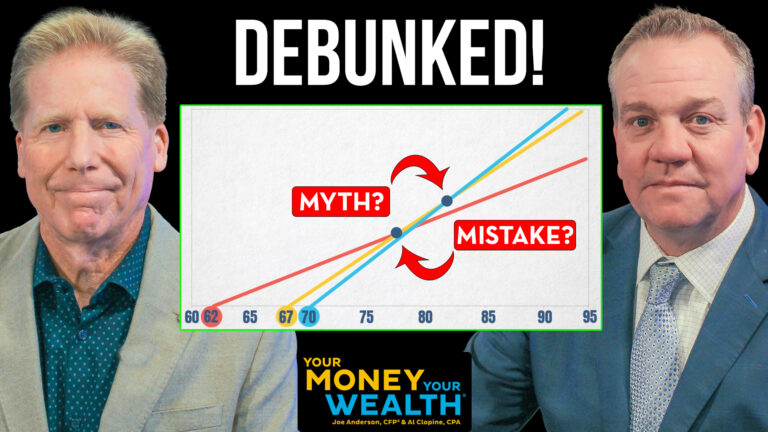
Joe: Hey, you probably heard it. Age 62 is the sweet spot for retirement. You’re old enough to collect Social Security and young enough to enjoy it, but retiring at 62: will it actually set you free or could it set you back?
Welcome to the show, everyone, show’s called Your Money, Your Wealth®. Joe Anderson here, CERTIFIED FINANCIAL PLANNER® President of Pure Financial Advisors and I’m with the big man, Big Al Clopine.
Al: Morning Joe. How you doing?
Joe: Good. How are you Big Al?
Al: I couldn’t be better.
Joe: 62.
Al: Let’s do it.
Joe: All right. Retiring at 62. Great idea or huge mistake? We’ll help you run the numbers, find the solutions, expose the risks to determine if 62 is right for you. That’s today’s Financial Focus.
Hey, join the crowd folks. Look at this. 2024. The average retirement age was good old 62, but retirement is not about a number. It’s about a formula and let’s bring in the big man to help us break it down.
Al: Alright, so you wanna retire at 62. I think a lot of people do, right? So you gotta prepare. You gotta know what the risks are, and most importantly, what are the solutions? How can you get it done? Because a lot of people are retiring at 62 and a lot of people wanna retire at six, at 62, Joe.
Joe: Yeah. Let’s dive in. Let’s get into this right away. Prepare, what are the things that you gotta be thinking about? First off is longevity. 30% of male, 42% of females that are age 62 are gonna live to the age 90. And I think these numbers even come out further if they’re married.
Al: Yeah. So if you look at two lives together, it’s more like 50% at to age 92. So I guess the point is you’re 62 years of age. You gotta plan for a long retirement, which is actually a great thing, but also it means you have to plan for it.
Joe: Yeah. The good news is that we’re living longer. The bad news is that 25 to 30 years of retirement, that’s almost a third of your life that you’re going to have to create your paycheck. Do you have a strategy in place to make sure that you can live the lifestyle that you want for 25 or 30 years?
How Much Money Do You Need to Retire at 62? Social Security, Income and Budgeting
Al: And Joe, I think you start like, you know, at 62, just a little reality check. How much money do you need? And this is kind of just a rough number. This is by Smart Asset. So what they’re suggesting is 62, you should have 14 times your income, right? So if your income’s $115,000, Joe, you should have about $1.6 million to live the same lifestyle.
Joe: So if I’m 62 and I don’t have this, it’s like, all right, how can I bridge the gap? There’s Social Security of course, so we could claim as early as 62, or you can wait until age 70 and Al, I think there’s pros and cons to any age in between here. 62, just grab it when you can get it, you’re going to have a reduced benefit, but if I can hold off a little bit, that’s great too because I get a lot more money. But if you need the money, I would take it. If you don’t necessarily need the money, you might wanna delay.
Al: Yeah, I think that’s right. So that’s probably the best way to say it. If you need the money at 62, you’re not working, go ahead and take it. But if you’re still working, wait. ’cause every month, every year that you wait, you get a higher benefit. And if you can wait all the way to 70, it’s quite a bit larger benefit,
Joe: Even though the studies say. Hey, take it at 70. Still, people are claiming it a lot earlier, and I think the reason for that is that we feel comfortable with some sort of fixed income coming into our checking account. We don’t necessarily like to sell all of our investments, and plus your distribution rate when you start selling your investments to create that additional income is gonna be a little bit less. But I think the strategy here is just to figure out what’s appropriate for you and your spouse if you’re married. And I think that goes with the budget.
Al: It does. I think that’s kinda where you gotta start this. In addition to the income, look at your expenses. So you may have spending that you’re doing during your working years. Maybe it’ll be the same or different, in some cases even more. ’cause you wanna go on more trips. But take a look at what your needs are, what you have to spend each month, and then your wants. You gotta separate those two. And the reason is because some years the market’s great, so you can distribute more. That’s great. You can do those bigger trips. But when the market is down, you don’t necessarily wanna be taking a big distribution. It’s hard to catch up, you know? And also, Joe, you gotta figure, you gotta plan for one time expenses. ’cause they come up.
Joe: Yeah, the AC goes out and then the roof. And I think that’s why you wanna also make sure that you have an emergency fund just so you don’t wanna sell stocks when the markets are a little bit bananas, or if you have to sell a little bit more that you still have some cash on hand. And then just understanding your debt control, the debt, of course, to make sure that hey, everything is kind of in line in regards to your overall budget. But I think the next step, Al, is to looking at, all right, now I have my budget. I know my needs and wants, and maybe some extra cushion for emergency or one time or two or three time expenses. Now it’s just figuring out where that income’s coming.
Al: That’s the other side of the equation. So take a look at what you have, right? Social Security, we just talked about that. When are you going to take it? What’s gonna be the best time for you if you’re married, maybe one spouse takes it early and one spouse takes it later. There’s pros and cons in all of that. Take a look at that. IRA, 401(k). You’ve been saving for years and years. Now is when you’re gonna start using it. That’s why you’ve been saving it. You use it in retirement. You may have Roth accounts, and if you’re fortunate enough to have a pension plan, Joe, that’s even better.
Joe: Yeah, I think the biggest equation of all though is that you gotta still find your purpose. I don’t care how much money that you have, how much money that you’re spending, and everything lines up perfectly mathematically, but still 33% of people, you know once you retire, it’s like, now what? You know, some people are more busy in retirement than they ever were when they were working, but a lot of people enter retirement and it’s like, now what do I do? I get bored or maybe I lose a sense of self. My social circles are gone because those were my buddies at the office or at work. So I think being mentally and emotionally prepared ’cause it’s a huge step.
Al: And Joe, I think that’s, you’re kind of equally it as important to think about that. I think about my dad years ago when he retired. He was volunteering. He was in a coffee group doing this and that, and he told me, he said, I need to retire because I’m too busy to work. And I think if you have that attitude, you’ve got so many things that you wanna do, you’ll probably have a much more successful retirement than someone that has no idea.
Joe: Retirement’s not a finish line. It’s a transition. The question isn’t when you’re going to stop working. It’s how are you gonna live your life? Once you do, let me help you with that vision. Go to YourMoneyYourWealth.com, click on our Retirement Readiness Guide. Create that clear vision of what your life is gonna look like when you actually retire. It’s not a finish line, it’s a starting line. To retirement, go to YourMoneyYourWealth.com. Click on that Special Offer. We’ll be right back.
Andi: Can’t get enough Joe and Big Al? Follow us on the Your Money, Your Wealth® podcast in your favorite podcast app and on YouTube. Visit YourMoneyYourWealth.com and click Ask Joe and Al On Air to get a Retirement Spitball Analysis.
Joe: Alright, we’re talking about retirement at 62. Great idea or big mistake? You know where to go. Go to YourMoneyYourWealth.com. You gotta figure it out. You gotta get a plan in place. Get our Retirement Readiness Guide. Are you ready to retire at 62? Go to YourMoneyYourWealth.com to figure it out. Hey, let’s see how you did on that true false question.
Al: 5% of Americans have a million dollars saved for retirement. True or false? Good question because a lot of us here, we need a million dollars or more for retirement, but if only 5% of us have it. Joe, what do you think?
The Biggest Risks of Retiring at Age 62
Joe: That’s a negative. Less than 5% have a million dollars saved for retirement. And this is one of the biggest risks, right? Because we wanna retire, we run the numbers, and a lot of times it’s like, yeah, you need a million, million five, 800,000. And a lot of people don’t necessarily have that type of capital, but they might be spending dollars that will potentially have them run out.
Al: But yeah, how much do we have? I mean, look at this chart and you know, you look at a 45 to 54-year-old, they have about $115,000. That’s the median. If you forgot what this is in your math class when you were younger, median is half the people are above. Half the people are below, but 65 to 74. Couple hundred thousand dollars. Now that’s a lot of money, but is it really enough to retire in the lifestyle that you want?
Joe: Yeah, 65 to 74 200,000. That’s roughly $8,000 to $10,000 a year of income.
Al: Not much income.
Joe: Yeah, not a ton of income. Even though $200,000 is a really large number. Here’s another risk. Inflation. So let’s say you have $500,000 saved. What is the purchasing power of that 500,000 10 years later as you’re going through retirement with 3% inflation, $371,000?
Al: That’s not good. And that’s why you don’t put the money in the mattress. You need some growth, right? You need a, at least a savings account, if not stocks and bonds portfolio.
Joe: Here’s another huge risk at retiring at 62: Healthcare Gap. Medicare comes in at 65, so if you’re looking at retiring a little bit earlier, right? What do you do? Do you get private insurance? You go to the Affordable Care Act, you can get on corporate for a little bit.
Al: So if you retired 62 or before 65, you’re going to have to pay that insurance. Now, if your employer, typically they have health insurance and you have COBRA, that can last for 18 months, but you gotta pay for that as well, so you just have to add it to your budget.
Joe: Yeah, I mean, it’s a pretty expensive, it’s another a thousand, $2,000 a month, you know, depending on what type of insurance that you want. So you gotta add that back in. Here’s another sequence of return risk, Al.
Al: Yeah, that’s a tricky one. And so basically what that is talking about is what is the market going to do right after you retire? Hopefully. It’s going up and you’ll have a much better retirement experience, but if you happen to retire and the market crashes or goes down significantly, it makes it much harder to recover.
Joe: I think sequence of return risk is one of the biggest dangers that people have as they approach retirement. Because look at David and Annie here. They’re gonna retire. They have the same goals, they have the same money as they’re starting out, but there’s a little bit of luck involved here. David has some bad luck and she’s got some good luck.
They start with roughly a million dollars. They wanna spend $50,000 a year. They want to increase that $50,000 with a little bit inflation, and we can assume an average rate of return, let’s say starting here. For this time period at 6%. So this is the danger of some financial planning software too, or if you’re playing with calculators at home, because an average 6% rate of return is fine as you’re accumulating wealth because you’re not taking dollars out.
But once you start taking dollars out. This 6%, some years you could have 20%. Some years you could have negative 15. So it really depends on what happens with the market, especially in your first few years of retirement as you’re taking dollars out. Unfortunately, David here, he hit a bear market when he retired.
He still averages 6%, but he was taking that $50,000 out. Let’s just say that market declined 15% over that three year period. It’s very difficult for David to recoup the principal amount because he was taking the 50 plus, lost a little bit of growth or lost a little bit of capital because of the market decline, and on, on the other hand, had a little bit of a bear, a bull market.
So she gained some capital as she was taking those dollars out, and guess what? She didn’t really have any sleepless nights where David probably had quite a few sequence of return. Risk is a huge risk. That’s why you need to have a true strategy. As you’re taking dollars outta the portfolio,
Al: Joe and that’s why we talk about the expenses. You know, take a look at your needs and your wants, expenses that you have to pay regardless of the market, but your wants. There’s another category like vacations and things like that. So when there is a bear market you scale back. You’re just paying your absolute ne necessity expenses and you’re not paying the other ones.
Joe: Taxes is another one, right? Because, hey, I have my living expenses. If tax rates go up. My cost of living goes up too because I have to pay Uncle Sam. It all depends on where the money’s held. If it’s all in these 401(k)s and IRAs, it’s all tax ordinary income.
Al: Yeah, that’s right. And I think a lot of people don’t really think about that. So you gotta have a tax strategy in retirement, just like you do during your working years. And that’s right. IRA 401(k), unless it’s in a Roth. Side, it’s fully taxable as ordinary income. It’s taxed the same way as a paycheck, except you don’t have to have Social Security withheld and realize this. For some of you that have done pretty well in your IRA, 401(k), you have to start taking money out. Currently at age 73, that’s gonna go to age 75 in a few years, but you have to take money out whether you want to or not.
Joe: Here’s an interesting chart because I, I think a lot of us don’t really know how much money that we can actually pull out to have a sustainable portfolio. This is from Morningstar. This is high level, but it will at least give you some guardrails as you’re taking distributions. So let’s just assume you have a 50% waiting in stocks versus bonds. So 50% of the portfolio stock, 50% in bonds. We have a 90% success rate, but if depending on how much money that I’m pulling out, if you pull out 9% on outta your portfolio, you have a hundred thousand dollars, you’re pulling out $9,000, or you have that million dollars and you’re pulling out almost $95,000 a year to live off of, Hey, I have a million dollars, 95,000. We’re in good shape. If you did that. There’s a 90% probability that, alright, you can make it 10 years, but I don’t know about 11. If I have a 20 year timeframe, that’s that 5%. 30 years, 3.7, that’s where we get that 4% rule. So understanding how much money that you take out, I think is huge.
Al: People get confused, Joe, because they think they, the rate of return, you know, stock market on average earns 8%, 9%, 10%, whatever it may be. And so they think they can pull that amount out and that’s not the case. ’cause it doesn’t earn that every single year sequence. The return risk. And so just be careful. The distribution percentage is gonna factor into how long your money’s gonna last.
Joe: Hey, I get it. It’s a lot to juggle, but don’t worry, none of these are deal breakers. You just need a strategy and to help you with that strategy, go to YourMoneyYourWealth.com. Click on that Special Offer. It’s our Retirement Readiness Guide. Are you ready for retirement? Do you have your strategy? Go to YourMoneyYourWealth.com. Click on that Special Offer and get ready for retirement. Hey, coming up next, we’re gonna get into those solutions, so don’t go anywhere. We’ll be right back.
Andi: Sign up for our free assessment online at PureFinancial.com or call 866-876-7873 to schedule your appointment.
Retirement Solutions That Make 62 Work
Joe: Hey folks, welcome back to the show. We’re talking retiring at 62. Great idea? Huge mistake? I don’t know. We have the solutions though, but before we get in those solutions. Let’s see how you did on that true false question.
Al: You’ll need enough savings to replace 80% of your pre-retirement income. True or false? That, that’s basically a true statement. And if you look at a lot of publications, that’s what they’ll tell you. The way that they get that figure by the way, is you look at your income now, you no longer are gonna have Social Security, so there’s less taxes on that part, and you’re not saving to a 401(k), 403(b). So that’s how they get the 80%. Is that the right number for you? Maybe not. Some of you wanna spend more because now you’ve got more time and you wanna retire. Some Joe by necessity will spend less.
Joe: Some of you might spend 180% of what you’re currently spending today in retirement. Some of you probably might spend 50%, not because you necessarily want to, because you have to, but I think the whole goal here, retiring at 62, good idea or huge mistake, is really understanding a. Is it 80%, 180? Or is it 50 to come up with that strategy to make sure that you know, but The Rule of 1,000 Al, this is a new one.
Al: It’s a new one. So here’s the way this works. So you got, let’s say $240,000. In this example, we’re assuming you’re withdrawing 5%, so that’s $12,000 a year. A thousand dollars a month, you feel like, okay, I got my thousand dollars a month, but do you really have a thousand dollars a month? And the answer is no because of taxes.
So you really have to consider where your savings is located. Is it all in retirement accounts that are gonna be fully taxable or maybe you’re fortunate to get some in a Roth? IRA Maybe got some outside retirement, Joe. They’re all taxed differently.
Joe: Yeah, no, that’s a really good point. And it’s if all the dollars are here, then you have to budget or plan for ordinary income tax. If all your money’s here in tax free, such as a Roth IRA, guess what? There is no tax because you already paid tax on those dollars as you went in, but all of the growth grew tax free for you or taxable. You kind of paid your tax along the way, so you wanna be diversified in your strategy as you start creating the income that you need, right? This will stretch your dollars out. This could save you tens of thousands of dollars if you do this correctly.
Most often people have a lot of their money here. Over the years though, we’re seeing people. Are more educated, they’re getting more dollars in the tax free account, which is great because if all of my money is sitting in this tax deferred, I have very little control over my taxes because every dollar that I pull out is taxed at ordinary income. The more dollars I pull out, the more tax I’m going to pay. If something happens where I wanna buy. Different items, go on vacation, have a big purchase, and it comes from here. It could pop me into a higher tax bracket. And guess what? That RV that you bought or that vacation you took, cost you a lot more than it needed to be if you were a little bit more tax sensitive in your strategy.
Al: Yeah, taxes are such an important part. And then creating income is another part. Of course, one thing you can always do is if your accounts, certain accounts have gone up, certain accounts haven’t done as well, the accounts that have gone up more than others. You sell a little bit of those to create some income, but there are other ways to think about income too. Maybe dividend paying stocks or bond ladders that have guaranteed income. Maybe Joe, you go, you gotta go back to work. Part-time work.
Joe: Yeah.
Al: And that’s that happens sometimes.
Joe: That’s the last thing I would wanna do, unless you really want to go back to work. ’cause you’re so bored. Here’s a real simple way to think about it too. Is that alright? Here maybe I just want a few years and cash. So, alright. I don’t care what happens to the market in three to five years. I have enough to cover my living expenses in cash, CDs, treasuries. So if the market fluctuates over that time period, hey, I know that I can count on my cash. Alright. And then maybe six to 10 years from there or maybe I have a little bit more balance. I want some growth here because I wanna fill up this cash bucket again, but. You know, you kinda look at it at a 10 year, 12 year timeframe. And then you have your growth bucket where, hey, I don’t need this money for 10 plus years.
So you can take on a little bit more risk. So this all boils down to again, what is your income, what is your expenses, what is the shortfall or the demand for the overall portfolio? And then it can help you put together a bucket strategy if you wanted to. People like to segment their cash. In different years. So they know that this segment, Hey, I don’t have to touch this for 10 plus years.
Al: So another way to think about this is spending, you can adjust your spending and probably should adjust your spending when the market goes down. Or if there’s a bear market, maybe this is not the year that you remodel the home or go on a nice vacation, maybe you pair back the expenses. So be flexible in your spending and. Above all, Joe, don’t panic sell.
Joe: Yeah, that’s the worst thing that you can possibly do. And I think what will help you, this is a process that you wanna make sure that you’re doing on an ongoing basis. It’s not a set it and forget it. Hey, I’m 62, I ran the numbers and I feel pretty good. Because things are gonna change throughout your life. Things are gonna change within the markets, and sometimes you want to stress test this thing and run different what ifs. What if the market drops 20%? Am I still on track? Am I still doing the things that I want to do, or am I going to freak out and sell?
If you have a strategy in place, you’re going to have more confidence, even though it is a scary time and you’re seeing those monies go down as you’re taking withdrawals. But if you have the right strategy in place. The confidence by running these different scenarios, knowing that, hey, we’ll be okay. What if inflation hits 6% or higher so the cost of goods continue to increase and you only plan on something a lot lower than that?
What is that gonna do to the overall portfolio? Are you still gonna make it? What if you live until age 93? We kind of talked about that the good news is that you’re living a lot longer. The bad news is that you got more years that you gotta cover your living expenses. So running different scenarios. Hopefully we’ll give you the confidence so you don’t panic sell when things go bad.
Al: Yeah. To me, that’s one of the most important things you can do when you’re planning your retirement is look at different scenarios so that you know you’re going to be okay no matter what happens.
Joe: Yeah, and Al we talked about this a little bit before, it’s finding that purpose again. It doesn’t matter if you have the best thought out plan, right? If you don’t have the purpose of what you’re going to do. And some helps is, you know, find some projects. Get in a routine, you know, and then also looking at your social connection. And there’s probably a ton more, but these are just some simple examples.
Al: Yeah. And I think, you know, when you break it down it’s probably volunteering or maybe it’s part-time work, or maybe it’s hobbies that you just haven’t had a chance to do. Or maybe you’re watching your grandchildren or your nieces and nephews, whatever it may be, whatever’s gonna get you excited to get out of bed in the morning. You do need some reason to get up every day.
Joe: Alright folks. Million dollar question, I don’t know. Retire at 62. Huge mistake or a great idea? It’s neither. It’s a choice, and that choice becomes great only if you’re informed. It’s tested and tailored to your specific situation. Find out for you at YourMoneyYourWealth.com. Click on that Special Offer. It’s our Retirement Readiness Guide. Get ready for retirement. And make those best decisions possible, YourMoneyYourWealth.com. Click on that Special Offer. It’s our Retirement Readiness Guide. For Big Al Clopine, I’m Joe Anderson. Hopefully enjoyed this episode of Your Money, Your Wealth®. We’ll see you next time folks.
IMPORTANT DISCLOSURES:
• Investment Advisory and Financial Planning Services are offered through Pure Financial Advisors, LLC. A Registered Investment Advisor.
• Pure Financial Advisors, LLC. does not offer tax or legal advice. Consult with a tax advisor or attorney regarding specific situations.
• Opinions expressed are subject to change without notice and are not intended as investment advice or to predict future performance.
• Investing involves risk including the potential loss of principal. No investment strategy can guarantee a profit or protect against loss in periods of declining values.
• All information is believed to be from reliable sources; however, we make no representation as to its completeness or accuracy.
• Intended for educational purposes only and are not intended as individualized advice or a guarantee that you will achieve a desired result. Before implementing any strategies discussed you should consult your tax and financial advisors.
CFP® – The CERTIFIED FINANCIAL PLANNER® certification is by the CFP Board of Standards, Inc. To attain the right to use the CFP® mark, an individual must satisfactorily fulfill education, experience and ethics requirements as well as pass a comprehensive exam. 30 hours of continuing education is required every 2 years to maintain the certification.
AIF® – Accredited Investment Fiduciary designation is administered by the Center for Fiduciary Studies fi360. To receive the AIF Designation, an individual must meet prerequisite criteria, complete a training program, and pass a comprehensive examination. Six hours of continuing education is required annually to maintain the designation.
CPA – Certified Public Accountant is a license set by the American Institute of Certified Public Accountants and administered by the National Association of State Boards of Accountancy. Eligibility to sit for the Uniform CPA Exam is determined by individual State Boards of Accountancy. Typically, the requirement is a U.S. bachelor’s degree which includes a minimum number of qualifying credit hours in accounting and business administration with an additional one-year study. All CPA candidates must pass the Uniform CPA Examination to qualify for a CPA certificate and license (i.e., permit to practice) to practice public accounting. CPAs are required to take continuing education courses to renew their license, and most states require CPAs to complete an ethics course during every renewal period.