More Posts
“Walter and Skyler” in Iowa ask if they’re on track to retire early, or if they’re just “cooking up overconfidence?” And how aggressively should they convert their retirement savings to tax-free Roth money before the pension and Social Security kick in? California Dreamin’ has it down to one decision: convert to the top of the 22 percent tax bracket, or push into the 24? “Mike and Carol” in Florida ask, when you’re weighing a conversion, should you be looking at your tax bracket, or your actual effective tax rate? Finally, is it worth the cost for “Westley and Buttercup” to use the brand new option to turn a big employer contribution into Roth money?
When Should You Do Roth Conversions?
Roth conversions may be appropriate in the low-income window after you retire, but before Social Security benefits, pensions, or required minimum distributions begin, when your taxable income falls into a lower tax bracket. For example, if you will be in the 32% tax bracket or higher later in retirement, converting to the top of the 22% or 24% bracket before fixed income begins can prevent much larger RMD-driven tax bills later.
Frequently Asked Questions
Q: When is the best time to do Roth conversions?
A: The window between retirement and the start of Social Security and required minimum distributions, because your taxable income is at its lowest. Converting then locks in lower tax rates before RMDs push your income into higher brackets at 73 or 75.
Q: Should I convert to the top of the 22% or 24% tax bracket?
A: Many retirees convert to the top of the 22% bracket and opportunistically reach into the 24% bracket during market downturns. A down market lets you convert more shares at a lower value, and the recovery happens tax-free inside the Roth.
Q: What’s the difference between my marginal tax bracket and my effective tax rate for conversions?
A: Roth conversions are taxed at your marginal rate, the rate on your last dollar of income. Your effective rate is your average across all income. The key question is what bracket your future RMDs will land in, since deferring now can mean a much higher marginal rate later.
Q: Should I move my pre-tax 401(k) contributions to Roth?
A: It depends on your current bracket and how much you’ve already saved tax-deferred. If you have little Roth and expect large future RMDs, shifting contributions to Roth or using a mega backdoor Roth builds tax-free balances. Some prefer the upfront deduction and convert later.
Q: Can I move bonus or RSU money directly into a 401(k) or mega backdoor Roth?
A: Not directly. You increase your paycheck contributions so more salary flows into the plan, then cover your living expenses by drawing from the cash you set aside from bonuses or vested RSUs. It routes that money into tax-advantaged accounts indirectly.

Roth conversions can either save you thousands in retirement taxes… or cost you thousands if mistimed. Learn the 10 Roth Red Flags to look out for! On this episode of Your Money, Your Wealth® TV, Joe Anderson, CFP® and Big Al Clopine, CPA show you common Roth planning mistakes that often get overlooked, how to […]

Today on Your Money, Your Wealth® podcast number 585, Joe and Big Al spitball for folks who are already winning and thinking about getting fancy with it. Reno in Oregon is 50, and his pension is so big he’s not sure how to invest or why he would need to convert to Roth. Michael is considering taking out a half-million-dollar margin loan to juice investment returns. What do the fellas think? Tune in for the surprising debate. Husker Fans just pocketed two million from selling their business, and here come the product pitches: should they buy annuities, set up a charitable trust, or just swallow the tax? What do the fellas think of whole life insurance? And finally, John and Lib on Waltons Mountain – or rather, the Catskills – aren’t sure if they’ve saved too little or too much. Can they bridge the gap until their pension?
Heidi from the Space Coast of Florida found a money-saving tidbit in a past episode that completely changed how she thinks about her financial advisor’s fee, and Joe and Big Al expand on the strategy. Laverne and Shirley have four million bucks, Roth conversion questions, annuity questions, and a retirement plan so detailed it may require a diagram. Finally, Bess and George from Pure Michigan are already retired, already on Social Security, and already losing sleep over their investments. So why are they so stressed? Joe and Big Al’s debate about a 1% advisory fee gets a little spicy in that one.
Joe Anderson, CFP® and Big Al Clopine, CPA spitball for people sitting on life-changing gains who are just one wrong move away from handing a third of it to the IRS. How should they diversify their concentrated stock positions? That’s today on Your Money, Your Wealth podcast number 583. First up, Walter’s a software engineer who got lucky 15 years ago. Now he’s got $1.6 million in company stock, and a retirement clock ticking down in six years. Richard from Staten Island listened to his son six years ago, went big on oil, saw a huge gain, and now 80% of his portfolio is in that one position. His custodian wants him to sell, but he’s not so sure. Finally, Doctors “Bones and Beverly” just discovered they’ll be inheriting millions still sitting in an old 401(k) loaded with company stock.
Half of Americans say they’re too nervous to invest, and the ones who do invest may still be leaving serious money on the table. Joe Anderson, CFP® and Big Al Clopine, CPA break down your investing psychology and exactly why your emotions are working against your portfolio, and what it actually takes to build the […]
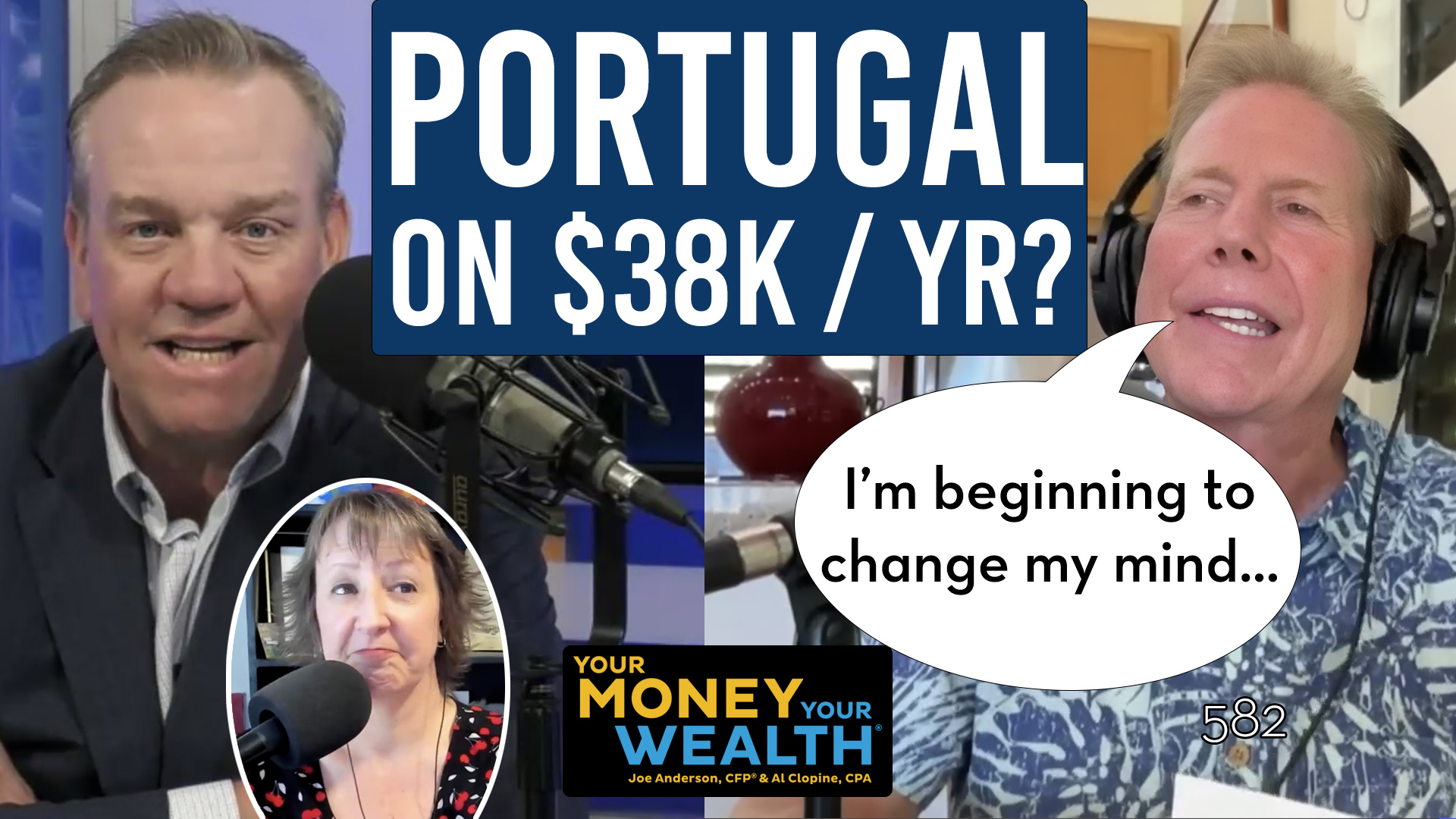
Joe Anderson, CFP® and Big Al Clopine, CPA address something a not-insignificant portion of this audience has been complaining about for years: their so-called ‘absurdly conservative’ safe withdrawal rates for early retirement. Rand and Elayne from Ohio are here to gripe about it directly with a thought experiment: a million bucks at age 36 and a three-year sabbatical in France. When, if ever, would Joe and Big Al say they should cut it short and go back to work if the markets turned ugly? Mike2me17 piles on, with his own SWR take about AUM fees in his Apple Podcasts review. But first, a real-world example: Ron and Harry from Florida are elite performers with a high-risk specialty job. Can they safely pull off moving to Portugal and living on $38,000 a year in their early 40s? If you’re one of the people yelling at your podcast app every time Joe or Al mentions a 2% withdrawal rate, today’s your day.
June in Washington State is 62 with $2.5 million saved and a $350,000 pension on the table. Should she take the lump sum or the monthly check for life? (Spoiler alert: there’s a 3-to-1 vote in the studio, and Big Al is the one.) Plus, how aggressive should “Homer and Marge” get with Roth conversions, and is it smart to pay the conversion tax from an inherited IRA RMD? Pompous Assets drops his big, fat wallet on the YMYW table next: with millions in tax-deferred and taxable accounts, why is his financial advisor fighting him on a Roth conversion? Of course, Joe and Big Al have some thoughts on the subject. Finally, Johnny Mercer in Georgia is eyeing an immediate income annuity and a MYGA. The fellas break down why that 7.5% “rate of return” might not be what he thinks.
This week Joe and Big Al are spitballing for some folks who’ve done the work, hit the numbers, but aren’t sure if they can really walk away yet. Martha in DC is 44 and says her soul is being sucked out of her body by her employer. When can she stop working full-time and foster puppies instead? “Bandit” is bullish on his company stock in archeology instruments, but not so much on his work itself. “Kevin” is staring down a wall of deferred comp and needs a spitball on how aggressive his and “Winnie’s” Roth conversion strategy should be before RMDs hit. Can both “Bandit and Chilli” and “Kevin and Winnie” call it quits this year?
Brian in New York and “Todd and Margo” in Utah each have over $3 million in their pre-tax accounts. What should their Roth conversion strategies look like, and can Todd retire this year? But first up, should “Captain Morgan” go Roth to avoid RMDs and can he retire in a couple of years? Should “Klo Jopine” contribute to Roth instead of traditional if his income will always remain the same? Finally, Kyle and Katie have high incomes and need a spitball on how they can avoid future RMDs. Ya think Roth conversions might be in their future? We’ll find out.
“Chase and Ryder” are 56 and 55 with $5 million saved and huge pensions the day they retire. So why are they so nervous about pulling the trigger? “Andy and April” are 46 with $2.4 million saved and 10 years until they want to retire. Can they get there, and do they need a trust? “Burt and Sally” are in their late forties with solid pensions and a retirement dream, but is the math close enough to make it work? Finally, does “Dolly” have any options for squeezing more out of Social Security when she and her spouse have identical benefits? She’s inheriting a brokerage account too, and wonders about the asset mix.
“How much do I need to retire?” Joe Anderson, CFP and Big Al Clopine, CPA hear this question all the time. Today on YMYW, they delve into a crucial aspect of retirement planning: determining how much you can spend in retirement without running out of money. Find out how to calculate a safe withdrawal rate, […]
Joe Anderson, CFP® and Big Al Clopine, CPA spitball on whether a popular early retirement strategy could actually blow up your financial plan, today on Your Money, Your Wealth® podcast number 577. Red and Kitty from Wisconsin are burned out at 40 and wonder if retiring at 45 using the 72(t) tax election to take substantially equal periodic payments, or SEPP, is a smart bridge strategy. Jiminy Billy Bob in North Carolina is also considering a 72(t). How should he structure his withdrawal order, and does he need to shift into bonds before downshifting his career? Plus, Steve and Sharon in Minnesota have 8 million bucks. Steve is getting laid off at age 56. What should they do with their 401(k), stock options, incentives, and benefits before and after the layoff?
Are Roth conversions worth it? We’ll find out, today on Your Money, Your Wealth® podcast number 576. TJ in PA is gonna have huge capital gains. Joe and Big Al spitball on whether it’s worth it for him to convert. Rebels Without a Gauze in New England are over 70. Is it too late for them to convert? How much should Biking Barnsey convert from his tax-deferred accounts to Roth each year, and are there any single ladies in the YMYW audience that would like to help him spend his retirement money? Finally, the fellas spitball on whether Zisi and his wife are being too aggressive with their conversion strategy.
Pure’s Director of Tax, Amanda Cook, CFP®, CPA, Esq, provides strategies and proactive planning techniques to help you make the most out of tax-saving opportunities in 2026. Outline 00:54 – Tax Return Basics 07:16 – Tax Rates & Tax Cuts Jobs Act 10:49 – New Deductions & Trump Accounts 15:24 – Charitable Contributions & Social […]