More Posts
Purefinancial

“Walter and Skyler” in Iowa ask if they’re on track to retire early, or if they’re just “cooking up overconfidence?” And how aggressively should they convert their retirement savings to tax-free Roth money before the pension and Social Security kick in? California Dreamin’ has it down to one decision: convert to the top of the 22 percent tax bracket, or push into the 24? “Mike and Carol” in Florida ask, when you’re weighing a conversion, should you be looking at your tax bracket, or your actual effective tax rate? Finally, is it worth the cost for “Westley and Buttercup” to use the brand new option to turn a big employer contribution into Roth money?
When Should You Do Roth Conversions?
Roth conversions may be appropriate in the low-income window after you retire, but before Social Security benefits, pensions, or required minimum distributions begin, when your taxable income falls into a lower tax bracket. For example, if you will be in the 32% tax bracket or higher later in retirement, converting to the top of the 22% or 24% bracket before fixed income begins can prevent much larger RMD-driven tax bills later.
Frequently Asked Questions
Q: When is the best time to do Roth conversions?
A: The window between retirement and the start of Social Security and required minimum distributions, because your taxable income is at its lowest. Converting then locks in lower tax rates before RMDs push your income into higher brackets at 73 or 75.
Q: Should I convert to the top of the 22% or 24% tax bracket?
A: Many retirees convert to the top of the 22% bracket and opportunistically reach into the 24% bracket during market downturns. A down market lets you convert more shares at a lower value, and the recovery happens tax-free inside the Roth.
Q: What’s the difference between my marginal tax bracket and my effective tax rate for conversions?
A: Roth conversions are taxed at your marginal rate, the rate on your last dollar of income. Your effective rate is your average across all income. The key question is what bracket your future RMDs will land in, since deferring now can mean a much higher marginal rate later.
Q: Should I move my pre-tax 401(k) contributions to Roth?
A: It depends on your current bracket and how much you’ve already saved tax-deferred. If you have little Roth and expect large future RMDs, shifting contributions to Roth or using a mega backdoor Roth builds tax-free balances. Some prefer the upfront deduction and convert later.
Q: Can I move bonus or RSU money directly into a 401(k) or mega backdoor Roth?
A: Not directly. You increase your paycheck contributions so more salary flows into the plan, then cover your living expenses by drawing from the cash you set aside from bonuses or vested RSUs. It routes that money into tax-advantaged accounts indirectly.

Roth conversions can either save you thousands in retirement taxes… or cost you thousands if mistimed. Learn the 10 Roth Red Flags to look out for! On this episode of Your Money, Your Wealth® TV, Joe Anderson, CFP® and Big Al Clopine, CPA show you common Roth planning mistakes that often get overlooked, how to […]
Pure’s Director of Education, Kathryn Bowie, CFP®, AFC®, breaks down the essentials of IRA planning and shares strategies to help you grow and protect your retirement savings. Outline 0:00 — Introduction & Overview 0:29 — Retirement Account Basics & Contribution Limits 2:53 — The Three Tax Environments 10:23 — Traditional vs. Roth IRA Differences 17:06 — Roth Conversion Strategy 19:59 — Savings Strategies by Life Stage 33:28 — Tax Reduction Strategies & RMD Planning 37:46 — Common Mistakes & Q&A Transcription: (NOTE: Transcriptions are an approximation and may not be entirely correct) Kathryn Bowie, CFP®, AFC®: Retire Smarter: IRA Strategies to Maximize Your Savings. Welcome, […]
June in Washington State is 62 with $2.5 million saved and a $350,000 pension on the table. Should she take the lump sum or the monthly check for life? (Spoiler alert: there’s a 3-to-1 vote in the studio, and Big Al is the one.) Plus, how aggressive should “Homer and Marge” get with Roth conversions, and is it smart to pay the conversion tax from an inherited IRA RMD? Pompous Assets drops his big, fat wallet on the YMYW table next: with millions in tax-deferred and taxable accounts, why is his financial advisor fighting him on a Roth conversion? Of course, Joe and Big Al have some thoughts on the subject. Finally, Johnny Mercer in Georgia is eyeing an immediate income annuity and a MYGA. The fellas break down why that 7.5% “rate of return” might not be what he thinks.

This week Joe and Big Al are spitballing for some folks who’ve done the work, hit the numbers, but aren’t sure if they can really walk away yet. Martha in DC is 44 and says her soul is being sucked out of her body by her employer. When can she stop working full-time and foster puppies instead? “Bandit” is bullish on his company stock in archeology instruments, but not so much on his work itself. “Kevin” is staring down a wall of deferred comp and needs a spitball on how aggressive his and “Winnie’s” Roth conversion strategy should be before RMDs hit. Can both “Bandit and Chilli” and “Kevin and Winnie” call it quits this year?

Brian in New York and “Todd and Margo” in Utah each have over $3 million in their pre-tax accounts. What should their Roth conversion strategies look like, and can Todd retire this year? But first up, should “Captain Morgan” go Roth to avoid RMDs and can he retire in a couple of years? Should “Klo Jopine” contribute to Roth instead of traditional if his income will always remain the same? Finally, Kyle and Katie have high incomes and need a spitball on how they can avoid future RMDs. Ya think Roth conversions might be in their future? We’ll find out.
Are Roth conversions worth it? We’ll find out, today on Your Money, Your Wealth® podcast number 576. TJ in PA is gonna have huge capital gains. Joe and Big Al spitball on whether it’s worth it for him to convert. Rebels Without a Gauze in New England are over 70. Is it too late for them to convert? How much should Biking Barnsey convert from his tax-deferred accounts to Roth each year, and are there any single ladies in the YMYW audience that would like to help him spend his retirement money? Finally, the fellas spitball on whether Zisi and his wife are being too aggressive with their conversion strategy.
Joe and Big Al focus on Social Security claiming strategies as part of the retirement spitballs, today on Your Money, Your Wealth® podcast number 574. Bijou Plutus and her husband in Massachusetts are 62 and 64 with about a million dollars. Can she retire at 65, and should he claim Social Security early? Dr. Jekyll and Mrs. Hyde in the Twin Cities have about the same at 51 and 49, plus big pensions and high spending. Can they afford to retire early, and when should they claim Social Security? Diggler and Roller Girl in Tennessee are 57 and 58 with about $600K, and Diggler estimates his Social Security break-even is at age 77. Can he collect Social Security early and simply work recreationally?

Juan and Mary in Brooklyn are 49 and 48 with $2.2 million saved. Can Juan afford to retire early, or just walk away if he gets fired? And if they get divorced, yikes – but does the math still work? That’s today on Your Money, Your Wealth® podcast number 573. But first, “Reuben Sailing Shoes” is 68, single, retired, and has $1.6 million saved, but he’s never had a budget in his life. How much can he actually spend? “Leslie and Ben” are federal retirees in their seventies with great pensions and a mix of pre-tax and Roth savings, and “Mork and Mindy” in Delaware are retired with an annuity, a pension, Social Security, and $1.3 million in an IRA. Joe Anderson, CFP®, and Big Al Clopine, CPA, spitball on how Roth conversions and RMD timing can help both couples minimize taxes and make the most of what they’ve got.
“Carl and Jane” have eight million bucks and their advisor is suggesting a 130/30 long-short investing strategy. Joe Anderson, CFP® and Big Al Clopine, CPA, spitball on whether this is a smart tax move or unnecessary complexity — and whether they would do it themselves. Plus, Tyrone and Tova think they may never even need their retirement accounts, so do they really need to bother with Roth conversions if the kids are going to inherit the money anyway, or could skipping the conversions mean losing half their retirement income to taxes? Mark in San Diego is juggling Roth conversions and Social Security timing without blowing up his tax bill, or the income-related monthly adjustment amount for Medicare, or net investment income tax. And “Boat Drinks” has a big non-qualified deferred compensation plan. How can he structure payouts before it turns into a tax nightmare – and before he potentially gets laid off?

When you’re standing at a major financial crossroads, the timing of your decisions can mean the difference between success and failure. Joe Anderson, CFP® and Big Al Clopine, CPA spitball on the “when” of five retirement decisions, today on Your Money, Your Wealth podcast number 569. We’ll kick things off with a whale of an email: “Fine and Dandy” is 42 years old with a multimillion dollar private equity offer on the table. Should he sell his business now or hold out for a second bite of the apple later? He also wonders if it’s crazy to spend more on his vacation home than on his primary residence. David calls himself an “elderly orphan,” flying solo at 66 and in need of a plan to protect his million-dollar portfolio as he ages. BB and Shell are trying to time their final year of retirement contributions to save as much as possible before moving to a lower-tax state. Should they go Roth IRA or traditional? Joel wonders when to take required minimum distributions from retirement accounts for the maximum tax benefit, and Brian in New York needs a spitball on when it makes sense to have an emergency fund as a retiree, and for how much.

Should Al and Peggy in Illinois keep hammering pre-tax retirement savings, or should they pivot to post-tax Roth for better tax diversification? Which pension option is best for their early retirement plans? Long-term care insurance premiums are going up endlessly for Eloise in Connecticut. Is she walking into an insurance industry trap? How do Eric and Tami in Baton Rouge help their kids with college without blowing up their own retirement, and when do student loans make sense? Finally, should Lana and Sterling harvest capital gains or prioritize Roth conversions before moving to a much higher-tax state? The basic question in all of these is the same: how do you protect your future from rising costs and unknowns that are out of your control?

“Mr and Mrs Smith” have nearly $850,000 saved at age 43, but they’re very concerned about retirement. “Lucy and Desi” are 58 and 64 with nearly $7 million saved, but they still lie awake wondering if it’s enough for their high-expense life. “Tony and Carmela” are in a similar boat with millions saved at 61 and 59, but they’re worried their asset allocation won’t get them through their retirement. No matter the numbers, the fears sound exactly the same: will you run out of money in retirement? Turns out overcoming that fear is not about hitting a magic number. We’ll find out what it’s all about, today on Your Money, Your Wealth podcast number 566 with Joe Anderson, CFP®, and Big Al Clopine, CPA. The fellas also spitball Roth conversions, long/short direct indexing capital gains tax strategies for “Juicy Squeeze”, working after retirement for Wendi, and how one confusing word can completely change a retirement timing decision for “Jacques and Johana.”
Hana’s mom is 92. Mom’s husband is 74, and after years of trying to help a family member, nearly a million dollars is gone. How do they stop the bleeding before it’s too late, and how much can they spend each year from what’s left? That’s today on Your Money, Your Wealth® podcast number 564 with Joe Anderson, CFP® and Big Al Clopine, CPA. Plus, “Peter and Gwen” from Virginia have a pension, Roths, and a shrinking IRA. With the new tax law, IRMAA, and Social Security decisions all colliding, should they keep converting to Roth, and when should they actually collect Social Security? Also, does it make sense for “Mr. and Mrs. Scarecrow” to claim Social Security early and invest it? Finally, “Rosie and Astro” from Pennsylvania ask if they can retire in just three years with $1.3 million, and whether it’s time to hire an advisor to help them get there.
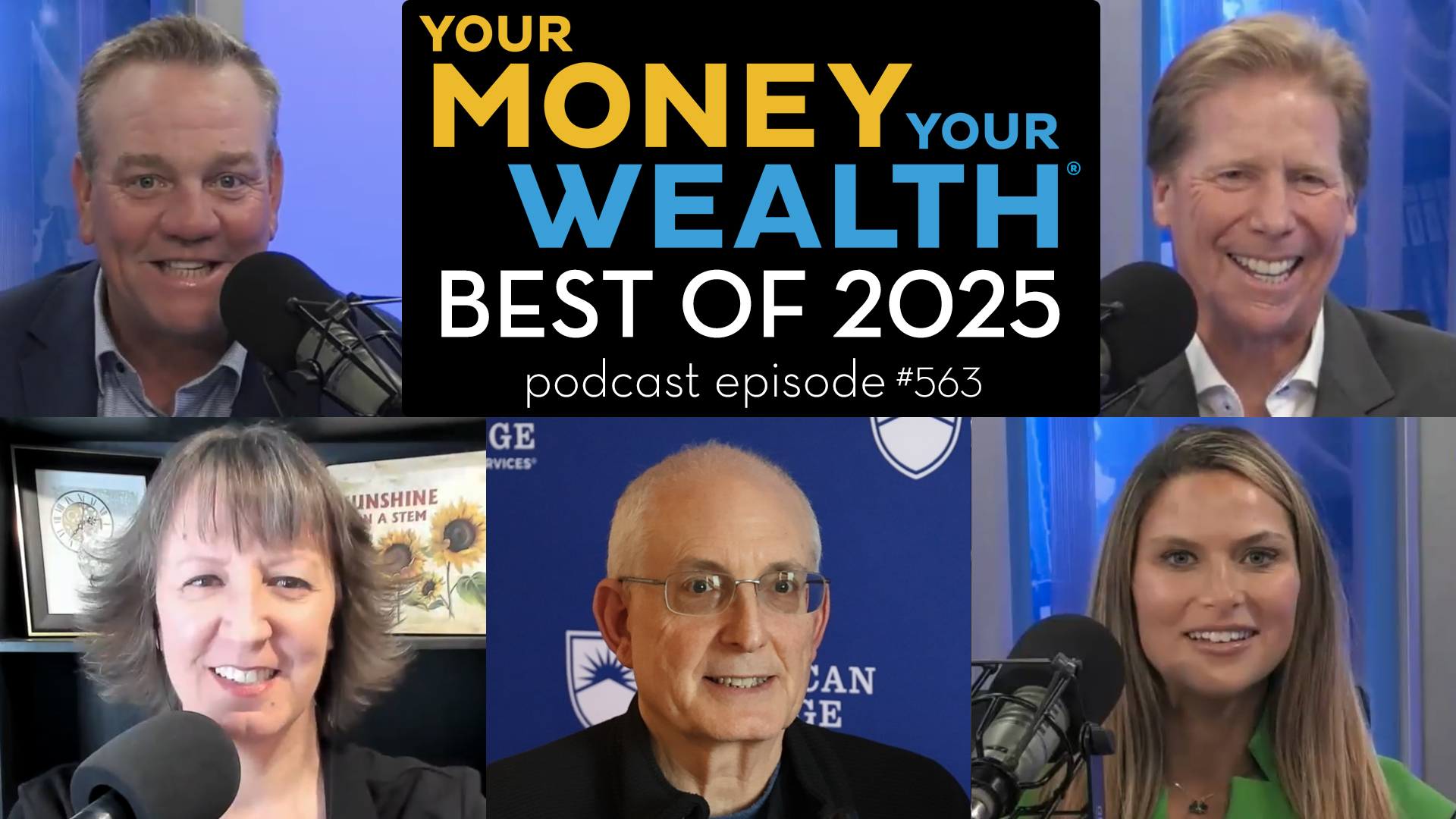
What actually mattered most to the YMYW audience in 2025? It turns out to be tax-free gains on investments, retirement timing, and claiming Social Security. In this Best of 2025 episode, Joe and Big Al break down the smartest tax moves, the biggest Roth mistakes to avoid, and how real people solve real retirement problems – with the help of some special guests. Find out when Roth conversions help or hurt, how to lower lifetime taxes for you and your heirs, what it really takes to retire confidently, even without a massive portfolio, and more. Watch or listen and steal the financial strategies that made YMYW’s most popular episodes of the year.