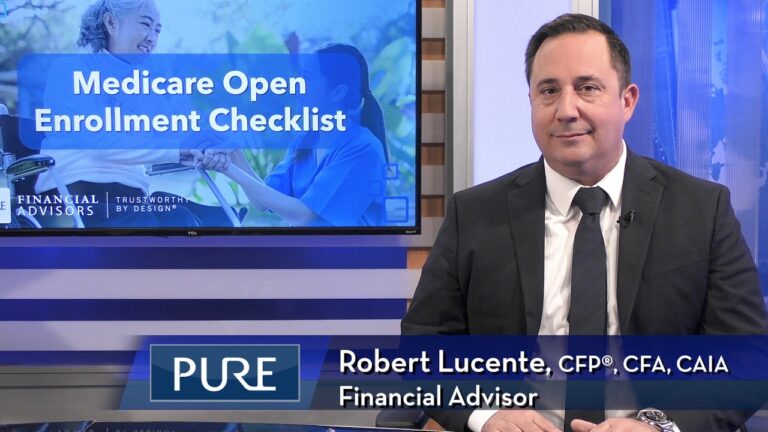
Pure’s Principal, Marc Horner, CFP®, reveals how to prepare for the income questions, tax surprises, and healthcare gaps that don’t wait for you to be ready.

Transcript
So when you make the decision to retire, your first instinct is often to tell everyone. Call the kids, tell your friends, maybe even post it online. My advice? Slow down. Research from the Employee Benefit Research Institute found that nearly half of retirees leave the workforce earlier than planned.1 So before you share the exciting news, you have to get three parts of your plan nailed down: your income plan, your tax plan, and your healthcare plan.
So let’s start with the foundation, and that’s your income plan. Locking in your income plan doesn’t mean hoping the math is gonna work out. It means you can point to exactly where every dollar’s coming from month by month. Which accounts fund your monthly spending? What fills the gap before Social Security starts?
What’s the order your accounts get used, and why does that order matter? Pulling from the wrong account in the wrong year isn’t just inefficient, it could permanently raise your tax burden, trigger Medicare premium surcharges, and accelerate how fast your portfolio might shrink. So before you retire, map out a written withdrawal order.
Which accounts come first, which you preserve, and why? A solid income plan doesn’t just protect your money, it protects your confidence. When that voice in your head asks, “Are you sure we can afford this?” You’re not guessing. While you’re working, taxes, they’re pretty simple. Your employer withholds them, and you pretty much move on.
In retirement, your income could come from five or six different sources, and all may be taxed differently and interact with each other in ways that could push you into higher brackets. There are three specific tax planning topics. The first is Social Security. A lot of people assume their Social Security benefit is theirs, free and clear.
But depending on your combined income from all the other sources, up to eighty-five percent of your benefit could be taxable. For married couples filing jointly, benefits can begin to be taxed when combined income exceeds thirty-four grand, and up to eighty-five percent becomes taxable above forty-four grand.2
If you’re pulling from a traditional IRA and turning on Social Security at the same time without a plan, you may be handing a significant portion of that benefit straight back to the IRS. The second trap is IRMAA, income-related monthly adjustment amounts. These are Medicare surcharges, and they’re based on your income from two years prior.
A single large withdrawal today, maybe a Roth conversion, a property sale, an unexpected distribution, can raise your Medicare premium two years from now. Those surcharges begin for individuals with modified adjusted gross income above a hundred and six thousand or two hundred and twelve thousand for married couples filing jointly.2
The third is the ripple effects from poor RMD planning. Starting at age seventy-three under Secure 2.0 Act, required minimum distributions force taxable income whether you need the money or not. If your RMDs are large enough, they can push you into higher brackets, trigger higher Social Security taxes, and activate IRMAA surcharges all at once.
So what does tax planning look like? You forecast your retirement income from all those sources. Forecast the role of Roth conversions, when and for who Social Security turns on, the impact of RMDs. If you haven’t looked at all three, you don’t really have a tax plan, and you’re set up for more of a tax problem.
Healthcare is the third piece. Employer coverage ends the day you retire. But Medicare doesn’t start until age sixty-five. So if you’re retiring before then, you’ve got a gap, and potentially a multi-year gap. Now, a lot of people, they default to COBRA because it’s easy and familiar. Unfortunately, that’s usually the wrong move.
According to Fidelity, the average employee pays about $114 per month for their health coverage while they’re working, because their employer is covering the rest of the monthly premium.3 The moment you go on COBRA, that math flips. Now you’re paying the full premium plus a 2% administrative fee. Here’s what most people don’t realize.
Retiring can actually work in your favor on healthcare if you plan for it. When you stop working, your income drops, and that drop in income could make you eligible for ACA marketplace subsidies that weren’t available while you were earning a salary. Credits that can significantly reduce your monthly premium.
So if you’re within two years of retirement and maybe you’re not certain that all three of these are actually locked in, that’s exactly what our no-cost financial assessment is designed to figure out. Here’s what I want you to take away from this. Retirement doesn’t get easier to navigate after you announce it.
The income questions, the tax surprises, the healthcare gaps, those don’t wait for you to be ready. But the people who enter retirement with confidence are usually the ones who built a plan first.
Sources:
-
EBRI. “2026 EBIR/Greenwald Retirement Confidence Survey.” February 2, 2026.
-
IRS. Publication 915.
-
Fidelity. “What is COBRA coverage and how does it work?” September 25, 2025.
Subscribe to our YouTube channel.
IMPORTANT DISCLOSURES:
- Investment Advisory and Financial Planning Services are offered through Pure Financial Advisors, LLC, a Registered Investment Advisor.
- Pure Financial Advisors LLC does not offer tax or legal advice. Consult with your tax advisor or attorney regarding specific situations.
- Opinions expressed are subject to change without notice and are not intended as investment advice or to predict future performance.
- Investing involves risk including the potential loss of principal. No investment strategy can guarantee a profit or protect against loss in periods of declining values.
- All information is believed to be from reliable sources; however, we make no representation as to its completeness or accuracy.
- Intended for educational purposes only and are not intended as individualized advice or a guarantee that you will achieve a desired result. Before implementing any strategies discussed you should consult your tax and financial advisors.
CFP® – The CERTIFIED FINANCIAL PLANNER® certification is by the CFP Board of Standards, Inc. To attain the right to use the CFP® mark, an individual must satisfactorily fulfill education, experience and ethics requirements as well as pass a comprehensive exam. 30 hours of continuing education is required every 2 years to maintain the certification.