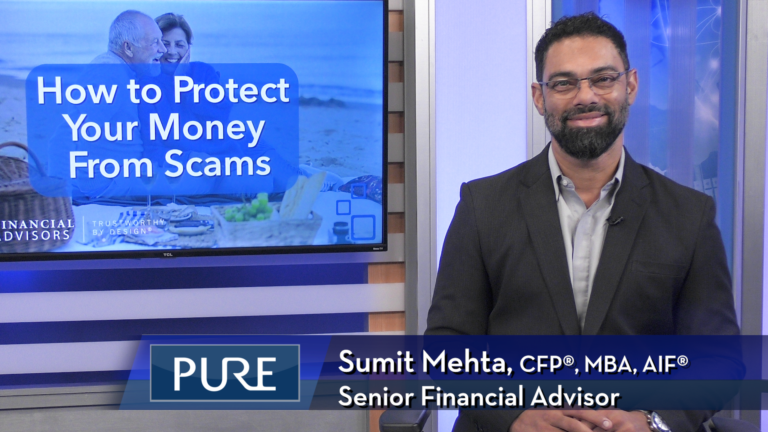
Pure’s Senior Financial Advisor, Michael Chipperfield, CFP®, AAMS®, AIF®, shares a few simple, consistent cybersecurity tips to protect yourself and your finances from scams, fraud, and identity theft.

Transcript
Your financial life is increasingly digital. Bank accounts, retirement plans, and investment portfolios are all accessible with a few taps, and that convenience also makes them a target. With Americans losing an estimated 148.2 billion dollars every year to online scams, cybersecurity is an increasingly vital aspect of financial security.1
The good news is that a handful of simple and consistent habits can help go a long way toward protecting what you’ve built.
Let’s start with your passwords. Every financial account should have its own unique password, because reusing one means a single breach can expose several accounts at once. Longer passphrases are generally stronger than short, complex ones, and a reputable password manager can generate and store them, so you don’t have to remember each one.
Next, turn on multi-factor authentication wherever it’s offered. This adds a second step, such as a code or an app prompt, before anyone can log in. Even if your password is compromised, that second step makes the account much harder to access. When you have the option, an authenticator app is typically more secure than a code sent by text.
Let’s explore fraud prevention next. Scammers often rely on urgency. A call, text, or email claiming there’s a problem with your account and pressing you to act immediately is a warning sign. Rather than clicking a link or calling a number in the message, contact the institution directly using the number on your statement or its official website. You may also want to freeze your credit with the three major credit bureaus, which prevents new accounts from being opened in your name.
Finally, round out your checklist with a few routine safeguards. Review statements and transaction alerts regularly, keep your devices and software updated, and avoid accessing financial accounts on public Wi-Fi. Many institutions also let you name a trusted contact they can reach if they notice unusual activity.
Protecting your finances isn’t a one-time task, so revisit this list periodically and check out our guide on identity theft to learn more about how you can make small changes that have a big impact on your financial security. If you have any questions, please reach out your advisor at Pure Financial. And if you’re new here, start a conversation today by scanning the code on your screen to take advantage of a free financial assessment.
Sources:
-
Consumer Federation of America. “The Scam Economy: The True Cost of Online Scams and Crimes in America.” July 28, 2026.
Subscribe to our YouTube channel.
IMPORTANT DISCLOSURES:
- Investment Advisory and Financial Planning Services are offered through Pure Financial Advisors, LLC, a Registered Investment Advisor.
- Pure Financial Advisors LLC does not offer tax or legal advice. Consult with your tax advisor or attorney regarding specific situations.
- Opinions expressed are subject to change without notice and are not intended as investment advice or to predict future performance.
- Investing involves risk including the potential loss of principal. No investment strategy can guarantee a profit or protect against loss in periods of declining values.
- All information is believed to be from reliable sources; however, we make no representation as to its completeness or accuracy.
- Intended for educational purposes only and are not intended as individualized advice or a guarantee that you will achieve a desired result. Before implementing any strategies discussed you should consult your tax and financial advisors.
CFP® – The CERTIFIED FINANCIAL PLANNER® certification is by the CFP Board of Standards, Inc. To attain the right to use the CFP® mark, an individual must satisfactorily fulfill education, experience and ethics requirements as well as pass a comprehensive exam. 30 hours of continuing education is required every 2 years to maintain the certification.
AAMS® – Individuals who hold the Accredited Asset Management Specialist℠ or AAMS® designation have completed a course of study encompassing investments, insurance, tax, retirement, and estate planning issues. Additionally, individuals must pass an end-of-course examination that tests their ability to synthesize complex concepts and apply theoretical concepts to real-life situations. All designees have agreed to adhere to Standards of Professional Conduct and are subject to a disciplinary process. Designees renew their designation every two years by completing 16 hours of continuing education, reaffirming adherence to the Standards of Professional Conduct, and complying with self-disclosure requirements.
AIF® – The AIF® designation, administered by the Center for Fiduciary Studies fi360, certifies that the recipient has specialized knowledge of fiduciary standards of care and their application to the investment management process. To receive the AIF Designation, the individual must meet prerequisite criteria based on a combination of education, relevant industry experience, and/or ongoing professional development, complete a training program, successfully pass a comprehensive, closed-book final examination under the supervision of a proctor and agree to abide by the Code of Ethics and Conduct Standards. Six hours of continuing education is required annually to maintain the designation.