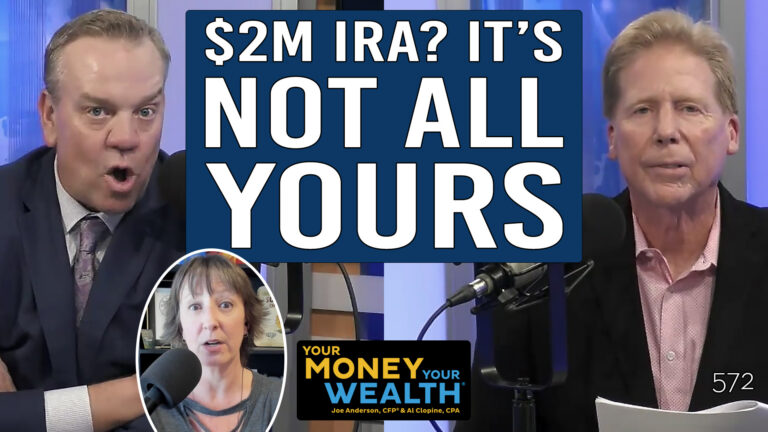
George in Torrance wants to know the smartest way to deal with the giant UGMA account set up by his kids’ grandparents. Suzanne in Detroit has a twist on the new 529 plan to Roth rollover rule. “Homer and Marge” need a spitball on whether they can build huge 529 plans for college savings and still retire early. Plus, Bill in Chicago just inherited a $950K IRA and needs a withdrawal plan before he triggers a tax explosion. Aaron in Cincinnati wonders whether maxing out his health savings account every year as part of his overall pre-tax contributions is a good idea. Carl in Western Maryland has questions about the required minimum distribution age and HSA rules, and wonders whether those who make the tax code are on drugs! And finally, Marc wants to know how to avoid the tax kaboom from $the 4 million sitting in his traditional IRAs at age 73.

Show Notes
- 00:00 – Intro: This Week on the YMYW Podcast
- 01:07 – Best Tax Moves When Your Kid Has a Huge UGMA Account (George, Torrance, CA)
- 06:23 – 529 to Roth Rollover or Midwifery: What’s the Smarter Play? (Suzanne, Detroit)
- 14:47 – Can $650K High Earners Afford to Build Huge 529 Plans and Still Retire Early? (Homer and Marge, No CA)
- 24:01 – Inherited IRA Withdrawal Plan: How Much Should You Take Out Annually? (Bill, Chicago)
- 31:23 – Should You Really Max Out Your HSA Every Year? (Aaron, Cincinnati, OH)
- 33:07 – Do You Take RMDs at 73 or 75? Was the Government on Drugs When They Came Up with HSA Rules? (Carl, Western MD)
- 38:07 – 73 With $4 Million in IRAs: What’s the Best Tax Strategy? (Marc, 92024 – Encinitas, CA)
- 39:31 – Outro: Next Week on the YMYW Podcast
Free Financial Resources:
DIY Retirement Guide – LIMITED TIME SPECIAL OFFER! Download yours by Friday, November 28, 2025!
Financial Advisors Expose the Internet’s Worst Retirement Strategies! – YMYW TV
Guides | Blogs | Educational Videos | YMYW Newsletter | Subscribe on YouTube

Watch today’s podcast episode on YouTube

Transcription
(NOTE: Transcriptions are an approximation and may not be entirely correct)
Intro: This Week on the YMYW Podcast
Andi: Joe and Big Al are defusing some of the most confusing tax time bombs out there, today on Your Money, Your Wealth® podcast number 557. George in Torrance wants to know the smartest way to deal with the giant UGMA account set up by his kids’ grandparents. Suzanne in Detroit has a twist on the new 529 plan to Roth rollover rule. Homer and Marge need a spitball on whether they can build huge 529 plans for college savings and still retire early. (They make $650K/year, by the way.) Plus, Bill in Chicago just inherited a $950K IRA and needs a withdrawal plan before he triggers a tax explosion. Aaron in Cincinnati wonders whether maxing out his health savings account every year as part of his overall pre-tax contributions is a good idea. Carl in Western Maryland has questions about the required minimum distribution age and HSA rules, and wonders whether those that make the tax code are on drugs. And finally, Marc wants to know how to avoid the tax kaboom from $the 4M sitting in his traditional IRAs at age 73. I’m Executive Producer Andi Last, and here are the hosts of Your Money, Your Wealth®, Joe Anderson, CFP® and Big Al Clopine, CPA.
Best Tax Moves When Your Kid Has a Huge UGMA Account (George, Torrance, CA)
Joe: It’s been a hot minute since we’ve all gotten together.
Al: Yes, I think you’re right. That’s a East coast term, I think. Hot minute. Really? I’d never heard that until someone from the east coast told me that. Oh, I was just in the East Coast. Oh, there you go. Okay.
Joe: All right. let’s get right to it. We got George from Torrance, California, right?
City. He goes, Hey, my kid’s grandparents. Okay, why doesn’t he just say My parents?
Andi: might be his wife’s parents?
Joe: yeah.
Al: he says that my kid’s grandparents. Then you have to really do some math here.
Joe: Let’s see, what does that mean? set up an UGMA account for our three kids for the purpose of education and the amounts currently around $275,000 each.
Great problem they have. Wow. The plan is to use it for whatever purpose they need to help them after high school, such as college education, investments, or real estate. My question is how do I minimize the tax implication as it comes out? Unified Gift to Minors Act?
Al: Yes. And it’s, it, Joe, it’s an account that’s set up for the kid For a minor.
For a minor, yeah. The parents are still on it. They, have to, once they hit age 18, then they can spend it, but in the meantime, it’s an account that it gets taxed on the kid’s return. and it’s under a, something called a kitty tax. And the way that works is the first $1,300 of income is tax free.
The second $1,300 of income is taxed at the child’s rate, which is typically 10%. And then anything over $2,600 of income is taxed at the parents’ rate. That goes on through age 18, 19 to 23. If you’re a full-time student, then you still are subject to the kitty tax, which means if it’s a lot of income, 275,000 will probably be a lot of income, I’m guessing.
Joe: what’s the, what’s the basis?
Al: Yeah, we don’t know. Yeah. Assuming they, is it capital gains, is it interest? What’s kicking out of it as well? What’s it invested in? Yeah. Yeah, exactly. So, so I guess, I guess the point is right off the bat to be, to minimize, first off you have to understand taxes.
It’s tax at the kids rate for a little bit of income and that the parents rate, once you know that, how do you keep it tax efficient? You invest in like tax efficient ETFs that are more growth oriented as opposed to bonds or CDs or something that kicks off a lot of income
Joe: if you have, if the grandparent set it up.
Is it still taxed at the parents’ rate or would it be taxed at the grandparents’ rate?
Al: parents’ rate
Joe: still.
Al: Still, it doesn’t matter. Doesn’t matter. Yep.
Joe: Okay.
Al: Yeah, so, and if there’s capital gains, then, and there’s an opportunity to tax less harvest for the kids, that could be another way to save some taxes.
But I think the most important thing is to try to be tax efficient with the investments, probably.
Joe: Yeah. I think, George, what you need to figure out is what’s the cost basis? And what I mean by that, how much money was totally invested in the accounts because it’s worth 275,000 today. Did they put $75,000 into the account?
I grew it 275. So now you have $200,000 of capital gain.
Al: Right.
Joe: Or did you reinvest the dividends on an ongoing basis and the dividend, you know, in your basis is maybe somewhere close to 200? Or was it all
Al: cash and then it was invested? Yeah, we don’t know.
Joe: Yeah. It could be all cash and never invested. Yeah.
So just think of it as your own investment in a sense. I mean, there’s some nuances in the tax, but it’s. It’s pretty small. This is a pretty large number, $275,000 in it’s UGMA account. I think the, largest UGMA account that I’ve seen in 25 years is probably 15,000. Yeah, I was gonna say 20, but not 205.
Wow. 75,000. So yeah, you’re right. It’s a good problem to have. Yep. It’s, but, until they reach age of majority, it’s gonna be taxed at this kitty rate, which is $1,600 of interest.
Al: Yeah. 1300 tax three,
Joe: 1300. Yep. Yep. But yeah, there’s no secret weapon here. There’s no, you know, trust that you can put it in or there’s no,
Al: yeah.
You know, I think the main comment is it’s a good problem to have and that’s true,
Joe: right? It’s just understanding of, What is it invested in on an ongoing basis? Can you reduce the interest kicking out or the dividends, or you just wanna be tax smart from an investment perspective, but because it’s in an UGMA, I mean, sometimes people are like, oh, is there.
Kind of a secret backdoor to get the money out. Yeah. Not really. Nope. So
Andi: now in his email, he says he’s thinking about being able to use it for investments or real estate. Is that an option with an UGMA?
Joe: Yeah. you could take it out and let’s say buy the kids a their first home. Got it. Okay. You could, it’s like a down payment or,
Al: yeah.
It’s not like a 529 plan where it’s only education. This could be used for anything. And once the kid hits 18, it’s their money. They can spend it on anything, which is why a lot of financial planners, us included, tell you to be careful with it because sometimes kids at age 18, they’re not quite responsible enough yet. Sometimes they are.
Joe: Yeah. And if you wanted to save for minors, you know, you can’t necessarily open up a brokerage account for like a 5-year-old. Yeah, It has to be in some sort of custodial account, so, yeah.
529 to Roth Rollover or Midwifery: What’s the Smarter Play? (Suzanne, Detroit)
Joe: All right. let’s go to Detroit. Okay. The Rock. Hi Joe Al. I’ll throw in your name Andi.
Andi: Thank you.
Joe: My daughter is an rn. All right. My sister’s an rn. Wow. Yeah. we assumed she would go away to college but commuted instead. And that resulted in as older funding her 529 plan. This year we did the first rollover of a portion of the 529 plan to her Roth IRA, leaving a balance of around $60,000 in the Schwab 529 account.
She has now decided to go for an advanced degree in midwifery. Let’s be a midwife. I think so, yes. Midwife deal again. they hope I
Andi: don’t, they help. Yeah. They help birth the baby child childbirth.
Joe: Yep. Is okay. Is that like an anesthetist?
Al: No. No. Is that the midwife helps the whole process of the birthing process.
You’re you, are you thinking about an anesthesiologist? No. If I said that No. Anesthetist,
Andi: anesthetist. is the person who actually puts you under when you’re having a procedure done. So that’s the person
Joe: that’s isn’t well, what’s an anesthesiologist? that’s what I thought you were trying to say.
Andi: I think they’re the same thing. I think an anesthesiologist and anesthetist are the same thing, and both of them are working at the head end to knock you out. The midwife is working, I think on the other end to help the baby come. They definitely work. What’s,
Joe: what’s the doctor or the medical profession that’s also has to deal with childbirth?
Andi: the obstetrician, yeah. Is the actual doctor.
Joe: There’s another term. there’s gotta be another person in there.
Al: Oh, OB GYN is the, no, not that one either. Yeah. that’s the doctor, but the midwife is the one that’s actually staying. Staying with you, making sure the doctor just goes the whole time.
Yeah, it goes in and out.
Joe: I was there before my sons birth. There was no one there the whole time besides me.
Al: Okay. you didn’t get a midwife then.
Joe: I guess not.
Andi: So a midwife job description includes providing care for women and their babies during pregnancy, childbirth, and the postpartum period.
Responsibilities range from antenatal checkups and education to monitoring during labor, delivering babies and offering postnatal support, like help with breastfeeding, et cetera.
Al: All right. the midwife we had was only the birthing process. That was it. Got it. You had a doula, is that what It’s a doula do.
I believe that’s
Andi: the actual name of the person that helps with the actual birthing process.
Al: Got it. Okay. this
Andi: was way TMI on birthing a baby.
Joe: I’m so glad. Still think I still think there’s something else. There’s something else. Okay. Anesthetist. I dunno. I think s right? I am. yeah. Alright. the cost of which is estimated to be $120,000 that will take three years to complete the current 529 plans is $60,000.
Would likely get her halfway home. My question for you is whether it makes sense to keep doing the match Roth rollovers each year from a 529 to potentially borrow b borrow more or stop the Roth rollovers completely. So she borrow borrows less. Oh boy. Yeah, it’s gonna be a long day. You’re thinking about midwives.
I know, for ba for background, she’s 25 and currently has a Roth of about $90,000 that she has funded herself with the exception of, the previously mentioned rollover. Also, what is your recommendation for where the 529 plan should be invested now that it’ll be used for the next few years?
We both enjoy a nice glass of wine once in a while. Red for me. White for her. Thanks for all you do. We’ve learned a lot, Suzanne. Alright, couple things. So let’s talk about the Roth rollover rules for the 529 plan.
Al: Yeah, so it’s a relatively new rule. So it, it, it states this, that if you’ve got too much money in a 529 plan, you graduate from college and you got extra in there.
The IRS allows you to roll up to $35,000 from a 529 plan into Roth IRA slowly,
Joe: it’s like a normal contribution per
Al: year. Yeah. It’s se 7,000 a year. or if you’re over 50, it’s 8,000 a year. Yeah. So that’s what you can roll up to a max of 35,000. But there’s a few caveats. F first of all, the 529 plan needs to have been in existence for 15 years, and you can’t roll over any contributions that have been made in the last five years.
So anyway, so it can be done. So that’s what the, she’s talking about
Joe: what the Roth needs to be in existence for 15 years, or it needs 15 years before the
Al: tax free treatment come out. No, The 529 plan needs to be in existence for 15 years and the. Contributions to the 529 plan, need to have been done five years or longer.
Got it.
Joe: Okay.
Al: Because
Joe: she, the, student’s only 25, the midwife. True. She’s 25. Yeah, So they must have started the 529 plan 15 years ago. So last year since she stopped working, she’s an rn, right? It was like, Hey, you’re $7,000. Instead of making a contribution out of cash flow, we could just take it from the 529 plan as long as she qualifies from an income perspective.
Yeah. She could put the money into a 529 plan, $7,000 or into the Roth IRA and let it grow tax free. Just like a normal contribution. But now the question is, hey, she’s going back to school. She needs to use the 529 plan. Should she continue to take money from the 529 plan to fund
the Roth or use the 529 plan for college tuition.Yeah.
Al: Use the 529 for college tuition. That’s what it’s for. Yeah. Yeah. And
Joe: continue to fund the Roth if you can.
Al: Yeah. With cashflow. Yeah. Yeah. With cashflow. But that’s what the 529 is for. It’s for college education. So stop the rollovers, pay for education. So you borrow less, you’d rather borrow less when it comes to college.
So that’s the whole point of the 529 plan so that you can borrow less. So yeah, I would stop that.
Joe: Yeah. I would stop the rollover, but I would want to continue to make the contributions. Yeah, she could do both. So if she’s gonna continue to work Yeah. Have earned income. If she can put, you know, she doesn’t have to max the plan out, but if she can continue to contribute into the Roth each year.
’cause she’s only 25, she’s got $90,000 in the Roth already. Pretty amazing. Yeah. That’s crazy. Yeah. So, you or if I was the parents, maybe you gift $8,000 in, into her. Roth IRA, for it because Yeah. I mean, those dollars will compound nicely.
Al: Yeah. You definitely wanna keep those going.
Yep, for sure.
Andi: All right. And did you answer, is it possible to any money that you’ve already rolled from the 529 to the Roth, can you roll it back
Al: to 529? No, I don’t think so. Okay. One way it’s actually, nice that it’s sent her Roth, but I’d stop it for now.
Joe: Yep. Three years. It’s gonna cost 120 grand.
I, that’s a tough one
Al: kid that she already has 60 though.
Joe: Yeah, she’s got 60 grand. But you put another, I don’t know, 21,000. She still has 40,000
that she has in the 529 plan.
Al: Oh, you changing your mind.
Joe: I don’t know.
Al: I wouldn’t, I would use the 529 plan for what it was intended for it, myself.
Joe: All right.
Andi: Stop the presses and get ready to start downloading. After a long absence, our DIY Retirement Guide is once again this week’s Special Offer. If you are trying to figure out how to build college savings without blowing up your taxes, or when to use an HSA the right way, or how to keep RMDs from lighting up your tax return, this guide is going to feel like someone finally turned the lights on. It is packed with so much practical, do-it-yourself retirement planning information, which we normally only make available in our retirement classes or one on one meetings. Stuff like:
– the five steps to plan your retirement income, starting with how to figure out where you stand today
– how to choose a tax efficient distribution method
– how to balance your income buckets
– how to protect yourself from retirement risks like inflation, market swings, and those tax surprises we all love so much.
There is even a quick retirement calculation worksheet in the back so you can find out if you are actually on track, or if you are just hoping for the best. (That’s on page 44, if you want to skip straight to the truth.) Click or tap the link in the description of today’s episode and claim the DIY Retirement Guide before the Special Offer changes sometime this Friday, November 28th. Go get it now.
Can $650K High Earners Afford to Build Huge 529 Plans and Still Retire Early? (Homer and Marge, No CA)
Joe: Homer and Marge.
Al: Okay.
Joe: You know, I saw something about The Simpsons on, I don’t know, social media that they had like episodes years ago that told the future.
Al: Oh, really?
Joe: It was like an episode 10 years ago. Were they predicted Donald Trump was president?
Al: Yeah.
Joe: It was like this was aired and it was way before he was ever running for president.
Al: Wow. So it became true.
Joe: Yeah. And then there was like some other like really weird stuff.
Al: So we should start watching it to see what happened in the future.
Joe: Not sure if that was fake news or, what? I’m not a big, not a big social media guy.
Yeah. But that, that caught my attention. Interesting. Are they still on the air?
Al: Yeah.
Joe: Oh yeah. 30 years, 40 years,
Andi: 37 seasons. They started in 1989.
Al: 89. Wow. Oh geez. I got married in 88, so my entire married life, I’ve been watching it.
Joe: Yes. all right, so let’s get back to Northern California. Joe, Big Al would love a little retirement spitball from you guys. My wife, Marge and I are both in our mid forties. We currently have two and a half million dollars saved in pre-tax retirement accounts, 401(k)s and IRAs.
We have two children, Bart and Lisa, ages eight and 13. Of course. That’s so cute. Yeah. We currently have a hundred in $5,000 in, 5 29 plans for Barts. For Bart in 180 in leases. That’s a lot of money in a 5 29. It sure is. A couple hundred thousand. The goal is to have 250 in each by college ages. What school do they want? What’s Bart’s not gonna go to Harvard. yeah. And Lisa will probably get a scholarship that, you’re probably right about that. That’d be a lot of money.
Al: that’s like heavy loaded 529 plans.
Joe: It sure is.
Al: That’s I assume they’re expecting outta state at an Ivy League.
Joe: Yep. Right, right. Neither one of us will have access to pensions in retirement and between us, we’ll get roughly $7,500 a month in Social Security.
My wife would like to retire between 50 and 55, and I’ll wait until 59 and a half. Our household income will be $650,000 this year. We currently spend $20,000 a month saving the rest. Our only debt is $730,000, still remaining on our mortgage at 2.8%, five years into a 10 year arm. Our home is currently valued at two and a half million dollars and with a couple of investments that should be paying off over the next few years.
Yeah. They anticipate paying it off with those investments. Yeah. So he is got a couple investments that he’s not sharing with us here, apparently. Yeah. Just little side deals. Yeah. They’re gonna come through, he’s gonna invest in what? Moe’s bar, wasn’t that his name?
Al: I think so. Yeah. I think you’re right.
Andi: Yeah. Moe’s. Yeah.
Al: I like Moe.
Joe: Yeah. We anticipate being able to pay it off by 2030. Okay. All right. In retirement, we’ll ideally like to be able to spend $20,000 a month in today’s dollars. All right. Okay. Been listening to the podcast for several months down and loving the show. I drive a 2020 Ram bought used.
I will drive into the ground. My wife drives a 2023 Toyota Highlander that was also bought and used. That will be driven into the ground. I enjoy beer. Lots of it sounds like Homer. Love a good Russian River IPA, or a little Sierra, Nevada Old Chico Wheat.
Al: Old Chico, maybe the town of Chico. I don’t know.
Joe: Okay. My wife loves a glass or two of pinot. Looking forward to what you gotta say.
Al: Okay.
Joe: Alright. They make $650,000 a year. They say they save,
Al: they didn’t really say how much,
Joe: so they, spend $20,000 a month. Correct. And they save everything else.
Al: yeah.
Joe: 200 4640. That’s 400 grand. A hundred some odd thousand dollars in tax, that still gives us $300,000 of saving maybe $250,000 of savings per year.
Al: yeah, they’re, fine. I, took, hold on. I’m just gonna call BS here.
Joe: I’ve, got less savings. I think there’s no way they’re saving everything else.
They’re spending more than 240,000 a year. I agree with that.
Al: Yeah.
Joe: Because everything is in the tax de report account. They have nothing in a brokerage account
Al: unless they just didn’t tell us they have Oh, is whole secret in business. Yeah. The ones is not sharing yet. Yeah, because it could be, it’s a little gray.
It’s a little gray. You know, all we can do is go with the, what he gave us. And so there’s a lot of assumptions in this one. So first of all, he says mid forties, so I’m gonna say 45 years old. Okay. Okay. All right. Then he says I’m saving the rest. it’d be helpful to have a number. Sure. But since we don’t, I got the income of six 40 taxes.
Joe: He’s out a number. Yeah. We spend about $20,000 a month. 240 a year. Doesn’t, he doesn’t. I’m receiving the rest. No, he’s spending more than $250,000 and he’s saving less than that. Or because there’s, gaps on the balance sheet. Could be the 3 million looks nice in a tax deferred account, but it does. If you’re saving several hundred thousand dollars a year or more than two, you can’t save
Al: $200,000 in a 401(k). No, it you’d have a bunch in the taxable. Again, maybe he does, he is just not telling us. But if you go with just his numbers, so I got six 40 income taxes, 200. Guess that. Expenses two 40.
savings 200. I just said one 50. Okay. Let’s say one 50. Alright, so 1 50, 15 years. If he wants to retire at 62.7 million right now, 6% he gets, to 10 million. Okay, let’s, just say 4% of that is. 400,000. if you two 40 doubles, the cost of that’s about right. At two 40, at 3%, 15 years is 3 73.
So with these numbers, it’s right, but that I have the same concern as you. I think he’s spending more than he thinks.
Joe: when you’re making six 50, you don’t pay that much. You’re not paying attention.
Al: That’s been our experience. It’s like, yeah.
Joe: How about, yeah. Oh, gotta take a budget. The guy that attorney was making $2 million a year had nothing, had his house and a 401(k) of 500,000.
Al: Yeah. It’s like, oh, we don’t spend that much. Yeah. We’re not lavish. Yeah. No, we, yeah, we save everything else. You might need to sell your home to retire. You don’t understand. I’m not selling my home. Oh. I guess you’re gonna work for until you’re 90. Yeah. Right.
Joe: Yeah, but that’s what happens. It’s that style creep again.
Al: It does. Yeah. Yeah.
Joe: That’s wrong.
Al: Yep,
Joe: Because they’re creeping that, they got, you know, but I don’t know. They got the money in the four. I don’t know, but I think they’re gonna be just fine based upon these numbers. Yeah. But that six 50 is the biggest asset I think they have.
Al: Yeah, you times that by another 15 years. Yeah. Yeah.
Joe: It’s, a lot. It’s a lot. And so, yeah, they have a few million dollars saved in mid forties. That’s great. But it’s $650,000 of income. He’s in the top 1% of all wage earners.
Al: Correct.
Joe: That’s giant.
Al: It’s, a lot.
Joe: So even 10 years at $6.5 million of cash flow.
Al: Yeah. Yeah. And yeah, there’s a lot to work with. There’s a lot to work. There’s also a lot to spend.
Joe: Yes. I think he could still have a very lavish lifestyle, do the things that he wants to do, drink lots of beer, run the man into the ground.
Al: He can stick with the Russian River IPAs.
Joe: He doesn’t have to switch to no Coors or Bud, even though Coors is probably better.
Al: you like it better, the Rangey Water IPAs or the Russian River? you
Joe: haven’t tried it.
Al: What? The Russian River IPA? Yeah. You don’t know.
Joe: I guarantee it. I would not like it.
Al: Maybe it’s the one IPA you would like.
Joe: I don’t know. I’ve had Sierra Nevada before.
Al: Yes. I, and it was No, you didn’t like it.
Joe: Yeah. Didn’t like it. I know. Have you, you haven’t found a single IPA that you like it’s headache?
Al: Yeah. For me it’s usually the next morning.
Joe: Yeah. But it free Coors light. You, I don’t have two of them.
Al: No, I,
Joe: you know what I’m saying?
Al: here’s, what I’ve learned over my many years. So I’ll have a hazy, IPA one, but then I’ll switch to Coors or Dosis or something like that.
Got it. And then I’m Okay.
Joe: Okay.
Al: if I have, three or four. Like remember that Marzen? That was awful. I took the day off.
Joe: Yeah. After. Didn’t we have a radio show stuff you to do it?
Al: We have some live broadcast.
Joe: Exactly. Big Al is out of pocket today. yeah. And the Marzen hangover. I, sort of forget what we had that day.
Al: I do remember the day you showed up at the radio station. Yeah. And said, Al, you’re gonna have to talk more today because I may not be able to.
Joe: It was Halloween
Al: and you, had a trashcan right next to you just in case. Keeps ago. The thing was like almost 20 years ago.
Joe: It was 20 years ago.
Al: Yeah, it was.
Inherited IRA Withdrawal Plan: How Much Should You Take Out Annually? (Bill, Chicago)
Joe: Hi, this is an open air question for Joe and Big Al. Okay. An open air question.
Al: Okay. we’ve got an open mic, so we’ll do it.
Joe: I’m Bill from Chicago. My wife and I are in our mid fifties. I drive a Honda CR-V.
Wife drives a Toyota Highlander, drink a Choices diet Coke and rum. Wife likes an occasional glass of red wine. We recently inherited an IRA following the passing of her father. He passed away four years ago. This year, we have to start taking our minimum distributions and have to deplete the account entirely.
In six years. There’s about $950,000 in the account according to the online calculators for inherited IRAs. My minimum withdrawal this year is approximately 35,000. That seems low. We want to empty the account in six years, we are barely in the 24% income tax bracket. How much should we take out every year to avoid the massive tax bill in the last year?
Should we limit our withdrawals to the amount that keeps us in the 24% tax bracket? The inherited IRA is a mix of tax bonds, mutual funds, but does it make sense to sell the stocks in the inherited IRA as some online experts recommend? If we need more help on this, then a Joe and Big Al spitball will provide, should we seek the help of a certified financial planner, an enrolleda agent, or an accountant? Love the show. Andi deserves a raise.
Andi: Thank you, Bill.
Joe: Alright. Okay. So Bill inherited an IRA from his wife’s father.
Al: Yeah. And he died four years ago. Four years ago, but they just got the IRA, maybe it was in trust, maybe with the beneficiaries of trust and trusted the RMDs.
Joe: He has not taken an RMD? No. ’cause it’s under the Secure Act and he was waiting to figure out like was he gonna deplete it in the 10th year?
Al: Yeah. Or maybe because there was that confusion, whether you’re supposed over the last take it or not. Maybe that’s what happened. Take it, not take it. But then now he passed way
Joe: over his arm because I think the calculator is probably calculating the required minimum distribution based on her father.
I don’t know how old her father was when he passed, because there’s these weird rules if he passed after his required beginning date, if it is already taking the RMDs. Yeah. Then you just continue, then you continue those RMDs. Yeah. If there wasn’t an RMD take and so they, he died prematurely. Yeah. Then you can hold onto the account until you year 10 if you want.
Al: Yeah, exactly. Yeah, I agree.
Joe: So then he is doing the online calculators. I don’t know what online calculator would give him a $35,000.
Al: Maybe died right after he started RMDs because $950,000,
Joe: 35,000, that’s like 4%. That’s not very much.
Al: Although of course, maybe the account’s grown a lot in the last four years, so maybe it was lower.
I don’t know.
Joe: I don’t know, but he’s right. It does seem low. Yeah. What I would do is I would empty the bracket that you’re in. If you’re in the 24% tax bracket, go to the top of the 24.
Al: Yeah, I agree. I would go to the top of the 24 every year and then that last year, maybe you got a little extra, you know, so be it. But you got most of it outta the 24. That’s you’re, you just got into the 24% bracket. So yeah, go ahead and use that. if you don’t do this, you do the 35,000 per year, you wait till year 10, you’re gonna be paying 32%, 35%, 37% plus state tax. You don’t wanna do that. So Yeah. Top of the 24.
Joe: I mean, if the account grows at three and a half percent a year, that’s around $35,000.
Al: Yeah.
Joe: So in his 10th year, he’s got $950,000 that he’s gonna have to take out.
Al: Right.
Joe: A lot of that is gonna be to taxed at the top rates.
Al: Yeah. By the way, the top of the 24% bracket for a married couple is, we’ll call it about 400,000, actually about three ninety five. So call it 400,000. So get your income to 400,000. Remember you get a standard deduction married of about 30,000. So your income could actually be about 430. And still stay in that 24% bracket. That’s what I would do every year.
Joe: Yep. 24% tax bracket, max that out. And then what experts would say, do not have stocks in an inherited IRA. Dunno, that’s a strange thing. So he doesn’t have to sell the stocks either. No, but let’s say you’re, he’s a hundred percent in the video, or pick any stock or stock mutual fund or whatever, you don’t have to sell the stock. You can just take out the shares and put it into a brokerage account. So I’m not sure what online pundits are telling you not to invest in stocks or-
Al: I’m wondering that too, or mutual funds. It’s not an inherited IRA all, I could think of is, maybe you want, you don’t want your growth in there because you have to pay more taxes. It’s like, I, yeah. If I have lots of money outside of retirement account, I would favor a non-retirement account or a Roth IRA. But if my choice is making more money or less money and I want, I’d rather make more, even though I’m gonna pay a little more tax, that’s-
Joe: he’s in his mid fifties. It’s an inherent irate. What? So once you get into retirement, he might be thinking about asset location.
Al: Maybe.
Joe: So then you look at asset classes and you want certain asset classes, like stocks versus bonds in certain accounts, depending on how much money that you have in different accounts. And it’s all about taxes. So if you have a Roth account, you don’t necessarily wanna put a lot of bonds in a Roth account because the growth is gonna be tax free. If I have a brokerage account, I’d probably want to have more stocks in my brokerage account than bonds and CDs because I’m taxed at a capital gains rate, which is a lot less than ordinary income.
So the bonds that I do hold in my overall portfolio, I would favor them more towards a deferred account versus a non deferred account. But I think an inherited IRA is a totally different animal because it’s not like for it, it could be for retirement, but he’s gotta deplete the account way before he even retire, before he retires his retirement age.
Al: Yeah, right, So I, yeah,
Joe: so you probably want to invest that very similar to your brokerage account. I would just journal the shares out of the, inherited IRA and throw it into my brokerage account. Yeah. Or if,
Al: you’d rather sell the shares and invest different, then no problem. Then invest in something else in your brokerage account.
It’s doesn’t matter. Yep. Thanks Bill.
Andi: We’ll get back to required minimum distributions in just a couple questions, but wow – Bill actually saw finfluencers telling folks not to invest in stocks?! What about all the other terrible money tips that floating around online? You search one thing about retirement, and suddenly the internet thinks you need to refinance your home, buy crypto from a guy in sunglasses, and stop investing in mutual funds. So yes, it’s getting weird out there. Which is why you need to watch the brand new episode of YMYW TV called, Financial Advisors Expose Internet’s Worst Retirement Strategies. Joe and Big Al walk you through one thing you should absolutely stop doing right now, and then they break down thirteen more viral trends, risky shortcuts, and so-called strategies that look tempting, but can cost you big time – with simple steps to protect yourself so you don’t fall for YOLO investing, hot stock picks, dead equity tricks, or any of the other nonsense the finfluencers are peddling. Click or tap the link in the description of today’s episode to watch Financial Advisors Expose the Internet’s Worst Retirement Strategies, and tell us in the YouTube comments: what is the worst financial advice you have ever seen online?
Should You Really Max Out Your HSA Every Year? (Aaron, Cincinnati, OH)
Joe: Okay. Let’s go to Cincinnati, Ohio. Hi, Joe, Al, Andi. I have what I hope is a simple question. Given that monies in an HSA can be withdrawn after age 65 with no penalties for non-medical related expenses, can it be withdrawn tax-free for medical expenses at any time? Is there any good reason not to max out an HSA contribution every year and just treat the contributions as part of our overall pre-tax contribution bucket? Okay. HSA, health savings account, so he’s putting dollars into the health savings account. He’s maxing that out. He wants to know, alright, at age 65 and actually, you would have to roll it into an IRA to get the dollars out of there for any reason.
Al: Yeah, for any reason. But I think the rule is this, if you have a HSA plan, then you can use those dollars at any age for medical purposes that, so that’s what it’s for. You get a tax deduction going in and it comes out tax free. So that best of all worlds right now, if you have it, still have an HSA account and you reach age 65, you actually can pull the money out. But then Joe, it’s just, it’s like an IRA,
Joe: right?
Al: So in other words, there’s no penalty that there’s, you can use it for anything. Use it for anything. It’s tax and ordinary income. It’s taxable. It’s taxable ordinary income, just like an IRA. But what you avoid is if you do that before age 65, you have to pay a 20% penalty, plus you have to pay the tax. So that’s what you’re avoiding. So, so the answer is, or the answer, the question is, yes. There’s no reason not to max this out.
Joe: It’s a good deal because A, even after age 65, it can continue to use HSA funds for medical expenses actually.
Al: That’s right. Which generally we need to, we have more medical expenses as we get older.
Do You Take RMDs at 73 or 75? Was the Government on Drugs When They Came Up with HSA Rules? (Carl, Western MD)
Joe: Okay. Let’s go to, Western Maryland. Carl, Joe, Al, Andi. Absolutely love how you take such complex, topic- I can’t even read.
Al: I think it’s simple words. It’s entertaining.
Joe: Absolutely love how you take complex topics like taxes, investments, retirement in hangover cures. Keep up the great work. Dang. Question with a birthday of 11/4/59. Our RMDs delayed until age 75 or 73. Several respected public publications indicate it’s 75 and others indicate it’s 73. These questions are always tricky.
Al: Yeah, I know the answer to that. All right. What is it? 73? That’s an easy one.
Joe: 11/4/59. Yeah.
Al: So here’s how it works. So if you’re born, if you’re born in 1951 to 1959, it goes all the way through December 31st, 1959. Your RMD age is 73. If you’re born in 1960 and later it’s 75. I’m not sure what public publications have messed that up, but that’s the way it is. That’s the rule. But her required beginning date is the following year.
Andi: His.
Al: Yeah. That’s different. Do you wanna explain that since you brought it up?
Joe: She doesn’t have to take an RMD.
Andi: It’s Carl. I think. Carl is actually male.
Al: but the question was, do you have to take an RMD at age 73 or 75 when you’re born in 59, that’s, it’s actually 74. It’s well. Okay. If you wanna get, it’s April 1st of the year following, you turn 73. That’s a great statement. But if you do that, you have to do two RMDs in that year. Yeah. you just made this really complicated.
Joe: because it’s 74, that’s what it is. That’s a required beginning date would be age 74. Or Carl’s.
Al: Yeah. So I’ll say 73, but you can take it the year after.
Joe: You can take it the year after. All right, let’s go. let’s continue. He’s, got another question. Second question is on HSAs. Oh, another one. Okay. What is up with a US tax code? No idea. Are they on drugs when they created the crazy rule mandating you stopped contributing to an HSA six months prior to starting Medicare?
I can barely determine what day of the week it is, let alone the exact date I’m going to go on Medicare. And how does the six month rule change If you’re covered by your spouse’s health plan? Man, there’s a lot more questions in here than does Medicare require you to sign up for plan a hospital, or face a penalty?
My goal is to continue to max out the HSA contribution as long as possible. Thank you for making your, show so much fun. Huge fan.
Al: Okay, I’ll start with the Medicare. All right. So Medicare starts at age 65. and you don’t necessarily have to start it like, like, in other words, if you’re covered under a plan or your spouse’s plan, you don’t have to start Medicare at that point.
You can wait till they’re, they retire, or you retire and you’re not, don’t have medical insurance anymore. But the basic rule is this, if you go ahead and take Medicare at age 65, you need to stop your contributions HSA contributions the month before. So that’s how that works. That’s usually pretty easy to figure out.
Joe: But isn’t it six months prior? Six months after your 60. Okay, I’ll get into that.
Al: I think that’s where the six month comes into play. It’s got it. So if you delay Medicare, you can right under the circumstance that I just said, but then if you delay it after six five, then you have to stop your HSA contributions six months before you start taking Medicare.
So the, I guess the point is you have to estimate when it’s going to be, but I wouldn’t lose too much sleepover because if you put too many contributions in, you just pull ’em out before the tax filing date of the next year, and there’s no penalty, no harm, no penalty. So just make your best guess and then readjust later if you need to. So that’s the answer to that one. Got it.
Joe: What is the, I forget the penalty if you don’t sign up for Medicare, because there’s the, open enrollment. Is your six months prior to your 65th birthday, or is it three months prior to your 65th birthday?
Al: I forget off the top of my head.
Joe: I think it’s three months prior to your 65th, and then the month of your 65th and then three months after. Okay.
Al: Yeah.
Joe: That’s the six.
Al: Oh, that’s the six month period?
Joe: Yeah. Yeah, that sounds good. It’s actually, yeah, seven months. Seven months including the month of your 65th birthday. And that’s right.
Andi: The Part A late enrollment penalty is if you don’t buy it when you’re first eligible for Medicare, your me monthly premium may go up 10%. You’ll have to pay the penalty for twice the number of years that you didn’t sign up.
Joe: Yeah. So a good rule of thumb is, I mean, just sign up.
Al: There’s no reason not to, not, to, yeah. The Medicare Part B is the health insurance component, so you can wait on that if you’re covered under another plan. But yeah, part A, there’s no reason not to sign up. There’s no additional current cost.
Joe: Correct.
73 With $4 Million in IRAs: What’s the Best Tax Strategy? (Marc, 92024 – Encinitas, CA)
Joe: Let’s go to Marc. How best to reduce taxes at age 73 and 4 million in non-Roth accounts? I don’t know. No clue.
Al: Well the question is he’s gonna start his RMD. He is got 4 million bucks in a regular IRA. What does he do?
Joe: He’s 73.
Al: Kaboom is right. I’ll tell you what to do. So the smartest thing would’ve been to do Roth conversions before you turn age 73. But if with the RMDs, if they’re in a low enough tax bracket, you can still do additional Roth conversions to avert some higher taxes later on. That’s, you know, that’s one thing you can do. If you’re charitably inclined, you can do a qualified charitable distribution-
Joe: What’s his RMD 280,000?
Al: Yeah. Call it 4%, right? Yep. So that’s, maybe 1 64. What if Yeah. One 60?
Joe: 160,000. Yeah.
Al: Yeah. You could do a QCD for a hundred thousand that goes directly to charity and then it’s not on your tax return you could keep working if it’s in a 401(k) and delay it. So there’s a couple things, but it’s best that’s why we talk about Roth conversions on this show ’cause you sort of want to do this stuff before you hit RMD age. That’s the optimum way to go about this.
Outro: Next Week on the YMYW Podcast
Andi: The good news is that YMYW podcast episode 558 next week is a big ol’ Roth megasode. Joe and Big Al will break down exactly when conversions make sense, how far to push your tax bracket, whether high earners should ever convert, and how to avoid blowing up your ACA subsidies. McDreamy, Gary, Wine Guy and Gal, Robert, Luke and Lorelei, and Phil and Claire will get their specific spitballs, but if you’re wondering when to go Roth, when to stay traditional, or how to build tax-free income for your retirement, next week is your playbook too.
Your Money, Your Wealth® is your podcast. We just make it for you, and this show would not be a show without you. If you enjoy what you see and hear, please leave your honest reviews or ratings in Apple Podcasts or wherever you listen, subscribe and join the conversation in the comments on our YouTube channel, and share the show with anyone you know who thinks their tax situation is totally fine.
Remember, it’s November 25th, which means you’ve only got a very small window left to get your free financial assessment and make smart changes to bring down your 2025 taxes. For help figuring out your own Roth strategy, or if you just want to know where you stand before the calendar flips, click or tap the link in the episode description to schedule a free financial assessment with one of the experienced professionals on Joe and Big Al’s team at Pure Financial Advisors. Meet at one of our 14 offices across the country, or get your assessment online over Zoom right from home. It’s completely free and there’s no obligation, but the clock is ticking.
Pure Financial Advisors is a registered investment advisor. This show does not intend to provide personalized investment advice through this podcast and does not represent that the securities or services discussed are suitable for any investor. As rules and regulations change, podcast content may become outdated. Investors are advised not to rely on any information contained in the podcast in the process of making a full and informed investment decision.
_______
Listen to the YMYW podcast:

Amazon Music

AntennaPod

Anytime Player

Apple Podcasts

Audible

Castbox

Castro

Curiocaster

Fountain

Goodpods

iHeartRadio

iVoox

Luminary

Overcast

Player FM

Pocket Casts

Podbean

Podcast Addict

Podcast Index

Podcast Guru

Podcast Republic

Podchaser

Podfriend

PodHero

podStation

Podverse

Podvine

Radio Public

Rephonic

Sonnet

Spotify

Subscribe on Android

Subscribe by Email

RSS feed

YouTube Music
IMPORTANT DISCLOSURES:
Pure Financial Advisors is a registered investment advisor. This show does not intend to provide personalized investment advice through this podcast and does not represent that the securities or services discussed are suitable for any investor. As rules and regulations change, podcast content may become outdated. Investors are advised not to rely on any information contained in the podcast in the process of making a full and informed investment decision.
• Investment Advisory and Financial Planning Services are offered through Pure Financial Advisors, LLC, a Registered Investment Advisor.
• Pure Financial Advisors LLC does not offer tax or legal advice. Consult with your tax advisor or attorney regarding specific situations.
• Opinions expressed are not intended as investment advice or to predict future performance.
• Past performance does not guarantee future results.
• Investing involves risk including the potential loss of principal. No investment strategy can guarantee a profit or protect against loss in periods of declining values.
• All information is believed to be from reliable sources; however, we make no representation as to its completeness or accuracy. As rules and regulations change, content may become outdated.
• Intended for educational purposes only and are not intended as individualized advice or a guarantee that you will achieve a desired result. Before implementing any strategies discussed you should consult your tax and financial advisors.
CFP® – The CERTIFIED FINANCIAL PLANNER® certification is by the CFP Board of Standards, Inc. To attain the right to use the CFP® mark, an individual must satisfactorily fulfill education, experience and ethics requirements as well as pass a comprehensive exam. 30 hours of continuing education is required every 2 years to maintain the certification.
AIF® – Accredited Investment Fiduciary designation is administered by the Center for Fiduciary Studies fi360. To receive the AIF Designation, an individual must meet prerequisite criteria, complete a training program, and pass a comprehensive examination. Six hours of continuing education is required annually to maintain the designation.
CPA – Certified Public Accountant is a license set by the American Institute of Certified Public Accountants and administered by the National Association of State Boards of Accountancy. Eligibility to sit for the Uniform CPA Exam is determined by individual State Boards of Accountancy. Typically, the requirement is a U.S. bachelor’s degree which includes a minimum number of qualifying credit hours in accounting and business administration with an additional one-year study. All CPA candidates must pass the Uniform CPA Examination to qualify for a CPA certificate and license (i.e., permit to practice) to practice public accounting. CPAs are required to take continuing education courses to renew their license, and most states require CPAs to complete an ethics course during every renewal period.