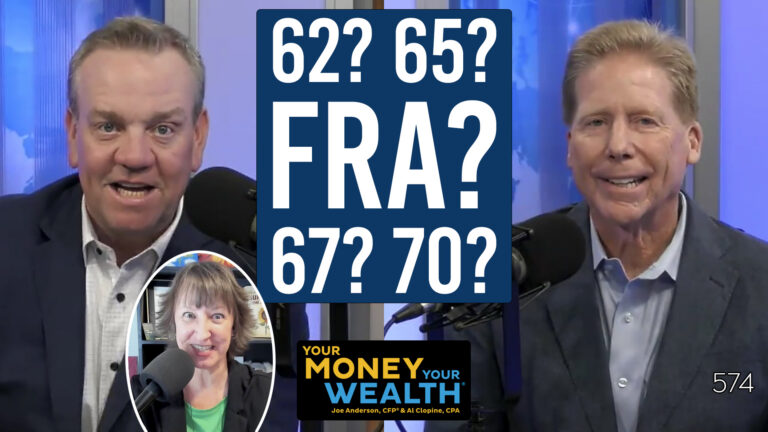
“Lloyd and Diane” in Montgomery County are 50 with $8.4 million. Can they retire early and still be generous with their kids? E and T in Missouri are 34 and 31 with $255K, and hopefully some big inheritances in the future. Can they fund the kids’ college, and help them buy their first homes, AND retire early? Kent in Kansas City is 73 with 12 million bucks and $2 million in life insurance. Do Joe and Big Al back up his plan to buy an annuity, gift money to his kids now, and still spend freely in retirement, Die With Zero style? Finally, should John in the San Francisco Bay Area sell the family home and move to Nevada, or hold the house for his autistic daughters to inherit later?

Show Notes
- 00:00 – Intro: This Week on the YMYW Podcast
- 01:10 – 50 with $8.4M. Can We Retire Early and Still Give to Our Kids? (Lloyd Dobler and Diane, Montgomery County, MD)
- 11:41 – Die With Zero: Spend My $12M or Buy an Annuity? (Kent, 73 & 70, Kansas City)
- 25:08 – Can We Afford Kids’ College AND Houses AND Our Own Early Retirement? (E & T, 34 & 31, Missouri)
- 34:17 – Should We Move to Save Money or Keep the House for Our Autistic Kids? (John, 68 & 66, San Francisco Bay Area)
- 42:29 – Outro: Next Week on the YMYW Podcast
Free Financial Resources:
Estate Plan Organizer – free download
Retirement Readiness Guide – free download
Four Hard Truths About Retirement You Need to Face – YMYW TV
Guides | Blogs | Educational Videos | YMYW Newsletter | Subscribe on YouTube

Watch today’s podcast episode on YouTube:

Transcription
(NOTE: Transcriptions are an approximation and may not be entirely correct)
Intro: This Week on the YMYW Podcast
Andi: Joe and Big Al spitball on how to build your own retirement AND support your kids financially, today on Your Money, Your Wealth podcast number 575. Lloyd and Diane in Montgomery County are 50 with $8.4 million. Can they retire early and still be generous with their kids? E and T in Missouri are 34 and 31 with $255K, and hopefully some big inheritances in the future. Can they fund the kids’ college and help them buy their first homes AND retire early? Kent in Kansas City is 73 with 12 million bucks and 2 million in life insurance. Do Joe and Big Al back up his plan to buy an annuity, gift money to his kids now, and still spend freely in retirement, Die With Zero style? Finally, should John in the San Francisco Bay Area sell the family home and move to Nevada, or hold the house for his autistic daughters to inherit later? Follow us on YouTube and watch us do YMYW in person. Turn on notifications so you don’t miss a thing, and join me in the conversation in the comments: how are you juggling retirement planning with helping your kids? I’m Executive Producer Andi Last, and here are the hosts of Your Money, Your Wealth, Joe Anderson, CFP® and Big Al Clopine, CPA.
50 with $8.4M. Can We Retire Early and Still Give to Our Kids? (Lloyd Dobler and Diane, Montgomery County, MD)
Joe: Let’s go with hi guys. This is Lloyd and Diane. Oh, Dobler?
Andi: and that one’s from Say Anything. Dobler. Yeah.
Joe: Oh, Say Anything? No. Really?
Andi: Yeah.
Joe: Say Anything. That’s the movie with the, Cusack, right?
Andi: Yeah. John Cusack and, what was her name?
Joe: Holding up the boombox over his head in the rain. Yep. Yep.
Andi: Yes. That’s the one. Ione Skye. That was her name.
Joe: Yes. Yeah, the actress. Look at that picture of him with the boombox. That’s like an icon picture of,
Andi: yeah, that one.
Joe: Yeah. There you go.
Al: There you go.
Andi: Playing In Your Eyes. Peter Gabriel.
Joe: Oh yeah.
Al: But I, I would say
Joe: Peter Gabriel,
Al: I’d say half the movies I don’t even remember if I saw ’em or not.
Andi: I’m with you. I’m totally not only doing that as soon as I walk out the movie I’ve lost it.
Al: I don’t even remember if I saw ’em.
Joe: hi guys. This is Lloyd and Diane writing to you from Montgomery County, Maryland. Love the show. First the important stuff. Lloyd drives a 14-year-old pickup. Diane drives an 8-year-old sedan, no car payments. Lloyd likes Maker’s Mark neat. Diane likes a glass of Chardonnay. We love margaritas in travel.
We own our home, which is worth about $1.5 million. With 750,010 years left on the old mortgage, we have three teenagers and expect to have enough 5 29 money saved for their college. We’re 50 years old. Lloyd plans to retire in three years. Diane plans to retire in six years. Our current savings, $4.4 million in a brokerage account. Wow, boy.
Al: Okay, that’s now we’re getting up there.
Joe: There you go. Allocated 55% stock, 20% bond, 20% hedge fund equity. Okay. 55% reit. Planning to save additional $20,000 a month for the next three years until Lloyd retires.
Al: Okay. Into the brokerage account.
Joe: Woo. $140,000 a year. Right into the brokerage account. 20 grand a month they’re saving.
Al: That’s correct.
Joe: Alright. Three half million dollars in combined 401(k)s.
$500,000 in Roth IRAs. Geez. Lloyd. Diane,
Al: I think you’re okay
Joe: that he’s 50.
Al: They are favors,
Joe: what is that? 900,000, I mean, 9 million.
Al: It’s there, 8.4 million.
Joe: Okay. Lloyd has a small pension that covers our healthcare, and that’s about $30,000 a year annually.
It won’t adjust for inflation until he is at least 60. We’re not sure what our Social Security distributions will be, but I’m guessing a hundred thousand dollars to 2040 $4 or $55,000 today. Look at you, Diane. Just doing some beautiful value.
Al: I like it.
Joe: Yeah. Got the old HP 12 C out.
Al: She does
Joe: currently spending $250,000 annually after inflation.
That will be about $300,000 when we both retire in six years.
Al: And I got the same number so she knows what she’s doing.
Joe: Be tough. We plan on buying a second home somewhere warm in the next six years when we both retire. So we’ll always have a house payment. We plan to leave our homes to our kids and ideally give some of our liquid assets to them while we’re alive.
Appreciate a little spitball here and your thoughts on any of the following. Let’s go. Number one, is our annual retirement budget doable, and if so, will we have extra money to give to our kids while we’re alive?
Al: Quick answer. Yes.
Joe: Yes.
Al: And I’ll give the math behind it.
Joe: Well, let’s go. They, yeah, they wanna spend two 50. I bet. Their accounts, when, do they wanna retire? Three years.
Al: Well, he’ll retire three a month.
Joe: Retire. Six. That’s, they got 8.8. I’m gonna be,
Al: I just,
Joe: it’s gonna be close to $10 million. 3% of 10 is 300 grand.
Al: I just did it now just to see what, about retiring now? Okay. And, they wanna spend two 50.
They got a pension of 30 leaves, 220,000 distribution rates for 2.6%. I’m, good with that. But if you work an extra three years and six years, even better, right?
Joe: Yep. Alright. Any tax moves we should make in the next few years?
Al: yes.
Joe: Yeah, but we don’t know what he, I mean there, there’s, he’s there. He or she’s saving $20,000 a month.
Al: Right.
Joe: 240 after tax of savings or spending 200, that’s five. They gotta be making a million dollars a year.
Al: Yeah. I think that the answer is you wait until you’re in the 24% bracket or lower to start doing Roth conversions.
Joe: Yeah. They’re not, they gotta be in the highest tax bracket.
Al: I think so, but I think you do Roth conversions all day long because the ‘
Joe: cause you’re gonna retire young. It’s not like you’re gonna retire at 70 and you only have five years to get like Right. $8 million out of a retirement account. You’re gonna retire at 55, let’s call it. Or 53.
Al: Yeah.
Joe: And you’re gonna have several years
Al: and they’re probably not even gonna touch their tax deferred or very little.
Joe: Right,
Al: right. So that’s gonna be 7 million, eight, 9 million.
Joe: That’s gonna be a big,
Al: imagine the RMD on that Joe.
Joe: Big number. Yeah. Four 500 grand.
Al: Correct.
Joe: let’s see. Is our asset allocation appropriate? I don’t know. you don’t like with the brokerage account, you’re gonna be, you need to transition the brokerage account a little bit, because you gotta live off of that.
I don’t know how tax efficient it is. You got 55 stock, 20% bond, and then you got this hedge fund. ’cause they got $4 million they filled that they had to buy an underperforming expensive, exotic investment.
Al: That’s right. What do you think of hedge funds?
Joe: No, I don’t care for ’em.
Al: I’m not a fan either.
But maybe they got the one good one.
Joe: Yeah. I don’t know. Two and 20. No. Thank you. Right. They’re super expensive and because of the constant fees, it’s like, yeah, they can outperform the market all day every day in most cases.
Al: But it minus the fees.
Joe: Yeah. Two example is 20% of the upside
Al: because they take a profit share plus fees.
Joe: Yes,
Al: Yeah. So this, I don’t know. I, don’t, for that reason, I don’t particularly care for ’em either.
Joe: Yeah. Well if you look at the hedge fund index itself over the overall markets, it’s abysmal.
Al: I know because of their fees.
Joe: It’s terrible.
Al: cause they get a profit share.
Joe: It’s terrible. but I don’t know. It sounds cool when you, at the cocktail, I got 20%
Al: I hear you. And it’s equity, whatever. Right? I mean,
Joe: 20%
Al: that, that puts ’em at 75% equities, 20% bonds. I think, when. I think they should have probably a little more in bonds. Oh, well, maybe not. What do they got? Four?
Joe: Yeah, it’s just 4.4 million to create the income that you need.
So you need to pull out 200, $250,000.
Al: I know 20% of it’ll, probably that’s 4.4. let’s, maybe it’s five by that point.
Joe: So that’s 800,000.
Al: Yeah. 800 to a million.
Joe: They got two 50,
Al: so that’s four years. Four or five years.
Joe: Five years. I don’t know if that’s enough.
Al: Well, I,
Joe: it could be if you rebalance back into the bonds or cash for sure.
Al: yeah. Maybe you go 30%, but it, I don’t think it’s too far off.
Joe: Yeah. Yeah. I suppose, I mean, because they’re young and they still want growth and they want to give to their kids.
Al: Right, right.
but maybe you rebalance the stocks into like a 30% bond portfolio in the brokerage account as you get closer to retirement. Maybe you do that.
Joe: Yeah. Yeah. Because this is where God, they could add a lot more value of how they’re looking at income, how they’re constructing the income coming outta the portfolio. How do you stay tax efficient? How do you manage the risk? How do you do the conversions? I mean, there’s a lot of strategy and planning that they would wanna look at, given the fact that they’re gonna retire pretty young.
They’re gonna be in low tax brackets for a while because they can control their taxes if they do this right,
Al: right.
Joe: Then they can get a lot of money into the overall Roth IRAs, and that’s probably the best gift that you could ever give. as an inheritance to a child, but I think they want to give while they’re alive.
But they’re also gonna get a couple of nice homes too.
Al: Right.
Joe: You know? So, yeah. I think they have enough cash and capital to give to their kids while they’re alive and enjoy it. They could spoil ’em. I think they’re in a really good spot.
Al: I think if Diane can at least work to 55, that’s cool, because then that would be the rule of 55 on the 401(k) and then they could live off of that.
Joe: Yeah, they could take down to the top of the 12 or something.
Al: That’s, and even though it says six years, you know, I think you can try to retire sooner, but if you get to 55, that’s great because you can pull money outta the 401(k), no penalty, and you’ll probably be in a much lower bracket. So it’ll be relatively tax efficient and you can still probably do Roth conversions.
Joe: Yeah, because the, RMD on the, retirement account is gonna be in the 24% tax bracket. Or higher.
Al: Or higher.
Joe: Right.
Al: if they don’t do anything.
Joe: Yeah. So, you know, she’s asking about sequencing of how to create the income when they retire in their fifties. So it might be draining some of the retirement account to live off of and conversions maybe to the, that’s what I would do.
22% tax bracket and then you’d, take the rest from the brokerage account.
Al: Yeah, that’s exactly what I would do. Yep.
Joe: Yep. Yep. So a lot of really cool, things that they can do on an ongoing basis.
Al: Yeah, because Joe, they got 4.4 million in a brokerage account, then there’s a lot of potential strategies there as well.
Which, is, what are the gains in each of these accounts and, can you tax less harvest? And do you have accounts with lot big gains and ones with lesser gains and those are the ones that you sell for income. Anyway, there’s a lot, of things you can do here.
Joe: Yeah. Congratulations. you know, you’ve done quite well, I would have to say,
Al: yeah, you are probably at age 50. I didn’t ask chatGPT, but certainly in the top 5%, if not one.
Joe: Yeah, top 1%,
Andi: probably 0.5%.
Retirement isn’t all beach umbrellas and ice cold beers. What do market crashes, adult kids moving back home, and boredom have in common? They’re all on Joe and Big Al’s list of retirement hard truths, this week on Your Money, Your Wealth TV. They’re talking market volatility, inflation, Social Security timing, taxes, longevity, healthcare, and long-term care and they’re not pulling any punches. They are bringing solutions for every single one. Watch the episode, then grab our free Retirement Readiness Guide to go even deeper. Income planning, tax strategy, healthcare costs, it’s all in there. After today’s podcast, y’all might want to dog-ear the legacy and longevity chapters of the Retirement Readiness Guide. Links to both YMYW TV and the guide are waiting for you in the episode description. Free, no strings, courtesy of Your Money, Your Wealth and Pure Financial Advisors.
Die With Zero: Spend My $12M or Buy an Annuity? (Kent, 73 & 70, Kansas City)
Joe: Kent from Kansas City. Are you familiar with the book Die With Zero? I am familiar with that book.
Al: Me too. I didn’t read it, but I get the concept.
Joe: Yeah. Die broke. The author suggests considering an annuity to let someone else guarantee that you won’t run outta money to self-insured, you will die with a lot left over. I have no debt. Eight and a half million dollars in retirement accounts, none as in Roth, another three and a half in various accounts, including $400,000 in HSA. $85,000 in Social Security. I’m 73 years old, my wife is 70, both in pretty decent help. If I buy a single life, a million dollar annuity with an annual income of about 84,750, the break even is about 11.8 years that in Social Security, give me an annual income of about $170,000.
Not planning on Social Security, knowing that the Ponzi scheme is running out of new investors to pay benefits. If I die before break-even, so what? I have a paid up $2 million life insurance policy, which my wife gets tax free, paid for the lump sum of after tax money. I can spend the remaining roughly $10 million without concern about running outta money.
What about the kids? I have three Attorney, married to another attorney partner, big up firm. All right.
Al: We’re supposed to pause, married to another attorney partner at a big firm.
Joe: Got it. Medical.
Andi: Well, it’s actually I have three, and then he lists his three children.
Al: Yes. Right. That’s right.
Joe: Got it. So, the guys loaded and his kids are super successful.
Al: They’re all loaded, they’re physicians.
Joe: And then why don’t I just buy an annuity in a life insurance contract?
Al: Yeah,
Joe: probably. is this the gist of this question?
Al: yes.
Joe: Got it.
Al: But there’s,
Joe: but he’s got three kids. One’s an attorney, married to another beautiful attorney.
Al: Yep.
Joe: Huge big law firm partner.
Al: That’s probably one we’ve heard of.
Joe: The other is a medical sonogadographer
Andi: that almost that started so well and then it went off
Joe: married to another very high earning physician,
Al: and the third one,
Joe: super successful.
Al: Third one’s three year medical student.
Joe: Oh, three year medical students at Harvard
Al: engaged to a software engineer.
Joe: Oh.
Al: Oh, we got money coming out of their ears.
Joe: Oh my god.
Al: I
Joe: mean, this family tree is
Andi: quadruple fat wallet.
Al: It’s, happening.
Joe: none have education loans because I paid for them all. I plan to spend money and gift money to children now when they need it, instead of when they die. How do when I die? Not when they die.
How do they need the cash? It’s a third year medical student.
Al: Well, they can buy the, buy their own mansion, I guess,
Joe: I suppose.
Al: Yeah.
Joe: Okay. $19,000 without give tax, $38,000 for my wife and I. We can adjust if, well, he’s just telling us what he’s gonna do. When, when? When’s the question?
Al: It’s at the very end.
Joe: Okay. About 70% equities now mostly in low cost index ETFs. We have lived very nicely, not lavishly and plan to continue that, but maybe actually enjoy some luxuries, more travel fly business class on long trips. What do you think advice. You don’t give advices here?
Al: Yeah, we spitball. to recap, they got $12 million.
Joe: Okay.
Al: Plus 85,000 in Social Security.
Joe: Yep.
Al: And eight and a half million is in tax deferred. And three and a half million is in a brokerage account. So with that in mind, thoughts, advice?
Joe: I don’t know what, so he gets into, right, let, me buy an immediate annuity.
Andi: Does he need an annuity?
Al: Well, it, increases his income.
But you know, Joe, if you, just look at what he’s got and he’s 73, wife, 70, you could probably use a 5% distribution rate. So they can probably spend 600,000 ish from their assets, another 85,000 Social Security. So they can probably spend about 700,000 anyway. Doesn’t seem like income’s a problem. I don’t have any problem with annuity in this case.
If you want more income, but generally. You need a, you do it when you need more income, not
Joe: you want to guarantee
Al: Yeah.
Joe: Insuring against longevity.
Al: and you know what, in another case, Joe, if you don’t have any kids and the money’s just, you don’t know where it’s gonna go, yeah, go ahead, buy some immediate annuities, fixed income annuities and let ’em run until you live and you could probably live a, better life in terms of spending.
Joe: So how would he live a better life? In spending.
Al: Well, not him, I’m just saying in general,
Joe: why would that, why would an annuity give him a better life?
Al: Not him. Well, let’s, take a couple zeros off the,
Andi: and he said, if you don’t have kids, this would be a potential.
Al: I, I said, if you don’t, if you don’t have kids,
Joe: oh.
If you don’t wanna worry about creating income yourself.
Al: Yeah.
Joe: Buy an immediate annuity.
Al: Yeah.
Joe: Right. You don’t, let’s get that guaranteed income in your, you’re buying insurance is
what you’re doing.
Al: Right. You don’t have kids, so you don’t care about that part. You have 500,000, which means you’ve got, you can live on about 20,000 a year.
You buy an annuity. You could probably double or more the income because it’s for life and there’s no principle leftover. Right.
Joe: Yeah. But I think you’re, what you’re seeing is a little misleading.
Al: Oh, huh. Okay. We educate me
Joe: because you’re saying you could double your income. But you’re not doubling your income, you’re basically taking the income off the annuity and the principle.
Al: Okay, lemme say it differently. You could double your cash flow.
Joe: Okay.
Al: You like that better?
Joe: Yeah, but it’s, it doesn’t make it sound like it’s better.
Al: Right. I got it.
Joe: I think it’s what an annuity does is it will guarantee a certain level of income for the rest of your life. And if you die prematurely, then so be it.
If you live a long life, you could win.
Al: That’s right.
Joe: If you look at the rate of return or the internal rate of return, it depends on how long that you live to see if it’s better or worse if you’re ranking it on, on a return.
Al: Yeah. But I’m, I guess what I’m saying is if you don’t really have enough to live off of and you don’t have errors, it could be a way to increase your cash flow without a lot of concern.
Joe: Well, yeah. Without risk of, running outta money. Right. And going, you know. Destitute later.
Al: Now the insurance company could go broke so that there is a risk. I’m not saying it’s risk free, but anyway,
Joe: but so then he’s saying, I already have a two, I already have a paid up $2 million life insurance policy that my wife gets tax free uhhuh.
So he’s already bought that. Or is he gonna take some of the annuity that he’s getting from the income to buy the insurance contract?
Al: Yeah.
Joe: How do you read that?
Al: My, my read is he’s already got the life insurance. He’s already
got
- That’s how I took too think about annuity because, ’cause why not? You know, like, like a mil here.
So here’s his example.
Joe: But he’s not dying broke.
Al: No, I know. I’m, aware of that.
Joe: He’s not dying with zero.
Al: But the con here’s the concept. Yeah. I don’t think, it doesn’t matter at all. If he wants annuity, go for it. If he does, but you don’t know, he doesn’t
Joe: buy some land in. Timbuktu.
Al: Well, the point is he doesn’t need an annuity.
Joe: Right?
Al: But, but here’s my point million dollars, 4% distribution rate. That’s 40,000 a year that you could pull out for cash flow. You put that same million dollars Joe in an annuity, and according to him, he could get 85,000. So that’s, a little more than double. Now I know he’s 73, so the older you are, the, higher the income relative to the principal.
Nevertheless, I’m just. It doesn’t matter for him. Right. I’m just talking generally. If, someone doesn’t have any heirs and they’re, a little bit tight and they don’t really, they just want kinda risk free, don’t worry about it. I, you know, I don’t, think that’s such a bad thing.
Joe: So he’s gotta live more than 12 years for this to make sense for him.
Al: Yeah, that’s right.
Joe: Right.
Al: Or well, or he dies and then wife gets 2 million. So,
Joe: but he already has the 2 million. So why is he comparing those two strategies together?
Al: I don’t know.
Al: Well, whatever.
Andi: Well, could it, would it be helpful if the market took a giant dive and, cut his portfolio in half? Would that be a good reason to actually have that kind of security in, the event that, that something like that happens?
Al: Well, yeah. If we have another great recession, which we could, Andi and, but. Realized the last great recession was the worst in the last a hundred years. the, it only went down for about a year and a half, and then it started going up again. So it’s not like this is a forever thing. And those that stayed the course, Andi, were in much better shape, within say three years.
And, if you did it properly within two years, you’re probably almost back to even three years. You’re happy you stayed four years and on it was a really good thing.
Joe: If he wants to put this on autopilot. Let’s see. Alright, I, wanna live off $170,000 a year. Yeah, buy the annuity. Then you have your Social Security.
All of the annuities gonna come to him as ordinary income. It doesn’t really matter ’cause he only, oh, man, he’s got three and a half million dollars in various accounts. Where’s he gonna buy the annuities? Is he gonna buy it in his tax deferred account or is he gonna buy it in his other account?
Al: Well, might as well buy it in the tax deferred.
Joe: If you’re gonna buy it, you absolutely need to buy it in the tax deferred account because his RMDs are gonna be what, 300.
Al: Well, call it, yes. 350 grand
Joe: and growing 50,000.
Al: Yeah.
Joe: So you got a $350,000 RMD, you have $80,000. Right. So you got 450 roughly of income. That’s gonna be taxed Ordinary income rights.
Al: Yeah.
Joe: there’s no reason for an annuity. Yeah.
Al: There’s absolutely no reason for an annuity.
Joe: But you want the flexibility to,
Al: yeah.
Joe: You don’t wanna have a guaranteed ordinary income source. If I could look at QCDs, if I could do conversions, if I could do, ’cause what he, you know, and he’s got three and a half million dollars outside.
Al: Yeah.
Joe: I’d be thinking of supplementing my income with the three and a half million dollars and I would be converting that eight and a half million dollars. As much as I possibly can into the Roth IRA over the next couple of years.
Al: A hundred percent agree. So I’ve got three points here. Jerry said the first one, Roth conversions are really important in this case, not only for you and your future taxes, but also for your kids.
and your, well say you pass away first since you’re male and older.
Joe: That’s statistically ’cause all his super successful kids are in high tax bracket.
Al: They’re, in high tax bracket too. So don’t you wanna leave Roth IRAs to them? And the answer is yes. That’s one thing for sure. number two is QCD.
Do you know about qcd? It’s qualified charitable distribution. You can give up to a hundred thousand dollars of your RMD, or actually of your IRA each year to a charity if you’re charitably inclined, right? So that’s a good way to go without increasing your taxes. And third, Live it up. Buy a new car.
Joe: Yeah,
Al: go first class, whatever. You got plenty of money. The kids are in great shape. No matter what happens, they’re gonna end up with a lot of money. So.
Joe: It’s hard for people like this to spend Now
Al: I know
Joe: they’re, that’s why they have 12 million,
Al: right? They’re used to not spending I totally get that. And that’s, as you, and I know it’s hard to turn that switch when your mentality is being frugal.
Joe: Yep. Save, saved my own entire life. Yeah.
Al: Oh, I would never go first class. Right.
Joe: And I, see his point. It’s like, I think he’s sold, dialed into income. It’s like, well, I’ll buy the annuity. I got my income and then maybe I take more risk with the other stuff.
yeah. But the RMDs are gonna come out, he’s gonna pay on taxes.
That tax bracket’s only gonna go up. He’s gonna lose more money than he probably should to taxes without the appropriate planning. Yeah. Right. He’s just laser focused on, let me get a, my income and not necessarily worry about it. And if I die prematurely, no big deal. My wife gets $2 million tax free plus another 10, 13, $10 million.
Al: Yeah,
Joe: I, get it. I think there’s, more st you know, there, there’s probably a better strategy.
But he, he does that. He’s fine. He does nothing. He’s,
Al: yeah. Yeah. I would say the biggest issue here is, he’s got a tax problem.
Joe: Tax problem, right.
Al: So get them as much money in a Roth as you can.
Maybe you go to the top of the 24% bracket, or you might even go higher. I don’t know. You have to kind of give that some analysis, but I would, so I’d at least be doing. Roth conversions to the 24% bracket that would be kind of a no brainer.
Joe: Yep. I agree.
Andi: You may not worry about leaving anything for the kids, or it may be your biggest concern. You may have the best legacy plan in the world, but if your family can’t find the details when they need them, it’s like it never existed. That’s where our free Estate Plan Organizer comes in. It’s a fillable document that puts everything your loved ones need to know about you in one place: your financial accounts, insurance policies, beneficiaries, contacts, final wishes, even your pets’ vet info. Fill it out, store it somewhere safe, share it with the people who need it, and update it as your life changes. And just to be clear: don’t send it to us. We don’t want to know where your safe deposit box is, but your kids do. Handing them a completed Estate Plan Organizer is the kind of thing your family will be incredibly grateful you did for them, even if they never say so. Download it free, right now, from the link in the episode description.
Can We Afford Kids’ College AND Houses AND Our Own Early Retirement? (E & T, 34 & 31, Missouri)
Joe: Moving on. My wife and I are 34 and 31. Call us E&T of Missouri if we get on the podcast, please. Alright, well we made it. You’re on, you made it to the podcast. Congratulations.
Al: Yep. and we’re only three months behind on his question.
Joe: We have two boys, ages three and five, pregnant with a third, and we’ll have a fourth if the third pregnancy goes well and t is filling up to it. Both love dry red wine.
Although not drinking at the moment, solidarity and all that, we’ll be opening a 2011 Napa cab after the birth of our child. Apparently the vintage has aged well.
I do enjoy a nice crisp light beer. When I’m doing home improvements or yard work. I drive a Honda Odyssey and T drives a Kia Telluride both paid up. We have a paid off home of $600,000. My parents gave me $500,000 when they retired, which cut our mortgage expense, 200,000 in our combined 401(k)s, $55,000 in a Roth, $30,000 in HSA, fully invested.
We also invest in a brokerage account, but used that money like a sinking pun. So excluding that, excluding the brokerage. We are investing about $3,000 a month. Most of these are in mid or large cap growth funds. I have this consistent nagging worry tugging at me. Well, let’s get rid of that. Tugging worry.
Al: Yeah, let’s do it. It looks like there’s four worries here.
Joe: Alright. he’s going to, number one, continue to contribute to those accounts and then increase to the limits each year. Number two, being able to retire without worry about. Money drying up in leaving any sort of sizable inheritance to my children.
Number three, pay for all the kids college. Number four, being able to get them down payments on their first homes like my parents did for me. Look at that.
one and two, I feel somewhat fine. Contributions towards the three accounts should be around $3 million plus inflation adjusted by the time we retire.
I worry about being able to also. Do that in conjunction with three and four. We are currently contributing to 5 29 plans, but I believe that will be around $40,000 in each account by the time they’re going to university. Expenses towards non-retirement need to come from a bigger shovel or better planning.
Do you think we’ll be fine? To back off the 401(k)s Roth IRAs and HSA account contributions in order to increase our brokerage contributions, the weekly contribution to the brokerage is $330 a week. Well, I wanna be able to plan in a silo. A backup exists in this show wouldn’t be what it is without this nice bit.
Al: Okay, this is a bit here coming up.
Joe: All right. My brother has no kids paid off home, about $800,000 between his retirement and brokerage accounts.
Al: Okay.
Joe: he has said my children will be inheriting everything assuming he does not get married or have his own kids. Doesn’t seem likely at this point. My parents will likely leave my brother and I an inheritance of about 15 to $20 million.
Al: That’s the bit.
Joe: got that bit. Of course they have a lot of brothers and sisters. I could see us getting maybe half of that between us. You three have been great and hilarious to listen to. Kind regards E and t. Okay. All right. Follow up. I’m unsure of Social Security income since in my mind there will be in inevitably be an overall.
Overhaul?
Al: Overhaul.
Joe: Oh, overhaul of the system.
Al: Yeah.
Joe: Got it.
Al: Could be.
Joe: All right. So if I had to guess a low conservative number, I would draw at 67, about $24,000. A guarantee would draw about $24,000 a year at age 70. Again, I know I’m being too conservative. The retirement age is another uncertainty for us. I would like to think we would work until about 65, but it’d be nice to be able to retire when I turn 55 and go part-time and start drawing from retirement accounts to offset the income our annual spending.
Hope would be to have a spending budget of about $110,000 after tax.
Al: Damn.
Joe: All righty. So what do we got here? We got a 34-year-old and a 31-year-old.
Al: Yep.
Joe: They got what, $250,000 in a home that’s paid off?
Al: Yep.
Joe: All right.
Al: And about 250,000 In liquid asset savings.
Joe: Yeah. Two 50.
Al: Yeah. Yeah.
Andi: And about 10 million that they’re gonna inherit.
Joe: Yeah.
Al: Well, forgetting that for a second.
Joe: Should they tone off the retirement accounts and start putting more money into a brokerage account? I don’t think so.
Al: No, I don’t think so either. I think, The parents. I think maybe you get the parents to contribute more to the 5 29 if they love their grandkids.
Joe: Yeah,
Al: they got the money, right. I think I’d look at that, but just, Joe, just in terms of calculations, 30 years is an awful long time.
Joe: It’s stunned. Well, how many these guys? 34 and 31.
Al: Yeah, but I did it just for fun.
Joe: All right,
Al: so 30 years from now. Based upon adding 36,000 a year to retirement, which is what you’re doing currently based on 7%, starting with 200,000, probably have about 4.9 million.
that doesn’t even, I didn’t even include the Roth, so it’s gonna be more than that. So, if you look at what you wanna spend, of 110,000, 30 years of inflation, Joe, that’ll be about two 70.
So you wanna spend two 70, your Social Security, I just did a 2% inflation. That’s about 90 based upon the numbers you gave me.
Yeah, they’re close Shortfall’s. 180, that’s a 3.7% distribution rate. That is fine. As far as 5 29 plans. Yeah. you do wanna kind of get more money in that and, you know, maybe you kind of stuff that while the kids are young and, but you’re gonna have three kids and maybe four. So that’s, an important consideration I think.
I would maybe try to lean on the grandparents there, but,
Joe: yeah, I, you know. I think they’re doing a really good job. They have $250,000 saved at 30 31.
Al: that’s a great number.
Joe: I would continue to fully fund your 401(k) plans. Fully fund the Roth IRA plan.
Al: Yep, yep,
Joe: you know, if you have the HSA go ahead, pump some dollars into there.
Whatever’s left over, you can start funneling into the 5 29 plans of brokerage.
But as they continue to age, get raises and do different things.
Al: Yeah. Then add more.
Joe: Yeah. Then add more. Yeah. I think if it, you just ran a flat rate of what their savings rate is today,
Al: I know
Joe: that’s gonna increase over time and so they’re gonna have significantly more.
More dollars. It’s
Al: yes. But then that’s offset with more expenses.
Joe: sure, sure.
Al: Sure. I guess the point is it’s impossible to know this is just a reality check, right? Are you in the ballpark? And the answer is yes. You’re in the ballpark. And that’s,
Joe: and I think he’s done some calculation, it sounds like.
Yeah. One and two, I’m not too worried about, but three and four. Why would you even be worried about that if you think you’re gonna get even a couple million bucks?
Al: Well, I think with the parents. Anyway, I don’t know. I guess I don’t wanna presume anything. I mean,
Joe: but even at the, he’s, he already knows that he’s gonna get a big chunk of change from mom and dad, and he is still saving the way he’s saving.
Or he’s saving.
Congratulations. You’re doing a hell of a job.
Al: It’s fantastic. Yeah. Yeah. No, there, I would actually, my, my, my summary is keep doing what you’re doing. Really?
Joe: Yeah. And just kind of keep looking at it year by year.
Al: Yeah. Yeah.
Joe: Reassess, take a look. What’s going on? What’s going well?
What’s not going well? How’s the income? Do you got, you know, you can adjust over time. It’s not like here, you’re gonna set it and forget it. Yeah,
Al: right.
Joe: You know, this is dynamic. You’re gonna change things as you age, as things happen as maybe you have twins and now you have five kids instead of the four.
And Yeah. Then you get, who knows? but then your brother, he’s going to. Get married at 45 and have children late in life. Yeah. And so there goes all of his, cals that he was gonna give you and the kids goes to his family.
Al: yeah.
Joe: Don’t overstress about this. You’re doing a great job.
Al: No, just
Joe: keep doing what you’re doing.
Al: A hundred percent agree. And that, I actually talked with a friend of mine today who’s 60 or 61, and she wants to retire full retirement age 67.
Joe: Yeah.
And you’re doing
some financial planning.
Al: I just did back of the envelope. Got it. Like this, a spitball. I didn’t do any advice. I did a little spitball for a friend and, it looks like, she can retire.
Joe: Yeah.
Al: At 67 should be a little bit short, but there’s a couple things that she could do to bridge that gap. but I said the same thing to her. This is not a set and forget, this is something you keep looking at. Particularly, don’t retire until the numbers are rerun to see where you’re at.
Joe: Right. Right.
Should We Move to Save Money or Keep the House for Our Autistic Kids? (John, 68 & 66, San Francisco Bay Area)
Joe: All right. We got John from San Francisco Bay Area. Love the podcast. We are longtime listeners, our sit longtime listener. What is that? Six months? Our situation in question is a bit unusual, but would appreciate your spitball analysis. I’m retired. I’m 68, my wife’s 66. We have two daughters. One is autistic and one has been receiving Social Security.
A little over a thousand dollars per month. Our autistic daughter has just converted to SSDI, when my wife started to collect her Social Security benefit in October. According to SSA, her daughter’s benefits will be split between SSDI and SSI and her benefit level will remain unchanged. My wife is now receiving approximately $900 per month in Social Security payments.
My youngest daughter’s currently unemployed and suffers from anxiety and is on the. Autism spectrum, but is not eligible for SSI or SSDI. Her income in the past has been at minimum wage. My wife gave up her career after our first daughter was born to provide the care. I hope to defer Social Security till the age 70 in My estimated payment is $5,000 per month at that time.
Both donors will live with us. Both daughters live with us. We currently have approximately $2.8 million in various retirement accounts, two and a half million dollars in traditional IRAs, $134,000 in a Roth, IRA $141,000 in a brokerage account. Our investments are basically split 60 40 between stocks and bonds given past health issues.
Neither my wife nor I have a long-term care policy. We have no debt. We live in the San Francisco Bay area and we own our home. Which we purchased over 30 years ago for approximately $330,000, and it’s now worth approximately 1.7 million. Both daughters each have an inherited IRA of approximately $108,000, and our oldest daughter has approximately $32,000.
In an ABLE account. We contribute approximately $3,000 per year in $19,000 in a special needs trust account. Current monthly expenses are approximately $11,000 per month. Our goal is to pass as much as we can when we die in order to abide for our daughters care. So as such, we have cons. We have considered selling our home and move to a less expensive area or state like Nevada in order to have more funds for our daughters when we are gone.
Do you think that’s a good idea or are my daughters better off? If we stay put
is the daughter’s better off if we stay put and have them.
Al: And have them with the help of the of family.
Joe: Oh. And have them
Al: with the help of family and advisors sell the home after we’re gone.
Joe: Okay,
got it.
Not really love this. She and recommend it to friends and family. My wife drives a 2017 Subaru Outback and I drive a 2018 Toyota RAV4 hybrid.
A drink of choice is anything that contains alcohol,
Al: not picky.
Joe: Perfect. Thanks for everything you do. All right,
Al: cool.
Joe: okay. Yeah. Unique question.
Al: Yeah, it’s, a good one.
Joe: And it’s a tough situation,
Al: just a little baseline based upon their spend and their fixed income, their distribution rate’s 2.2%, so I like that.
So, good check. So we can go onto the question.
Joe: Sell the house moved to Nevada.
Al: I do the opposite.
Joe: Stay home.
Al: Yeah. Because with help of family and advisors, they can sell the house. And property in San Francisco is probably gonna appreciate more than Nevada just saying
Joe: $2.7 million. They can live in a really nice house for 700,000, have another million for the girls.
Al: But do they want to?
Joe: Of course they do.
Al: I’d pick San Francisco. Well, I’ll put it this way, live where you wanna live because either works fine, but if, you’re asking financially, I would stay in the San Francisco home because you’ll see more appreciation in the future than a probably a Nevada home.
That’s, that would be my thinking.
Joe: So what’s the goal? Is it to leverage as much inheritance as possible.
Al: Yeah. It sounds like the daughters may need it.
Joe: Yeah, sure. Yeah. But is it to help the daughters currently as well? And how do they have enough cash cushion to take care of their daughters today, as well as leverage how much they can give in the future.
I mean, if they’re leveraging the, the inheritance, I agree with you. You’re probably gonna get better appreciation on a San Francisco home. Yeah. They bought it for 330, it’s worth 1.7.
Al: Right.
Joe: Right. That’s gonna continue to grow. Yeah. I don’t know. It’s a tough one. I always think, man, I’m gonna move cash.
Al: You know, I can,
Joe: I’m gonna move to Arkansas.
Al: I personally am staying in California.
Joe: You’re staying for forever, huh?
Al: yep.
Joe: Okay.
Al: Why not?
Joe: Well, maybe half and half
Al: Hawaii,
Andi: Arkansas, and California.
Al: Yeah. That would be your thing.
Joe: No, I, don’t know. I can’t see myself living in Arkansas. I go there twice a.
Al: And you get to stay in the basement.
Joe: Yeah, I get to stay in the basement. Well, now, the last couple times we stayed at my brother-in-law’s, pool house.
Al: Well, can you afford a hotel?
Joe: I can.
Al: You can’t do that.
Joe: it’s a little rich there in Little Rock.
Al: I suppose, eh,
Joe: well, but yeah, I don’t know. I would like to stay at a hotel, but, you know, that would be rude Al
Al: Got it.
Joe: Family wants us to stay with them.
Al: Well, if they want you to and
Joe: Yeah.
Al: Yeah. You gotta, make Rose happy too.
Joe: Yeah, I suppose. And, but yeah, it’s fine. It’s fine. It’s just
Andi: Al, do you ever have plans to be in Hawaii full-time?
Al: I don’t, I like California as well, plus I have kids here. I’ve got, they’ve got a lot of connections here.
Lot friends. Pure Financial is here.
Joe: Oh yeah.
Andi: I’m surprised there isn’t a Hawaii office already, to be honest.
Al: Anyway. Yeah, I, actually am, and I, just talked about this, like a week ago, and we wanna do our international travel during our go-go years.
Joe: Go-go years.
Al: I knew you’d love this.
Joe: what’s your slow go years?
Al: I don’t know. they’re not nearly upon us, but when they are, I could see us, Andi, spending more time in Hawaii.
Andi: Yep.
Al: Doing less international trips
Joe: and then coming back to California. Your no-go years
Al: probably because that’s where the kids are. We need help kids. Yep. Got it. They both have said they’ll help us, so that’s good.
Joe: Alright, there you go.
Andi: All right, so any final words on John before we move on?
Al: Oh, I got one more comment. the comment, Joe, given past health issues, neither my wife nor I have a long-term care policy.
That would be true for life insurance, but sometimes health conditions make you more favorable for long-term care because the insurance companies think you’re not gonna live as long as you might.
So I wouldn’t give up on that just yet.
Joe: Yeah. I would go through underwriting. At least
Al: try out maybe Yeah, I would too. Yep. Yep. But that’s all I, that’s, all I got.
Andi: I actually, this weekend I saw, Baz Luhrmann’s. Documentary about Elvis Presley. It’s like the Elvis part two. It’s the later story of Elvis, but it’s all original footage from Elvis in 70 and 71, I think.
And him talking about himself and his own career is very well done. Excellent movie. That was in theaters.
Joe: He did the movie Elvis that came out watched.
Andi: Yeah, with He’s the one, Elvis being young,
Joe: did Moulin Rouge. Right.
Andi: Yes.
Joe: What’s his name?
Andi: Yep. Baz Luhrmann.
Joe: Yeah, yeah.
Yep.
I like him. Put that on there.
Al: There you go.
Joe: Right, right after Stroker Ace. Alright. That’s the show, folks. Show’s called Your Money, Your Wealth®. Thanks for listening. Thanks for writing in. Thanks for the questions, comments, all the good stuff.
Al: Yeah.
Joe: Wonderful job today, Al. You were very prepared.
Al: I was. I like to be. Yeah, and you were fantastic too.
Joe: Well, thank you. This is the first time I’ve read this. Read my, reading. No, that can’t be off the charts today. Alright, Andi. Thank you. and we’ll see you guys next week. Show’s called Your Money, Your Wealth®.
Outro: Next Week on the YMYW Podcast
Andi: Next week on YMYW, is it worth it for TJ in PA and Rebels Without a Gauze in New England to convert their retirement savings to tax-free Roth accounts? How much should Biking Barnsey convert each year, and are Zisi and his wife being too aggressive with their conversion strategy? Tune in to episode 576 next week and find out.
This is Your Money, Your Wealth, your podcast! If you enjoy YMYW. Tell your friends and help us reach more listeners like you. Leave your honest reviews, comments, and ratings for Your Money, Your Wealth in Apple Podcasts, and in all the other apps that let you do that, like Amazon, Audible, Castbox, Goodpods, Pandora, PlayerFM, Podcast Addict, and Podchaser. We are on all of them!
Your Money, Your Wealth is presented by Pure Financial Advisors. To really learn how to make the most of your money and your wealth in retirement, you need more than a spitball: schedule a no-cost, no obligation, comprehensive financial assessment with the experienced professionals on Joe and Big Al’s team at Pure. Click the Free Financial Assessment banner in the podcast show notes at YourMoneyYourWealth.com or call 888-994-6257 to book yours. Meet in person at any of our locations around the country, or online, right from your couch. No matter where you are, the Pure team will work with you to create a detailed plan that’s tailored to meet your needs and goals in retirement.
Pure Financial Advisors is a registered investment advisor. This show does not intend to provide personalized investment advice through this podcast and does not represent that the securities or services discussed are suitable for any investor. As rules and regulations change, podcast content may become outdated. Investors are advised not to rely on any information contained in the podcast in the process of making a full and informed investment decision.
Topic
Topic
Topic
Topic
Transcript
_______
Listen to the YMYW podcast:

Amazon Music

AntennaPod

Anytime Player

Apple Podcasts

Audible

Castbox

Castro

Curiocaster

Fountain

Goodpods

iHeartRadio

iVoox

Luminary

Overcast

Player FM

Pocket Casts

Podbean

Podcast Addict

Podcast Index

Podcast Guru

Podcast Republic

Podchaser

Podfriend

PodHero

podStation

Podverse

Podvine

Radio Public

Rephonic

Sonnet

Spotify

Subscribe on Android

Subscribe by Email

RSS feed

YouTube Music
IMPORTANT DISCLOSURES:
Pure Financial Advisors is a registered investment advisor. This show does not intend to provide personalized investment advice through this podcast and does not represent that the securities or services discussed are suitable for any investor. As rules and regulations change, podcast content may become outdated. Investors are advised not to rely on any information contained in the podcast in the process of making a full and informed investment decision.
• Investment Advisory and Financial Planning Services are offered through Pure Financial Advisors, LLC, a Registered Investment Advisor.
• Pure Financial Advisors LLC does not offer tax or legal advice. Consult with your tax advisor or attorney regarding specific situations.
• Opinions expressed are not intended as investment advice or to predict future performance.
• Past performance does not guarantee future results.
• Investing involves risk including the potential loss of principal. No investment strategy can guarantee a profit or protect against loss in periods of declining values.
• All information is believed to be from reliable sources; however, we make no representation as to its completeness or accuracy. As rules and regulations change, content may become outdated.
• Intended for educational purposes only and are not intended as individualized advice or a guarantee that you will achieve a desired result. Before implementing any strategies discussed you should consult your tax and financial advisors.
CFP® – The CERTIFIED FINANCIAL PLANNER® certification is by the CFP Board of Standards, Inc. To attain the right to use the CFP® mark, an individual must satisfactorily fulfill education, experience and ethics requirements as well as pass a comprehensive exam. 30 hours of continuing education is required every 2 years to maintain the certification.
AIF® – Accredited Investment Fiduciary designation is administered by the Center for Fiduciary Studies fi360. To receive the AIF Designation, an individual must meet prerequisite criteria, complete a training program, and pass a comprehensive examination. Six hours of continuing education is required annually to maintain the designation.
CPA – Certified Public Accountant is a license set by the American Institute of Certified Public Accountants and administered by the National Association of State Boards of Accountancy. Eligibility to sit for the Uniform CPA Exam is determined by individual State Boards of Accountancy. Typically, the requirement is a U.S. bachelor’s degree which includes a minimum number of qualifying credit hours in accounting and business administration with an additional one-year study. All CPA candidates must pass the Uniform CPA Examination to qualify for a CPA certificate and license (i.e., permit to practice) to practice public accounting. CPAs are required to take continuing education courses to renew their license, and most states require CPAs to complete an ethics course during every renewal period.