Download the Withdrawal Strategy Guide:

Important Points:
- 00:00 – Intro
Subscribe to Your Money, Your Wealth® on YouTube!
Transcript:
(NOTE: Transcriptions are an approximation and may not be entirely correct)
Joe: This one mistake can ruin your retirement and over half of retirees are doing it right now. But what if, if there was a way or a strategy that you could have more income or stretch your money out a few more years with the same amount of dollars?
Welcome to the show, show’s called Your Money, Your Wealth®. My name’s Joe Anderson. I’m a CERTIFIED FINANCIAL PLANNER®, president of Pure Financial Advisors. I’m with the Big man, Big Al Clopine. He’s sitting right over there.
Al: How you doing, man?
Joe: Good. How are you Big Al?
Al: I’m ready to dive into this. This sounds interesting.
Joe: You know, there’s big mistakes that people make. There are, and they don’t even know that they’re making them.
Al: Right.
Joe: And if you can solve this one mistake, it will put your retirement in a bigger and better position. That’s today’s financial focus.
The #1 Retirement Spending Mistake
49% of people do not have a withdrawal strategy. What is a withdrawal strategy? How are you taking dollars out of your overall accounts? Are you looking at tax? Are you looking at the investment? How about asset location? Are you tax efficient? Lot of things that you need to think about. Let’s bring in the big man to break it all down.
Al: Alright, so a few things we gotta consider today. So first of all, take a look at your accounts asset location. Where are your accounts? Are they in IRAs? Roth or non-retirement accounts, and then you gotta come up with a withdrawal strategy. It’s a little bit more difficult than you think, and then you gotta put this all together. You gotta have a coordinated approach, Joe.
Joe: Yeah. When people hit retirement, it’s a totally different set of planning than what they’re doing as they’re saving dollars for retirement.
Al: Yeah. In a way, saving. A little bit easier, right? You save 5%, 10%, 15% on your paycheck. But how about withdrawal? You, you don’t have those guardrails.
Joe: Yeah. Now I’m taking 4% or 5% or 6% out of the overall portfolio. What do you need to be doing? Because you have to have a plan. Most people don’t think about it. I think there’s rules of thumb when we approach retirement. Do I have enough money? Right? But how, are you gonna take the dollars out? From what accounts, what is the tax consequence and sequence of return risk is probably another big one. So looking at an example, Al, let’s walk through this.
Al: Yeah. So this is as simple. So it is like, what? What do you wanna spend in retirement? You come up with a dollar amount, maybe it’s $120,000, then you gotta look at your fixed income. That might be Social Security, it might be pensions. Maybe it’s even in rental property income.
What’s your fixed income? What are your benefits? You subtract that from your spending. You come up with a shortfall. In this case, the shortfall is $60,000, 120,000, spending 60,000 benefits, and then $60,000 you need to produce with your own assets.
Joe: Yeah, and I think the simple rules of thumb that people are using is this 4% rule and it’s a good starting point, but this is not the end all, be all. This is going to tell you roughly how much money that you need to generate the shortfall that you have. So in Al’s example, I wanna spend 120,000, $60,000 benefit. So I have a shortfall of this 60,000. Alright, well 4% of $1.5 million is this magical, $60,000.
So roughly if I’m looking at retirement and I need a $60,000 distribution from my portfolio, and you’re thinking, Hey, I have 600,000, is that enough? Or I have 2 million, is that enough? Well, you could do some simple math just to get a starting point to figure out, do I have enough capital to produce the income that I need? Just from a withdrawal rate. This has nothing to do with strategy. This is telling you how much money roughly you need in liquid assets to provide the income so you have a high probability that you won’t run outta money.
The 4% Rule Is Not a Strategy
Al: Yeah, and I think that’s well said, Joe, because a lot of people think that’s the withdrawal strategy.
Just take 4%. Some people take their initial account. 4%. They take that amount their whole life. And the problem is things change. The markets change. You live longer than you expected, which is a good thing, but you gotta have enough money for that. And then Joe, a big part of this is where are your assets located?
Joe: Yeah, really good point. So we talked about you need that $1.5 million. So let’s say it’s all in your 401(k) plan or your IRA or 403(b). So I got this $1.5 million here. Joe and Al told me that if I take that 4% rule out of this at 1.5, that’s going to equal that $60,000 shortfall. But if it’s in your retirement account, well, what are we forgetting here?
You’re forgetting the tax implication on the 60,000 plus the $60,000 of Social Security benefit. So I have 120,000 of total income, but all of these dollars are going to be taxed at ordinary income rates. So you have to be thinking about, all right, well here I’m going to be pulling more than 4% out because it’s the dollars that I need to live off of, but I also have to pay my partner, which is Uncle Sam.
If I have dollars in this account. Alright, well I still have to pay a little bit of tax depending on the gain that you have. And a taxable account is just your brokerage. So that could be a mutual fund, a stock, a bond, ETF, whatever the case may be. It’s just anything outside of that retirement account.
These are taxed capital gains rate, which is a lot less in most cases than your tax-deferred or ordinary income rates. If I had the $1.5 million here. Well, that’s sitting pretty good because this is a hundred percent tax-free. So if I need $60,000, take that, that’s 4% out of this 1.5. I don’t have to pay any tax, but to get $1.5 million up here is quite the chore, right?
So you have to be looking at an inventory. A, how much money do I wanna spend? Then B, how much money do I have? And then C is like, well, where is my dollar sitting? Do I have enough capital? And if I do well, how much of that capital is sitting in my retirement accounts? How much of that is sitting in my Roth account?
How much of it is in my brokerage account? Then you can start formulating your strategy on how much money that you want to be pulling. From these accounts to create that shortfall with the least amount of tax possible.
The Tax Ripple Effect in Retirement
Al: Alright, good point, Joe. Let’s take a look at the tax ripple effect. So right off the bat there’s bracket B or bracket creep.
In other words, when you have extra income, you get pushed into a higher bracket. Why do you have extra income? Well, your RMD required minimum distribution. Did you know at a certain age the IS requires you to take money out of that? IRA 401(k), 403(b), and then there’s an IRMAA hike. So that determines how much Medicare, premiums you’re going to pay.
And it’s, it’s based upon your income level. And then finally, when your income level gets to a certain level, your Social Security income is taxed. Be aware of all these things, Joe, to be able to try to reduce your taxation.
Joe: Yeah, well, bracket bump, let’s look at that because again, if I don’t have diversification in my taxes.
As I’m taking dollars out, if all of the money’s sitting here and I’m pulling these monies out to live off of, all right, well, I, I will fill up maybe the 10% or 12%, but I still need more capital to live off of, right? That’s where I could then get into this bracket bump. It might push me into the 22% tax bracket because I need additional $20,000.
Now I wanna go on a vacation. I need to pull out another 10, $20,000. That will push, push me in potentially another bracket. If I have dollars in these areas, I could pull from here and it’s not gonna kick me up into the higher brackets. I can keep in those lower brackets if I’m diversified. Alan also talked about the RMDs that happen here.
Well, that’s a force out. You have to take dollars out once you reach a certain age. And sometimes that force out is a a lot more money than you, than you need, and so that can also push you up into these higher brackets again, because bracket stair step. Right, so a little bit is gonna be taxed at 10, 12, 22, 24, and so on, really depending on how that income is gonna be taxed.
But controlling the taxes long term by having this withdrawal strategy is absolutely key. But I think al people use this rule of thumb. That may hurt ’em in the long term.
Al: Well, they do. In fact, they, they go to the somo, so-called financial experts or articles. And a lot of times what you’re hearing is take your money outta your taxable accounts first, your non-retirement accounts, so you can defer, defer, defer your income taxes, right on your 401(k) IRAs and so forth.
And then once you finally use up all your brokerage account, non-retirement, then you go to your IRAs 401(k)s, and then finally you use that up. Then you go to your Roth IRA. Well, Joe, I gotta tell you, that may not be the best strategy.
Joe: Yeah, we’ll, we’ll walk through a couple of different examples when we get back from the break.
If you want a little bit more help with this, go to YourMoneyYourWealth.com. We have a Withdrawal Strategy Guide YourMoneyYourWealth.com. Click on that Special Offer this week. It’s our Withdrawal Strategy Guide. If you don’t have a strategy to withdraw the dollars, make sure you download the guy YourMoneyYourWealth.com.
We’ll be back in just a second. We’ll walk through some real life examples of the sequencing of what you should and shouldn’t do.
Joe: Hey, welcome back to the show. The show’s called Your Money, Your Wealth®, Joe Anderson and Big Al. We’re talking about common mistake that most retirees are doing that is ruining their retirement. You can solve this. Go to YourMoneyYourWealth.com. Click on our Special Offer. It’s our Retirement Withdrawal Guide. How are you withdrawing the dollars that you need to live off of in retirement? It’s a totally different strategy than saving money for retirement. Now you hit retirement, you’re in the second half of the game. This is when it’s win or lose. Let’s see how you did it on the true false question.
Al: A couple can pay zero taxes on almost a hundred thousand dollars in long-term capital gains. True or false? Well, interestingly enough, when you look at the capital gains, tax Joe, when you add all your other income, if your taxable income is below about a hundred thousand dollars, you don’t pay any capital gains tax on the capital gain portion.
Joe: And understanding that is going to help you. Think about your withdrawal strategy to say, Hey, maybe I should take advantage of 0% capital gains rates, or maybe I should think about ordinary income, or do I have tax free dollars? Let’s get into another example.
Al: So if we look at a withdrawal example, so in this case, 401(k) is a million dollars. Brokerage accounts 500,000 total of 1.5 million. Social Security is $60,000 and expenses are one 20. We kind of went through this last segment, which is we need $60,000 from our portfolio to be able to fund our retirement.
The Sequencing Trap: Brokerage First?
Joe: Let’s look at an example. I’m going to take the dollars outta my brokerage account first, and then I’ll hit the 401(k) to get the $60,000.
Well, here’s my taxes, right? Well look, your first few years of retirement. You’re not paying any tax whatsoever because you’re below the threshold. There is no capital gains tax. And so, alright, now I start paying taxes here and the reason why I start paying taxes several years later, 10 years later, is I ran out of my non-qualified accounts or that brokerage account that was taxed at that capital gain rate.
And then now I’m dipping into the overall retirement account. And so as that retirement account is taxed at ordinary income rates, you can see that the tax rate spike, we’re also looking at inflation, three and a half percent inflation rate on my spending needs. So my spending is increasing because of inflation and because of I have to take more dollars out of that, that account, that’s all taxed at ordinary income.
You can see my tax rates go up as well. What happens to my assets is that, well, it holds steady, actually grows because I’m not paying any tax here. But then you see the taxes kick in and then now you see the depletion of the overall assets. They’re missing a huge opportunity here where maybe it makes sense to pay a little bit of tax to chop this big tax in half.
Al: I think you’re right. And and maybe the best way to do that is to take some money outta your IRA 401(k) converted to a Roth IRA. Yes. You’ll pay a little bit more taxes in those first few years of retirement, but you’ll save a lot on the higher taxes later on. I think, it’s one of the, the most common mistakes people make in retirement is they retire, they pull out of their brokerage account, they have no taxes.
They think. This is easy, and then all of a sudden they gotta take money outta the 401(k) and IRA and Joe their taxes go way up, right?
Joe: Because they have no diversification here. So instead of having 0% tax, you might want to pay a little bit of tax maybe in the 10 or 12% tax bracket. This is where the diversification comes in from my withdrawal strategy. Maybe I take income from my retirement accounts in my brokerage account, so I’m gonna pay a little bit of tax. Right, but some of it’s gonna be tax at cap capital gains. Some of it will be tax at ordinary income. If I just go with one account first, deplete it and then hit the other one, right?
You’re leaving a lot of money on the table. Let’s look at this. Retirement accounts first. Traditional IRAs and 401(k)s we talked about. They’re tax at ordinary income rates. Of course, they’re subject to required distributions, and if you take the money out early. IRS is gonna penalize us. In this example, we’re pulling out the retirement accounts first, and it’s like, all right, well I’m gonna pay the taxes upfront, and then I have these capital gains taxes here, then zero.
Well, you want to have a better combination because again, you’re gonna see your assets deplete. So the rule of thumb was brokerage first. Alright? Don’t pay any tax at all and keep deferring those ordinary income. That’s probably a better strategy than this, but how about if you combined the both of them or add another component which you talked about Al, Roth conversions.
Al: Yeah, Roth conversions so important. You have contributions, you got conversions. Conversions are where you can put a lot of money. There’s no limitations on how much you convert. It’s only based upon the bracket. So when you do a conversion. It’s best to pay those taxes outta your brokerage account.
You don’t necessarily want to pay, do the conversion and then have to pull more money outta your retirement account to pay the taxes. Then you have to put more money out to pay those taxes. Reduces future RMDs. ’cause once it’s in a Roth IRA, you don’t have to take required minimum distributions, at least for you and your spouse.
Next generation does, but at least it’s tax free. All growth is tax free. You, your spouse, even your kids, when they get it’s. Tax free. And then you want to think about putting your asset classes that have higher expected returns like stocks. ’cause you’re rewarded for that growth by paying no tax.
Joe: Being diversified, having a strategy is key to stretching those dollars out.
If you need help, go to YourMoneyYourWealth.com. Click on that guide, that Special Offer this week gets our retirement withdrawal. Guide YourMoneyYourWealth.com. Get on track. Understand the strategies that you need to do for your specific situation. YourMoneyYourWealth.com. Click on that Special Offer. It’s our Retirement Withdrawal Guide. Alright, we gotta take another quick break. When we get back, we’re gonna put everything together. Don’t go anywhere.
Joe: The real secret of a successful retirement is having a strategy in regards to withdrawals. Go to YourMoneyYourWealth.com. Click on that Special Offer this week. It’s our Retirement Withdrawal Guide. Take advantage of it YourMoneyYourWealth.com. Click on that Special Offer. Let’s see how you did on the true false question.
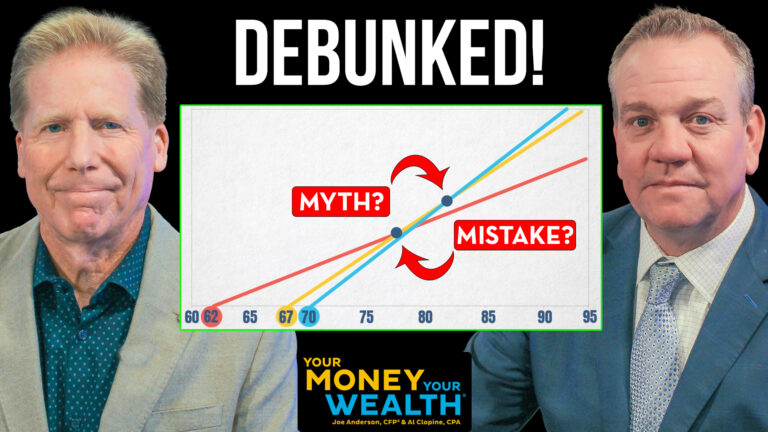
Al: You can lose up to 30% of your full Social Security benefit if you take it at age 62. True or false? Well, that actually is true. Full retirement age for most of us is age 67 currently, but you can take it as early as 62, but you’ll have a haircut of about 30% of your benefit.
Joe: Alright? Is that a big deal? Yes or no?
You don’t always want to run the numbers to figure out what’s best for you. I think it’s really what your life is all about, to come up with the right decisions here.
Al: Well, I think that’s right and I think a lot of financial advisors tell you to Wait, wait, wait, wait. And that’s not necessarily the right answer. Maybe it is, but maybe not. Some of you might need the cash early, so go ahead and take it. Some of you may want the cash early so you can take more vacations when you’re younger. It’s very personalized. Some of you, it will make sense to to wait because you’re working right? So just be aware. It’s, it’s different for everybody.
Joe: Let’s look about the taxation. Provisional income gets a little complicated because your Social Security may be subject to tax.
Al: And the way the formula works is you look at your adjusted gross income, you add non-taxable interest, you take half your Social Security benefits. You look at that combined income, that’s called provisional income, and then you gotta go to this little table to figure out, Joe, what your tax rate’s gonna be.
Joe: So up to 50 or 85% of your benefit is gonna be subject to income tax. It’s not an 85% rate or 50% rate. 50% of the benefit will then show up on the 10 40, or 85% of the benefit will show up on the 10 40 or somewhere in between here.
Al: Another way you can help this equation is instead of your required minimum distribution, maybe do QCD qualified charitable distribution, where you actually give money directly from your IRA to a charity.
And then it doesn’t show up on your tax return as income. It keeps that adjusted income, gross income lower and then maybe less of your Social Security will be taxed.
Joe: Yeah. There’s also, some other ones you talked about the QCD going, directly from your retirement account, but talk about a little bit more on bunching or itemized or the 65 plus bonus.
Al: Yeah, so there’s a concept called standard deduction itemized deduction. Standard deduction’s pretty high, so you have to have enough itemized deductions to be over the standard to get any benefit. So maybe you want a bunch deductions all in one year. Maybe you pay a couple years of property taxes in one year.
Maybe you do a couple years of contributions in one year, right? Be aware when you’re 65 and older. Also, there’s an extra deduction over and above the standard deduction per person.
Joe: So also when you’re looking at different tax strategies, there’s also legacy planning. So if I have a 401(k) dollars and I pass away those dollars.
Are still going to be taxed to my beneficiary. There is no way around the tax I’m gonna pay it. My spouse is gonna pay it, or my children will pay that tax. So understanding how assets pass to the next generation is also a factor on a, how you’re taking distributions today while you’re in retirement, or what is that overall withdrawal strategy?
What assets are the best to pass to the next generation, and what assets are probably the worst to pass to the next generation. Because if I have taxable dollars or capital assets such as my home or real estate or stocks, bonds, mutual funds. That are outside of retirement account. When I pass away, they get a full step up in cost basis.
The heirs can sell it and not pay any tax. So these are really tax efficient investments to pass to the next generation. These not so much Roth IRAs, no tax at all to the heirs, but they do have to deplete the account, but there is no tax. So these two are really good assets to think about as you’re passing to the next generation. The 401(k) probably the worst.
Al: Yeah, I think so too. And when you think about taxable assets like your real estate or stocks, a lot of people will ask, you know, towards the end of life, should I sell my assets? Should I sell my home? I’ll sell my home first so the kids don’t have to worry about it. Well, then you may have to pay a whole bunch of taxes when you sell your home. If you die with that asset, it gets a full step up in basis. The kids sell it. They don’t pay any tax.
Joe: Yeah. Another point too is that, let me put my child on, on title. be careful with that. Alright, because now you pass, you might only get a half a step up. Let the children inherit the assets. It’s a lot cleaner that way.
Build Guardrails Around Your Withdrawal Plan
Alright, let’s put some more guardrails on your withdrawal strategy. Keep it between three and a half and 4%. That is a distribution or burn rate from the overall portfolio. One to two money, cash. Or short term bonds, maybe a little bit more, maybe a little bit less, really, depending on what your risk tolerance is.
You have to adjust your strategy absolutely. With the market. We’ve been very fortunate over the last several years to have a market that keeps going up. We all know what comes up, goes down, and then it goes up. Then it goes down. We haven’t seen a downturn in the market for quite some time. You have to have a disciplined strategy.
When you’re taking withdrawals. You can abandon it or make sure that the strategy you have in place is stress test for bad markets, so you have to adjust as you go and then watch your spending. Right. Remember when you retire, it’s Saturday. Every day. What do we do on Saturday? We spend a little bit of money, so just be careful with that. Have fun, spend the money, but just know that, hey, I only have a finite number of resources. Make sure that you’re doing them appropriately.
Al: Yeah, and I think the guardrails Joe are, are so important because it’s not really figure this out set and forget. Just take the same amount every year. You gotta be looking at this every year.
That’s what makes this a little bit more tricky, the withdrawal side of things than saving. Saving. You can set and forget withdrawal strategies. You gotta review every year. Depending upon your goals, depending upon your previous spending de, depending upon your longevity, right? Depending upon what the market’s doing, you may have to change year by year.
Joe: Yeah. Some other things to consider too is you map your accounts, understand where your accounts and what are their tax types, where they held. How many accounts do you have? I have accounts all over the place. You probably want to consolidate. You want to take inventory, how much money that you have in retirement accounts, Roth accounts versus brokerage accounts, you want to project future tax rates.
Are they gonna stay the same? Are they gonna go down? Are they gonna go up? What do you think forecast your budget needs? Right? I wanna make sure that I have enough cushion in here for healthcare, maybe a long-term care state. You know what I want to pay for my kids, or grandkids wedding. Account for inflation, right?
The dollars that we’re spending today is gonna be different 5, 10, 15, or 20 years from now. Here’s your action plan folks. It’s up to you to take action. We can only lead you so far. If you want more help, go to our website, your money, or wealth.com. Click on that Special Offer. It’s our Retirement Withdrawal Guide. Understand your withdrawal strategy given your specific situation if you want to have a little bit more money. Stretch those dollar dollars out a little bit further. Get the right withdrawal strategy for you and your family, YourMoneyYourWealth.com. Click on that Special Offer. It’s our gift to you. All right, that’s it. Hopefully you enjoyed the show. For Big Al Clopine, I’m Joe Anderson. We’ll see you next time folks.
IMPORTANT DISCLOSURES:
• Investment Advisory and Financial Planning Services are offered through Pure Financial Advisors, LLC. A Registered Investment Advisor.
• Pure Financial Advisors, LLC. does not offer tax or legal advice. Consult with a tax advisor or attorney regarding specific situations.
• Opinions expressed are subject to change without notice and are not intended as investment advice or to predict future performance.
• Investing involves risk including the potential loss of principal. No investment strategy can guarantee a profit or protect against loss in periods of declining values.
• All information is believed to be from reliable sources; however, we make no representation as to its completeness or accuracy.
• Intended for educational purposes only and are not intended as individualized advice or a guarantee that you will achieve a desired result. Before implementing any strategies discussed you should consult your tax and financial advisors.
CFP® – The CERTIFIED FINANCIAL PLANNER® certification is by the CFP Board of Standards, Inc. To attain the right to use the CFP® mark, an individual must satisfactorily fulfill education, experience and ethics requirements as well as pass a comprehensive exam. 30 hours of continuing education is required every 2 years to maintain the certification.
AIF® – Accredited Investment Fiduciary designation is administered by the Center for Fiduciary Studies fi360. To receive the AIF Designation, an individual must meet prerequisite criteria, complete a training program, and pass a comprehensive examination. Six hours of continuing education is required annually to maintain the designation.
CPA – Certified Public Accountant is a license set by the American Institute of Certified Public Accountants and administered by the National Association of State Boards of Accountancy. Eligibility to sit for the Uniform CPA Exam is determined by individual State Boards of Accountancy. Typically, the requirement is a U.S. bachelor’s degree which includes a minimum number of qualifying credit hours in accounting and business administration with an additional one-year study. All CPA candidates must pass the Uniform CPA Examination to qualify for a CPA certificate and license (i.e., permit to practice) to practice public accounting. CPAs are required to take continuing education courses to renew their license, and most states require CPAs to complete an ethics course during every renewal period.