
As of this writing (4/30/2026), turmoil continues in the Middle East, and while we all hope for a permanent and peaceful solution, the reality is that wars and other geopolitical conflicts have long been a part of the human record. At some point, peace between the United States, Israel, and Iran will resume but it is a near certainty that another conflict will follow.
That is the bad news. The unfortunate reality is that global turmoil has always been a part of the historical record, and that seems unlikely to change in the future. That means that as an investor, you are likely to live through multiple armed conflicts over the course of your lifetime.
The good news is two-fold.
First, statistics show that the present age we live in is more peaceful than the 20th Century, although this may be difficult to believe given the nonstop flow of negative press we get from the 24-hour news cycle, online media, and doom scrolling Facebook.
Conflict Deaths Since 1945
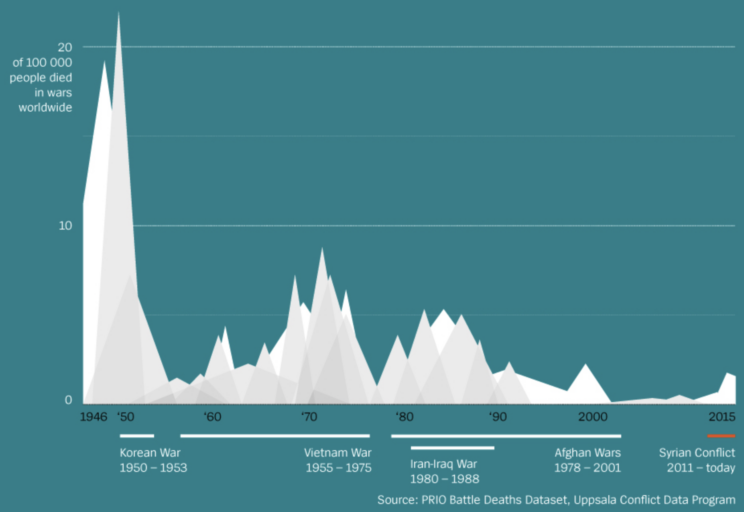
Furthermore, as an investor, the historical record shows that while conflicts are common, their impact is nearly always short-lived. Sure, global conflicts can be frightening, and it is easy to look for potential negative and/or long-lasting consequences. But it is important to set aside emotion and instead look at the evidence of how previous conflicts have impacted financial markets.
Fortunately for your finances, there does not seem to be a clear linkage between war and market declines. In fact, over the long run wars appear as just one more blip on the upward trajectory of stock markets.
The chart below shows the growth of $1 invested in 1926. An investor over the past century would have lived thru WW2, the Korean War, Vietnam, two wars in Iraq, 9/11 and Afghanistan, and a host of other geopolitical conflicts.
Growth of a Dollar
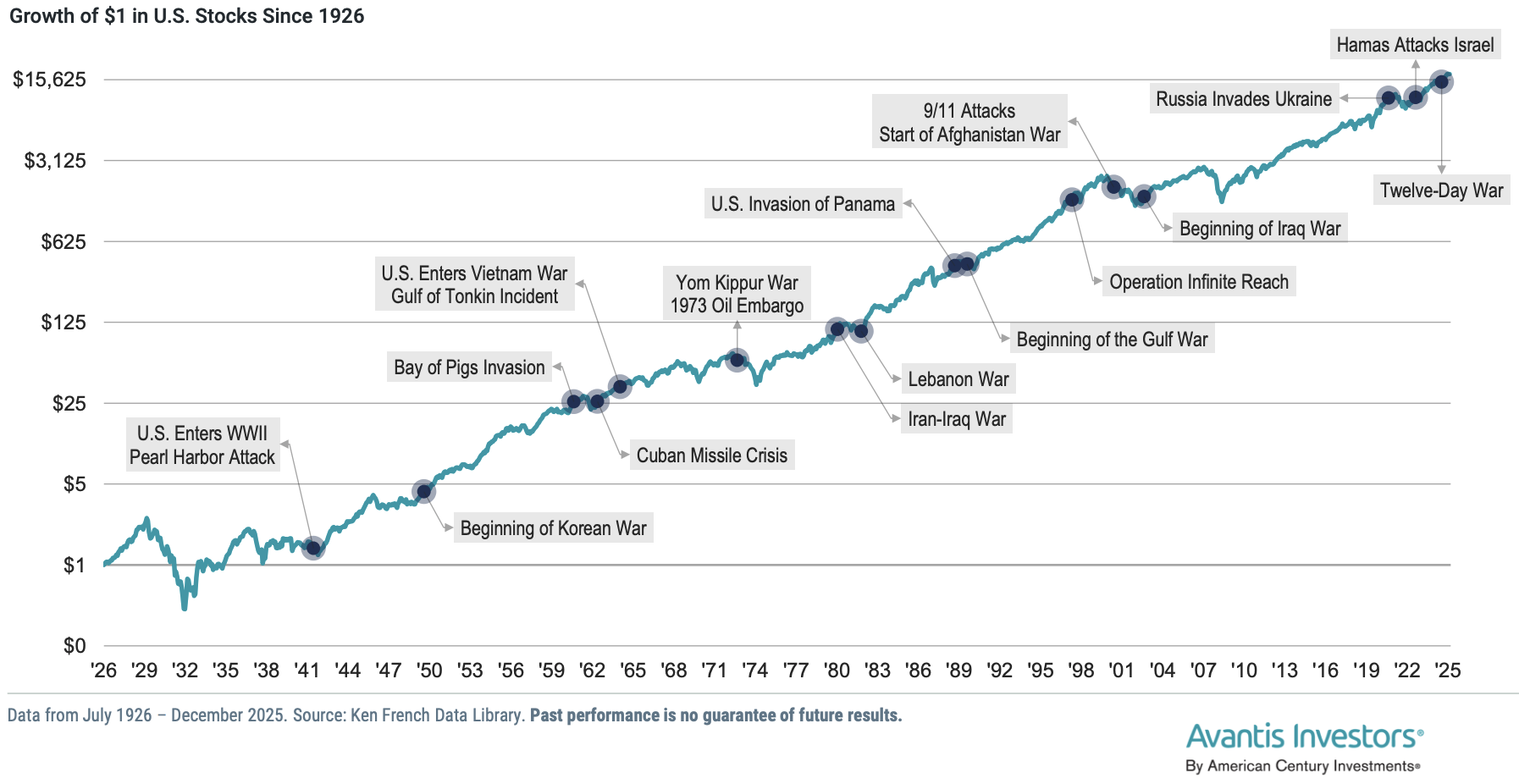
Despite the turmoil an investor would have lived through, that single dollar invested in 1926 would have grown to more than fifteen thousand dollars over the last one hundred years.
A Deeper Dive
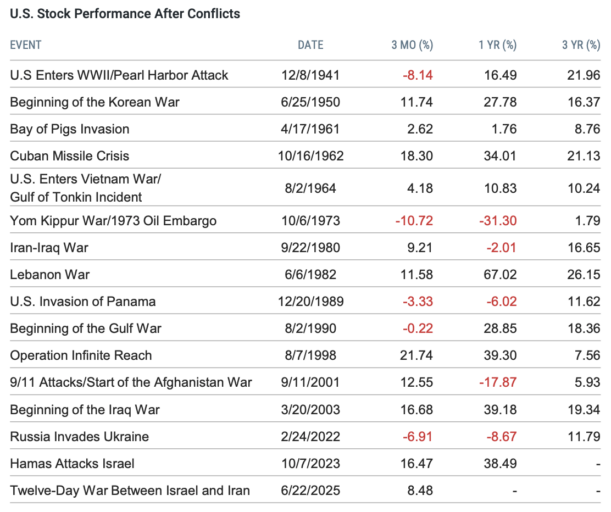
It is true that in the immediate aftermath of a conflict’s inception, the markets often decline as short-term traders flee uncertainty. But looking out a bit further, after 3- or 12-months markets are likely to be higher than they were pre-conflict. And if you extend the horizon to 3 years, markets have been higher in every scenario.
US Stocks Performance After Conflicts
The Reason Why
There is a simple explanation for the ability of financial markets to shrug off geopolitical events that often carry a horrific human toll. Here’s the key:
In the long run, you aren’t investing in a stock market…you are investing in a market of stocks.
That market of stocks represents ownership stakes in hundreds or thousands of companies. Some of those companies’ business models are shattered by war, but others are helped (think of defense contractors). Many other companies see little to no impact from a conflict, at least over the intermediate and longer-term horizon.
And so, as an investor, what you are focused on is the growth of corporate profits. And over time, corporate profits tend to grow as the global economy expands. From this perspective, conflicts are seldom more than a temporary hiccup. Furthermore, what impact does exist is never evenly distributed across geographies, industries, asset classes, or individual companies which means that a well-diversified global portfolio can be a powerful tool for hedging against geopolitical risks.
The Bottom Line
War is a terrible thing, and there is no denying that news headlines blaring negative events can be deeply unsettling but it’s at those times that it’s most important to step back and rationally analyze what impact geopolitical turmoil might have on your portfolio. Based upon historical precedence, wars and other conflicts tend to prompt short-term volatility. But in the longer run, well-diversified portfolios tend to rebound as investors turn their focus back to the longer-term trajectory of increasing economic growth and corporate profits.
Next Steps:
- Analyze your portfolio to make sure it is aligned with your required rate of return and risk tolerance.
- Review your investment holdings and asset classes to see if there are any others that might provide protection against future volatility.
- Take a deeper dive into your overall financial situation using our free Financial Blueprint