As the chart below shows, since March the interest rate on a 10-year Treasury bond has risen from approximately 4% to north of 5%. Other maturities have risen by similar or even greater amounts.
10-Year Treasury Yield (YTD thru 9/24/26)
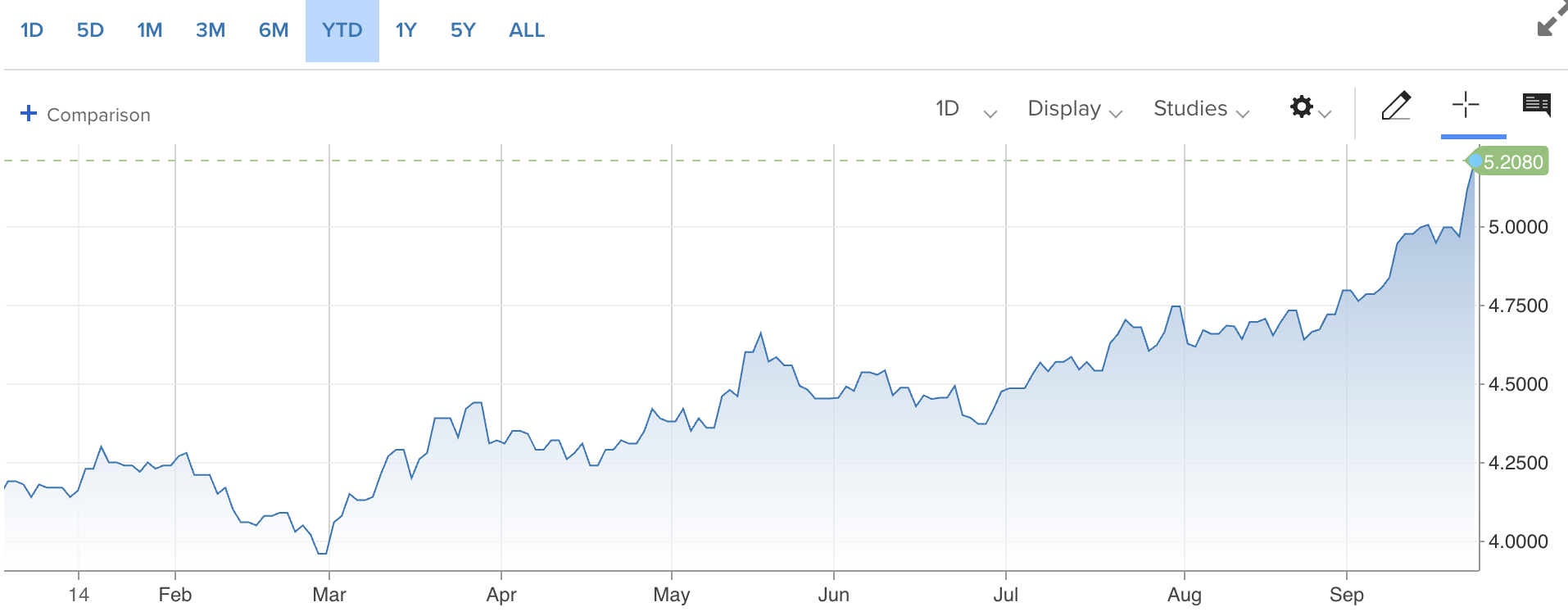
Source: CNBC, U.S. 10 Year Treasury, Accessed in September 2026.
These increases have prompted questions from investors. With that in mind, let’s look at several of the reasons for this increase, as well as the impact it might have on portfolios.
Question: Interest rates have been moving higher? What’s going on?
Answer: There are several factors at work.
In our view, there are several proximate causes, many of which are intermingled.
- The war in Iran has driven energy prices higher
- Higher energy costs have pushed up inflation readings
- Rising inflation prompted the Federal Reserve (Fed) to raise overnight lending rates for the first time in several years at its last meeting
- Meanwhile, the AI investment boom is adding to demand for capital, putting further upward pressure on rates
One thing to consider is that in the longer run several of the proximate causes can act as a double-edged sword. For instance, while higher energy prices can be inflationary in the short run, in the long run they can act like a governor on economic growth, which is inherently deflationary. In the short run, Fed rate increases can lead to higher bond yields, particularly if the market perceives that the Fed is behind the curve. But because rate hikes are designed to moderate the economy and lower inflation, all else being equal, they can ultimately lead to lower long-term interest rates. Perhaps that is why market-based inflation expectations such as TIPS and inflation swaps remain anchored around 2.25%, which indicates that investors do not think inflation is likely to get out of control in the coming years.
There are also two more points to consider. First, it’s important to remember that like all markets, interest rates fluctuate, and recent movements could just be part of the natural ebb and flow.
And second, while interest rates are higher than what we’ve generally seen over the past ten or fifteen years, they are well within the range we’ve seen on a longer time horizon. In fact, interest rates and bond yields still sit well below levels in the 1990s, a time of American prosperity and incredible financial market performance. In part that is because strong, growing economies tend to have higher interest rates because there is a high demand for investment. So, while the shift to higher rates can sting in the short run, it may also be a sign that the overall economy is performing well.
10-Year Treasury since 1980 (thru 9/24/26)
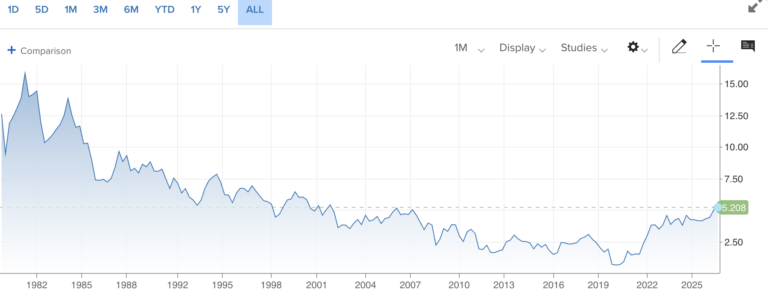
Source: CNBC, U.S. 10 Year Treasury, Accessed in September 2026.
Question: But what about the national debt? Should I be worried about that?
Answer: It bears monitoring. But markets may move higher in spite of the debt.
One final item contributing to the recent increase in interest rates is the level of the national debt, which recently approached a record $40 trillion. That is a big number, and ultimately a large national debt could lead to structurally higher interest rates.
National Debt (Since 2016)
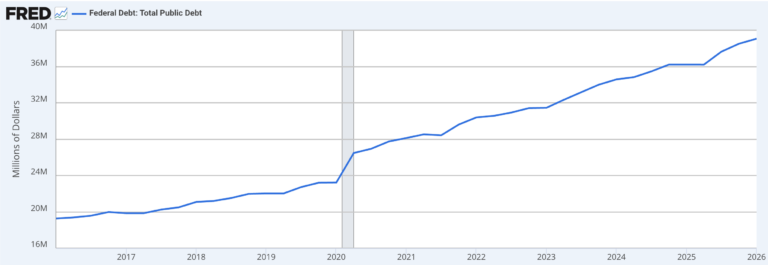
Source: FRED, Federal Debt: Total Public Debt, Accessed in September 2026.
But before you worry too much, consider a few things:
- We have been fielding questions about the debt for decades, but markets generally haven’t reacted to the debt level. That could change but doesn’t have to.
- While the absolute level of debt has increased over the years, so has the size of the economy. The number that really matters is debt as a percentage of GDP. Measured that way, the debt has increased but not as exponentially as the gross amount.
- Japan has had a much higher national debt than the USA for decades, but their interest rates generally remained below 1%. And though they have risen recently, even today Japanese rates are below ours. So, there is a precedent for high debt levels not leading to high interest rates.
- The U.S. benefits from being the world’s reserve currency, and there aren’t really any contenders for that spot. This allows the country to fund the debt at somewhat advantageous rates.
- According to a recent report from the Institute of International Finance, foreign demand for US Treasuries and corporate debt remains strong.
The bottom line is that the debt level bears monitoring, but it doesn’t have to be a disaster. In the long run, the amount can be paid down through a combination of stronger economic growth, higher inflation, or higher taxes. Those last two items (inflation, taxes) are areas it’s important to focus on in your financial planning and we are constantly evaluating ways to mitigate them.
Question: Well, what do higher interest rates mean for my bond portfolio? Is there any good news?
Answer: Yes. There’s actually a bright silver lining to rising interest rates.
In the short term, bond prices fall when interest rates go up. So, if you look at your investment statement, you could see mark-to-market losses in a rising interest rate environment. But in the longer run, not only is there a silver lining to higher interest rates, but as a matter of fact, you could argue they are actually a good thing. That is because the majority of a bond’s return comes from the income the bond generates. And higher interest rates lead to more income.
This has an important impact on your overall portfolio and its ability to help you meet your financial goals.
Consider the following (hypothetical) scenario:
Scenario: To meet their financial goals, a hypothetical investor needs to earn 6% from their portfolio over time. To accomplish this, the investor decides to put half of their money in stocks, and the other half in bonds.
2020: The year is 2020, and the yield on the 10-year Treasury sits below 1%, while our hypothetical investor’s bond portfolio is yielding perhaps 1.50%. That means that the bond portion of their portfolio is contributing 0.75% to their overall portfolio return (1.50% return X 50% allocation = 0.75%). But remember, the overall portfolio needs to generate 6% for the investor to meet their goals. Doing some reverse engineering, that means that the stocks the investor owns need to contribute 5.25% to the overall portfolio return (0.75% from bonds plus 5.25% from stocks = 6.00% combined returns). But only ½ of the portfolio is invested in stocks. That means that for the investor to meet their goals, their stocks need to earn an 11% return (0.5 X 11% = 5.5%.)
In other words, when interest rates are very low, investors need their stocks to produce above average returns if they are to meet their overall required rate of return.
2026: The year is now 2026, and the yield on the 10-year Treasury sits around 5.00%, while our hypothetical investor’s bond portfolio is yielding perhaps 5.50%. That means that the bond portion of their portfolio is contributing 2.75% to their overall returns. (5.50% return X 50% allocation = 2.75%). But remember, the overall portfolio needs to generate 6% for our investor to meet their goals. Doing some reverse engineering, that means that the stocks need to contribute 3.25% to the overall portfolio return (2.75% from bonds plus 3.25% from stocks = 6.00% combined returns). Once again, only ½ of the portfolio is invested in stocks. That means that for the investor to meet their goals, their stocks need to earn a 6.50% return (0.5 X 6.50% = 3.25%.)
In other words, when interest rates are at higher levels, investors can meet their financial goals even if stocks don’t do as well as they have in recent years. Looked at another way, a higher yielding fixed income portfolio can allow investors to take less equity risk.
The bottom line
The bottom line is that while rising interest rates can cause mark-to-market losses for bond investors, these losses are only realized if the investor needs to sell the bonds. For investors in it for the long haul, rising rates can be a significant benefit. That is because across a market cycle, higher interest rates have historically meant higher bond portfolio returns. That also means that bonds can make a more meaningful contribution to an investor’s efforts to meet their required rate of return.
Next Steps:
- Review your financial plan and investment portfolio to determine your required rate of return.
- Evaluate your investment mix and consider whether you have an appropriate mix of stocks, bonds, and other asset classes.
- Take a deeper dive into your overall financial situation using our free Financial Blueprint.