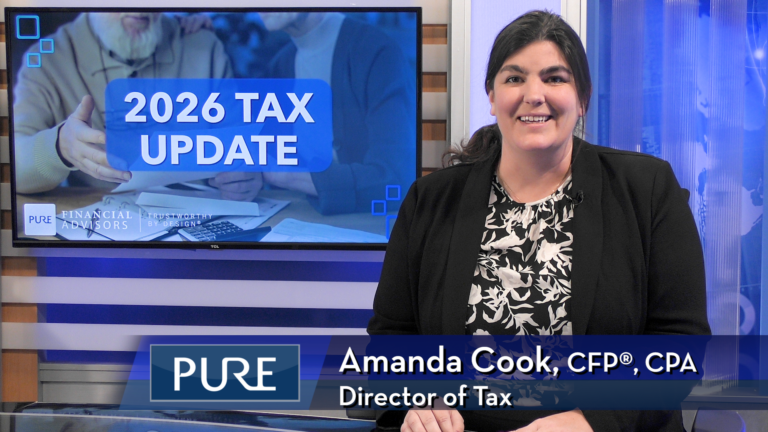
Pure’s Director of Tax, Amanda Cook, CFP®, CPA, Esq, provides strategies and proactive planning techniques to help you make the most out of tax-saving opportunities in 2026.

Outline
- 00:54 – Tax Return Basics
- 07:16 – Tax Rates & Tax Cuts Jobs Act
- 10:49 – New Deductions & Trump Accounts
- 15:24 – Charitable Contributions & Social Security
- 19:44 – Types of Income & Tax-Advantaged Accounts
- 26:02 – Q&A
- Can you explain what provisional income is, and does that include my spouse’s income?
- Where are gold and bitcoin in tax account environments?28:31 – Retirement Plans & Contribution Strategies
- 42:01 – Advanced Tax Strategies & Q&A
- Can you explain how you get property into either your donor-advised fund or an IRA?
- Are companies charged tax when they sell their company stock or when they put it into a taxable account?
- What is the net investment income tax?
- Should only high-wealth people have a donor-advised fund?
Transcription:
(NOTE: Transcriptions are an approximation and may not be entirely correct)
Kathryn Bowie, CFP®: Thank you for being a part of this tax planning webinar. We have Amanda Cook, Esquire, CPA, CFP, and our director of tax. We appreciate you being here, everyone, and we appreciate Amanda for taking her time to take care of us and give us all this great information. So I’m gonna let you take it away.
Amanda Cook, CFP®, CPA, Esq.: All right. Well that sounds great. Thanks so much for attending. We are talking about tax planning today. And this is the perfect time to be talking about tax planning because taxes are due in three weeks. For those of you who are not counting down the way that I am. So April 15th, it is for most people you can get an automatic extension to October 15th.
However those extensions are only an extension of time to file and not an extension of time to pay. If you owe tax, that’s gonna be due on. April 15th.
I wanna talk about first some of the just high level basics. When you’re looking at your tax return, what are some of these numbers you’re gonna see and what do they mean?
The first one is your gross income. Gross income is all of your income from whatever source derived. That’s how it’s defined in the internal Revenue code. Or how I like to say it is everything is taxable unless it isn’t. So, you’re gonna see everything that is a gross income item added up and totaled onto a line.
That says total income on the tax return, and then you’ll have adjustments after that. These are frequently called above the line deductions. Ever since 2017, that’s kind of not really been descriptive of the tax return the way it used to be. So it’s mostly us old, older practitioners who still refer to them as above the line deductions.
But basically these are deductions that you can take. That will affect your adjusted gross income and you don’t have to itemize for them. So most, the most common ones are for people who are self-employed. Some people with older divorce agreements may have deductible alimony. There’s $300 educator expense, which is really popular.
So a couple of adjustments like that. These bring you down to your adjusted gross income, and that’s the really big meaty number that we need for most tax calculations. Most phase outs are gonna be based on this a GI number, or sometimes it’s modified, and then it’s called modified adjusted gross income or magi.
But we’ll be talking about a lot about your adjusted gross income and what kinds of tax considerations there are for that number specifically.
Once you’ve determined your. A GI. Then we go to your deductions. So you have a choice. Each year you can take the standard deduction or you can take itemized deductions. The itemized deductions are all limited in their own way. So, you know, state and local income tax was limited to 10,000 new for 2025. If you’re preparing your 2025 return, it’s 40,000 For 2026, it’s 40,400.
Those numbers do phase out for a GI above about 500,000. There’s mortgage interest that is limited to the mortgage interest paid on up to $750,000 of principal. For most people, medical expenses have to exceed 7.5% of your a GI before any of them are deductible. So again, A-G-I-A-G-I-A-G-I. And then these charitable contributions, we’ll talk more in depth about later, but a lot has changed for 2026.
For 2025. It’s the regular rules that many of you probably know, which is that you can deduct your charitable contributions up to certain percentages of your income, depending on if it’s capital gains, property, cash, or non-cash contributions. When you add up all of your itemized deductions, if they’re more than your standard deduction, you’ll usually take the itemized.
If they’re less than your standard deduction, you’ll usually take the standard. There’s a few exceptions to that. Sometimes from a state perspective, it might make sense to take the less optimal deductions for federal purposes so that you can do the same for the state. Take the more optimal but for the most part, whichever one is higher is the one that you’re gonna take.
And then that gets subtracted from your a GI and brings you to your taxable income. So taxable income is the amount that your. Tax is actually based on. So once you’ve determined what that that taxable amount is, well actually new for 2025. There’s a couple of deductions that are ahead of determining your taxable income that are after your itemized or standard deductions.
QBI qualified business income. That has been around since 2020, but there’s a new. Personal exemption for senior citizens, those age 65 and older. There’s also a new one for tips and overtime income, and there’s a new one for auto loan interest. All of these have a GI limitations associated with them, but you don’t have to itemize in order to claim these deductions.
So those are new for 2025. They go through 2028 for the most part. Once you’ve identified your taxable income and calculated your tax, you can reduce your tax dollar for dollar by claiming tax credits. So common tax credits are gonna be the foreign tax credit. If you have any kind of a brokerage account, a lot of times you’ll see that reported on your dividend statement.
So you can deduct that there. Also the child tax credit is very common dependent care credit, American opportunity credit and earned income credit. So these are all kinda working family credits.
All right, so. Just to really drive home. What’s the difference between a deduction and a credit? Is that a deduction is just gonna reduce your taxable income, so you’re still going to pay for that deduction in a way. So a lot of times, you know, people think, oh, well I have this this business write off for example.
So if I pay $5,000 for this business, write off, it’s like it was free. No, it’s like you got a 25% discount if your tax rate is 25%, the other 75% is still coming out of your pocket. It’s just reducing the amount of income that we’re basing the tax on a credit on the other hand, will be directly offsetting the tax dollar for dollar.
So that will be true money back in your pocket.
All right. So a lot of do to do has been made over the last several years about the Tax Cuts and Jobs Act, which was passed in 2017. It reduced tax rates for, or the tax brackets for everybody. And it was by its terms set to expire at the end of last year in 2025. So everybody was thinking in 2026 we would have the this big tax increase.
During the year last year, they passed the one big Beautiful Bill Act, or O-B-B-B-A. And what they did in that act, among other things, is that they made this this regime permanent. So what that means is that it doesn’t have a sunset built into it. Of course, congress can always change the tax rates from one year to the next, but there’s no automatic change from these brackets.
So each year these numbers are gonna inflate and the way it works is that you pay, you know, first you pay the first rate, then you pay the next rate on each of these bands of income based on your taxable income.
So giving an example of that, you know, you can see the tiers here. I think I need to move out of the way here, but if there’s a little bit of a. Of income here in the zero to 12,400, that amount is gonna get taxed at 10% and then the next amount will get taxed at 12, and then the next amount will be taxed at 22.
So if you think to yourself like, oh I’m in the 22% tax bracket, and and I don’t wanna go into the 24% tax bracket because I don’t wanna pay 24% tax. It’s not gonna work that way. You’re still gonna pay 22% you know, well the 10, the 12, and the 22%, and it’s only those last couple dollars that you end up paying 24% tax.
So just a really important distinction, especially if you use the tax table, you can see this on your own return. If you take your taxable income and you multiply it by your tax bracket, that number should be higher than what your tax is.
Capital gains are calculated separately. We say they sit on top. So how that works is that first you figure out the tax on all of your other income that’s not qualified dividends or long-term capital gains. Then you figure out where you are on this chart, and that tells you what your bracket is for capital gains.
So it ends up being a little bit of a blended rate, but they can be as low as zero. For most people it’s 15. You can see those are very wide bands. And then for higher income people, it’s 20%. There’s also a net investment income tax that applies to capital gains style, income, and other investment income.
Of 3.8%. That is not adjusted for inflation. That’s gonna affect single well married filing jointly, 250,000, pretty much everybody else, 200,000. So a couple big changes for this year. I know I’m kind of running through this. It’s a lot of information. We’ll slow it down here as we get into the new kind of things that are gonna change going forward.
But, one of the big changes is taxpayers 65 and older do get a personal exemption again. So this is $6,000 for one person or $12,000 for both. If both people are over age 65, the the one big beautiful bill act put this into place for 2025 to 2028. And this is the thing. That was advertised as removing tax on social security.
So if you thought your social security was gonna be tax free and now you’re doing your tax return and you’re seeing that, oh no, it is still taxed, that’s because no change was actually made to how Social Security is taxed. There’s just significant overlap between the people who will qualify for this credit.
Or this deduction and the people who who collect social security. But if you’re, you know, over 65 and you aren’t taking Social Security yet, you still qualify for this. If you’re under 65 and you are taking Social Security, you don’t you won’t qualify for this. This is also limited by a GI. So a GI is gonna be 75,000 for most taxpayers, 150,000 for married filing joint.
So that’s that one. Tips in overtime. Tip income has been really a kind of a quagmire for people to figure out. It’s only tips that are paid. Optionally by the payer. So for example, if you go to a restaurant and they automatically add a 15% or 20% gratuity to your bill, that wasn’t at your option, so it would not be deductible by the waiter who received that tip.
It’s also only applicable to to people who normally receive tips in their job as of the time of the law passing. So if you wanted to tip your financial advisor or your tax preparer or somebody like that, they would not be eligible to deduct that tip. So you’re not giving them a, an extra deduction, unfortunately.
Overtime is kind of the same thing. It’s the pay that you normally make is not is not deductible. It’s only the bonus that you get for the overtime. So, for example, if you make $20 an hour and a working overtime hours gives you an extra $10 an hour time and a half, the deduction will only be for that extra $10.
Both of these are a little bit of an honor system this year. There’s no form for it. There’s nothing on your W2 that’s gonna indicate how much of your income is eligible for either one of these. Maybe your pay stubs would help. But next year there’s expected to be a form for 2025 since this passed in the middle of the year, and it was retroactively effective.
There’s no form for it. And a lot of employers didn’t even have a mechanism to track it retroactively. So that’s kind of on you if you qualify for either one of those. And then the last thing that I wanna highlight here is Trump accounts. These are a new form of tax preferred account for anybody that’s under age 18.
It can be used to save for college, to save for home, you know, different. Different expenses that may come up in the early adulthood years. It’s similar to an ira. But one big difference between this account and other types of accounts is that if your child is born in the next couple of years, the government will deposit a thousand dollars into it.
So, in those cases, you know, maybe just take the money right?
All right, so social security tax. I mentioned already that there has been no change to how that is taxable. It is still calculated based on your provisional income, and it’s gonna be taxed either 0%, 50%, or 85%. It kind of slides through those scales. The top amount that will be taxable is 85%. If your income is low enough, it would be as low as zero, or it could be somewhere in between.
Going back to charity this year in 20, in 2025, nothing really changed with charity, as I mentioned earlier. For 2026, there’s been a couple of changes to charity. One is that if you are making cash contributions, so cash or check not stock, or you know, donations of, you know, maybe personal goods to a charitable organization, but just cash and checks if you’re making those kinds of contributions, even if you don’t itemize.
You may deduct $2,000 for married filing joint or $1,000 for pretty much everybody else directly on your tax return. No itemized necessary. So you can think of it as sort of being like a boost to your standard deduction. If you do itemize in 2026, there is a brand new floor. For charitable contributions.
So it’s one half of a percent of your a GI will be non-deductible. So first you have to exceed that one half percent level before your, any of your charitable contribution is deductible. So it’s a, it creates a little bit of a different calculation than normal because maybe, maybe you’re close to itemizing, but you do a thousand dollars of charity and that makes your standard deduction a little bit higher.
So then you’ll just take that benefit instead of taking your $1,000 minus one half of your a GI for your itemized deductions.
This year also, there is an enhanced catchup for retirement contributions. If you’re age 60 to 63, you can do one and a half times, I believe it is, of the of the regular catchup contribution to your employer sponsored plan. If you are high income, that does need to be to a Roth account.
So thinking about how your taxes are gonna be going forward. You know, there’s this concept that we call tax time bomb, right? All of the assets that you’ve built up are going to be taxed probably at some point with a couple of minor exceptions. So the question is, when do you wanna pay the tax? Do you wanna pay it now?
Or do you wanna pay it later? Right? And so you can be strategic with the items that you own about how and when to pay that tax. You can see here that taxes have been all over the map, over the course of US history. During the World War II era, we were still pretty much paying our deficits, and so the highest marginal tax bracket went up to 94%.
Now remember, that’s just the highest marginal tax bracket, so that’s only gonna be the amount of income that’s in the 94% bracket, but still that’s a pretty high bracket. Over time that has gone down, it’s currently at 37%. So. For the most part, we have pretty low tax rates these days. You can see it over time.
Historically, they’re relatively low. So that might weigh in favor given your particular circumstances to paying taxes today versus in the future.
The average American will pay over a half a million dollars to some form of tax. This number I checked our sources, and this number includes property tax, sales tax income tax, all these different types of taxes. It also breaks it down by state. So, if you check the source here, you can see itself.
Do Inc. But it breaks it down by state. The highest tax state is not California, as many people would be surprised to find it’s actually New Jersey.
All right, so let’s talk about how different types of income are taxed. This is really where, you know, you can’t do anything about 2025. This is our planning segment right in 2025. Whatever happened already happened. That’s what you’re reporting on your tax return now in 2026 and going forward, this is what you can control and how are you gonna control your taxes?
Depends on what kinds of assets that you have, right? So you’re gonna have certain types of income, like your W2 income, your business income. Things like that. Those are your ordinary income items, and if you’re working and you’re kind of in the accumulation phase, your job is make as much money as you can, right?
And pay your taxes, but you’re gonna wanna save some of that money for future retirement. Or maybe you’re already approaching retirement and you usually have a choice between a couple of different accounts. Okay? You can choose tax-free account, taxable account, and tax deferred account. Most people choose this account because it’s pre-tax today they get a 100% deduction for the money that they put into this account.
This is your traditional 401k, 4 0 3 B-T-E-S-P traditional IRAs. So these accounts. Are pre-tax going in. They reduce your taxable income this year, and then when you retire, you start taking money out. They’re taxed at ordinary income rates, which is the same kind of rate that you’re getting on your wages.
Okay, so this is the tax table that we were showing you before. This is your 10 to 37% right? Another option is that you can save money into your taxable account. This is your typical brokerage account.
This account is gonna be invested in stocks and bonds. Usually whatever you paid is gonna create basis, so you’re putting in after tax money. Then you don’t pay tax on that money again. But anything that is growth in this account will come out at those capital gains rates. So as we mentioned, that’s 15 for most people, but could be as low as zero or as high as 20.
Finally, there is the tax free account. And this is like your Roth accounts up here could also put HSAs up here. But here, although HSAs are pre-tax when you contribute, but here for the most part, you pay the tax on the money going in. So you get no benefit to today for putting money into this account.
But when, by assuming it’s a qualified distribution, when it comes out, you pay zero. So all of these accounts have their respective roles in order for you to control your taxes. But we find that most people, because they’re saving so much money in this tax deferred account, that they have what we call a tax time bomb.
Why is there a bomb? At some point, there’s gonna be required minimum distributions, RMDs. That’s gonna start forcing money out of your account whether you need it or not, and it’s gonna be taxable at 10 to 37%. There’s also a concept called income in respect of a decedent. So even if you pass away with this money, your heirs are still gonna pay tax at whatever their ordinary income tax rate as is, as if they were you.
Meanwhile, this account is totally accessible for your whole life. You’re just paying tax on the gains, and then if you die with assets in your taxable account, they get what’s called a step up in basis for the most part, and so they’re not gonna be taxable to your heirs. And then there’s the tax free account, which has no RMD requirement.
When you pull, you can pull money out as you need it without paying any tax. And if you die with money in that account, your same concept here as the IRD, but your heirs will be taxed as if you, as if they were you, which would still be at this lovely rate of 0%. So. Because so many people find themselves with a lot of money in this tax deferred account.
They wanna know what’s the best way to get this money out. And this is where really managing your tax bracket and understanding what is your a GI, what is your taxable income and how do these things play into each other each year can help you really optimize. What rates are you paying here? You can take money out of this account and move it to this one that’s called a conversion.
And so you can be strategic about when you pay tax here instead of waiting for RMDs to force it out. Also from that date, any future growth that happens in that account is coming out. Tax free. So that’s the advantage of this tax-free account, but that doesn’t mean completely blow out of your tax deferred account.
You don’t necessarily wanna weigh, overpay your taxes today in order to underpay your taxes in the future. So really just managing your brackets and your timing depending on what your particular situation is.
Kathryn Bowie, CFP®: Someone said, I heard the regarding social security, that it’s half my social security check and you said all provisional income.
Can you explain what is provisional? And does that include my spouse’s income?
Amanda Cook, CFP®, CPA, Esq.: Yes. So provisional income is going to be all of your non-social security income on a joint return. That would be all of your joint. Social Security or all of your joint non-social security income plus one half of your social security income.
Kathryn Bowie, CFP®: And then that’s, and also by the way, you said 85% tax, you meant to say 85% of your social security check is taxed.
Amanda Cook, CFP®, CPA, Esq.: Right. That’s right.
Kathryn Bowie, CFP®: Yeah. So what is it’s tax
Amanda Cook, CFP®, CPA, Esq.: at ordinary rates, whatever your tax bracket is.
Kathryn Bowie, CFP®: Correct. So when to typed in 85%, I’m being taxed 85%. Okay. Just to be clear that it’s zero po portion of your social security check or half of your social security check, or up to 85% of your Social security check might be taxed.
At ordinary income
Amanda Cook, CFP®, CPA, Esq.: and it does kind of slide between those. So, so it could be that a portion of your check is taxable at 50%. It might not be like 0, 50, 85, but but those are the thresholds.
Kathryn Bowie, CFP®: Okay. And then last question we’ll get to is regarding the areas that you were just talking about where is gold?
Bitcoin in that, in those environments,
Amanda Cook, CFP®, CPA, Esq.: gold and Bitcoin, they’re typically gonna be here. But some and gold is actually, its capital gains rate is 28%, or your ordinary rate, if that’s less because it’s a collectible. So that’s a kind of a special case. It just has a different rate. So it’s, for the most part, it’s gonna be ordinary income tax rate.
Bitcoin is considered a capital asset, not a currency. So it will be just a normal zero, 15, 20%. That’s if it’s held in your brokerage or in your crypto account wherever it might be. You can also, depending on your your custodian. You can potentially hold those types of assets in these other accounts,
Kathryn Bowie, CFP®: okay?
Amanda Cook, CFP®, CPA, Esq.: In which case they’re not taxable until you distribute money. All right? So,
for most people, most of the time, employer plans are one of the best tax advantaged ways to save. For 2026, looking ahead, you know, 2025, as we said, what’s done is done for employees, but for 2026 elective deferrals are up to 24,500.
There’s a catch up available if you’re over age 50 of 8,000 if you’re between ages. 60 and 63, you get a special catchup of 11,250. That is instead of the 8,000, not in addition to the 8,000 many, many employer plans have a Roth option more than ever. Have a Roth option now because if you’re high income, you are now required to make your additional catchup contribution or your special catchup contribution on a Roth basis.
IRAs are another, you know, they’re kind of a personal account. If you have an employer account. Your ability to deduct your traditional IRA account may be impacted by the existence of your employer account and your a GI. So you might not be able to deduct your traditional IRA contribution, but you can always make a traditional IRA contribution as long as you have earned income to support it.
Roth IRAs, on the other hand, are Magi Limited, so when you wanna make a contribution to a Roth IRA, you may find that you are over the contribution limit. You can contribute to these even if you’ve already maxed out your employer plan. There’s no sharing in the limits between those two different plans, and this is one of the few things that you can do after the close of the year.
To potentially impact your, either your savings strategy or your 2025 tax return. If it is deductible and you make a traditional contribution between now and April 15th, you still would deduct that on your 2025 tax return. But as I mentioned, if you had an employer plan that you participated in. And your income is high enough overall income, then then it would not be deductible, so it wouldn’t impact that return.
That’s part of another strategy. If you are self-employed, and this includes like these kind of side jobs, right? If you have. A profitable side business, even if it’s small, it could be a good opportunity to stock a little bit of extra money away into your employer plans. You can create. If you have no employees, you can create an individual 401k plan.
And that’s really the, the one that’s gonna give you the most juice, right? It’s gonna allow you to maximize your employee side contributions up to a hundred percent. Of your taxable net income and it’s not included in pro rata calculations for traditional IRAs. So if you have made non-deductible traditional IRA contributions in the past, this is a way that you can you can get your basis out of that account tax free without waiting until you’ve depleted the entire account.
However, it’s a little bit more work to set it up. It’s a little bit more expensive to run it, and you do need to file Form 5,500 EZ at least when you close the account, but potentially each year if your balance is high enough. Alternatively, there’s two different types of IR accounts. They’re better for people who are not likely to maximize their contributions.
For the most part, or people who have already potentially maximized their contributions at their main job. SEP IRAs are contributions by the employer side only, and simple IRAs just have lower limits than 4 0 1 Ks.
When you have employees, things get a little bit more complicated. There are Safe Harbor 4 0 1 Ks that can allow you to set a partic a particular minimum match for your employees and then that helps you be excluded from some of the testing that goes on in 4 0 1 Ks. There’s a lot of testing for making sure that you’re not discriminating against any of your employees in favor of your highly compensated employees.
So really important. Feature that allows you to minimize the costs of managing your plan and prevent those over contributions by higher income employees. There’s also some options that came about in the two secure acts that offer different credits or different additional benefits that you could provide to your employees.
There’s a starter plan, which is kinda like a mini 401k. The student loan matching allows you to do an employer match to the, your employee’s retirement account based on what they’re paying to their student loans. So really good perk if you wanna offer that in California as of 12 31 20 25, if you have even one employee that’s not yourself.
You do need to have either an employer plan set up or you need to be enrolled in Cal Savers, which is like a, A Roth IRA for your employees.
All right, so I mentioned earlier that if you have a traditional IRA here, you could have a non-deductible contribution. And what that means is that. You didn’t get to deduct it and it forms basis in your account. So let’s say that this year you contributed $8,000 at the, be, well, we’ll say 2025 at the beginning of the year, and now it’s today and it’s $10,000.
If you wanted to roll this into into a Roth, IRA. It would be 80% non-taxable. That’s the pro rata rule. So just very straightforward. You put this money in, it’s non-taxable, but all the growth that happens on that money remains taxable. So what ends up happening is, let’s say that the zero isn’t here.
Let’s say that the zero is here. Right. And we have a much bigger account. It is then you are just talking about like a 0.08%. I’m not sure what the math is here, but it’s gonna be non-taxable each year. So, so that’s what the pro rata rule means when we’re talking about IRAs. That’s where you would wanna maybe isolate your basis if you have basis already.
But if you have no balance in your ira. Already. So your IRA balance is zero and it will be zero at the end of the year other than whatever contributions you make. Then let’s say you just do your $8,000 contribution to a traditional IRA. You convert your entire IRA to a Roth IRA, and that gives you a tax free contribution to a Roth IRA.
So this Roth IRA, has. Income limitations be to make a direct contribution, but this is called a backdoor Roth, IRA tradi. Technically it’s a contribution and then a conversion in order to get this money into the Roth. IRA. So the big key though, is this pro-rata rule. If you have any other balance in your traditional IRA, that is pre-tax money, that’s gonna create the situation where you have to figure out how much is tax free.
And it’s just like even even pro rata.
You could also, if you already have an existing IRA account, maybe you rolled over a 401k or you’d been contributing for a long time, you could convert much larger amounts as as we talked about with kind of the tax triangle there, you can convert to control your tax brackets. So for example, you know, let’s say that you are in the 22%.
As shown here, but you’re expecting that your RMDs from your IRA are gonna put you in the 32%, right? You could pay tax now, fill up this bucket, and then you’re only paying at 22%, and that can help you bring. This future RMD down to a more manageable level. Maybe you never end up in the 32%, your maximum is ever 24%.
So that’s kind of the goal of doing a conversion is that we’re just kind of, we’re looking at where are you today? Where will you be in the future? And does it make sense to, to start filling up these buckets today?
You’ll wanna avoid this strategy potentially depending on the balance of your account and and what your future expected rates are. There’s some cases where it just might not make sense. One is you’re in. 0% capital gains, as I mentioned before, you’re gonna calculate all of your ordinary income.
That’s what’s gonna tell you what ordinary income bracket are you. And then from there you see what band are you in for capital gains purposes, and you pay that tax. So if you’re in the 0% and then you start adding ordinary income, then you’re going, you’re gonna push those capital gains. From zero to 15, and even though technically it’s not being double taxed, it feels like being double taxed because you’re taking money that would have been at zero and you’re now putting it into 15.
So sometimes it’s not a good thing to do. Also, going back to that social security question, same thing happens with social security. Sometimes you add a little bit of income and then it makes more of your social security. Taxable. So again, it feels like a double tax even though technically there are different types of income that are being taxed.
The qualified business income deduction. Phase is completely out for people who are in specified service trades or businesses. I know all about that. That means lawyers. It means CPAs, it means CFPs. It also means a lot of other, you know, just service-based professionals who are reliant on their reputation to make money and their, you know, their knowledge or skills to make money.
They’re not manufacturing anything. They’re not building anything their service trades or businesses. Those people, their qualified business income deduction, which is a 20% deduction off their business income, will be phased completely out if their income is too high. So it may make sense to avoid doing Roth conversions while you’re operating a business in years when you would otherwise qualify for this deduction.
For those who are 63 and older, Medicare tiers begin to be a concern. Why 63? Because the Medicare office looks two years ago at your tax return to see what Medicare tier do you belong in this year. So for those of you who are on Medicare. This year, 2026 is based on what your income was in 2024.
Anything that you do this year, 2026, will affect your premiums in 2028. So beginning at age 63, 2 years before you would apply for Medicare, that’s when you wanna start thinking about what Medicare tier are you going to be in? That’s based on modified adjusted gross income. It’s your a GI from your tax return plus any tax exempt interest.
So interest from muni bonds or anything like that. And this can be significant, you know, it can really raise your premiums a lot, as I like to say. Just ’cause you pay more for Medicare doesn’t mean you get more Medicare. So, you know, you wanna make sure that you’re managing your tier to the extent that you can.
And then finally, just that pro-rata rule that I mentioned earlier.
So a couple last minute strategies before we take questions. When you’re dealing with your brokerage account, tax loss, harvesting is a major thing to be keeping an eye on. Most people are kind of set it for and forget it with their brokerage account. It’s just too stressful to watch the market go up and down.
But the reality is that the market is gonna go up and down, right? So if we say, this is kind of our baseline and our goal is. Overall to go up, there’s still gonna be these periods where it’s lower, and if you’re not managing your account, you’re gonna wind up in a place where everything is gained.
And then it’s hard to manage your tax when you need to start living on that money. Tax loss harvesting allows you to build a tax asset. To offset future gains without coming out of the market. So basically you’ll buy one, oh, well, you’ll sell one stock that you have at a loss, and then you’ll buy something similar.
That’s, you know, well correlated so that you’re expecting them to move in the same direction basically. So you stay in the market, but you get to realize. This loss and not be subject to the wash sale rules, which for IRS purposes would disallow that loss. So this is a really important strategy.
It’s just taking advantage of the normal fluctuations that you expect in the market. You know, obviously if something was going way down, maybe you would just wanna sell it and not rebuy something else that’s correlated with it. But, you know, just the normal fluctuations, you’ll take advantage of those losses.
The converse is also true. If you’re in the 0% bracket, you know, maybe it makes sense to raise your basis and start realizing gains in the 0%. Or if you expect in the future you’ll be subject to net investment income tax, then that’s another great time to realize gains. The net investment income tax was created.
I’m not sure exactly when. I think it was 2010.
Let’s go like this. 2010, and it was set at 250,000 of income for married, filing joint, 200,000 for everybody other than married, filing separately and 1 25 for married filing separate. You can imagine in 2010 this kind of income. Felt very different than it does in 2026. These numbers are not adjusted for inflation, so the idea that you’re gonna be subject to the net investment income tax in the future is very real.
This is an additional 3.8% that you could potentially save by making sure that you’re gain harvesting and loss harvesting strategically throughout your life.
Net un unrealized depreciation comes into play when you own your employer’s stock in your 401k or other employer retirement account. And so thinking about our triangle here, we have our tax free up here, our tax deferred here, and are taxable here inside of this account. You own stock in your employer.
Let’s say I own stock in Pure Financial, and I’ve been working here a couple of years. Let’s say I paid $40,000 for that stock, but now you know, we’ve tripled in size and it’s worth 120,000. I can elect if I have a qualifying event to move this money. Into my taxable account, and I will pay tax on the $40,000.
As soon as I do that, the $80,000 of gains will all be treated as capital gains instead of coming out of this tax deferred account as ordinary income. So it’s really powerful for people who have a lot of employer stock with a relatively low basis. If the stock is more recent, then it’s not going to be as valuable because you’re gonna end up paying ordinary income on most of it anyways.
So you want that low basis lots of capital gain. That’s what your unrealized depreciation is all that capital gain that’s built into your account. This is very technical process to make this move here. So recommend getting good advice before you do it.
Donor-advised funds are one of the fastest growing types of accounts that are available to everybody. I’m actually asked all the time, should we set up a private foundation or should we do a donor-advised fund, or can we turn our donor-advised fund into a private foundation? And most people are actually doing the opposite.
They’re taking their private foundations and they’re turning them into donor advised funds, but they’re also useful just for everyday charitably minded people. What happens with a charity is, let’s say that this year you’re gonna give them 20,000, and then next year you’re gonna give them 20,000. Then you talk to somebody and they’re like, you know, you should bunch your deductions into one year.
And so then you decide, I’m gonna do three years, 60,000. This charity now is calling you and saying, wow, you were such a great donor. Do you wanna give 60,000 again with a donor advised fund? You can take this whole deduction this year. Put the money into an account and still dole the money out to the charity each year.
20,000. 20,000. 20,000. So you’ve had, you got the full deduction in one year, but you maintained your regular gifting cadence over time. It can also allow you to put in property. So this is like your. Your stocks, your bonds, your crypto, if you like any capital gains type property, you can donate into the donor advised fund, and then you don’t pay tax on the capital gains.
So it’s kind of a double benefit.
Kathryn Bowie, CFP®: Some of the questions have been, very detailed. So I’ve put in the chat that if you want your questions answered, please go ahead and click on the assessment, the free assessment, because you can get a tax assessment from one of our very knowledgeable professionals and they will be able to take care of every, all your questions and have your specific questions answered.
Just a couple of things. So can you explain how do you get property into. Either your donor advised fund or an IRA.
Amanda Cook, CFP®, CPA, Esq.: Yep. I mean, for the most part it’s almost as simple as just opening that type of account, right? And then transferring the money. There’s for a donor advised fund, there’s no. There’s no limits on how much you can put into the donor-advised fund.
That’s why some people are finding it. Even really large donors are finding it a valuable type of account. You can just open a donor-advised fund or have your advisor open a donor-advised fund. The key is that if you want to avoid the capital gain. You’ll have to donate your stock directly, so you have to make sure it’s an in kind transfer of stock to stock in the account instead of cashing in the stock and then donating the money, right?
If you cash in the stock, that will be a taxable event to you. And then donating the money will just be a cash contribution. You wanna donate the property directly. Gotcha. For an IRA type account, you know, make sure you’re eligible, you have earned income and if it’s Roth that you’re within the income limit, but you can open up that type of account, donate and just put your money in it up to the limit.
Kathryn Bowie, CFP®: And then when you were talking about the company’s stock and regarding that, they only pay ordinary income on the first amount. You said 40,000. And then on the additional, they would only be charged that tax. When they sell their company stock, or do they get charged it when they put it in there?
Amanda Cook, CFP®, CPA, Esq.: Yeah, that’s right. It’s only when you sell the stock, so you have the opportunity to hold it indefinitely. It does get a little bit complicated depending on how long you’ve held it. All the unrealized depreciation on the day that you move it over is long-term capital gains, but any new appreciation to the value.
Is short term until it becomes long term. So it’s based on the holding period in your brokerage account. Also the unrealized depreciation is not subject to the net investment income tax, that additional 3.8%. So that can be a valuable type of holding to have for those years when you do get subject to that tax.
Kathryn Bowie, CFP®: And segue to the net investment tax, what was the it? That’s only if you’re a high income earner.
Amanda Cook, CFP®, CPA, Esq.: It’s a GI modified adjusted gross income actually of 250,000 for married filing joint 1 25 for married filing separate and 200,000 for single or head of household.
Kathryn Bowie, CFP®: Excellent. Well, there,
Amanda Cook, CFP®, CPA, Esq.: it’s a little bit of a marriage penalty, right?
Because married people don’t get double the single number.
Kathryn Bowie, CFP®: I know that’s very interesting. Does only high wealth people if I wouldn’t consider myself a high wealth person? If only do only high wealth people, should they, I’m sorry, I’m reading this wrong. Should only high wealth people have a donor advised fund, I guess is what they’re trying to say?
No. Do you have to be high? Wealth is, I guess, the question.
Amanda Cook, CFP®, CPA, Esq.: No. So one of the biggest benefits of a donor advised fund is I mean, I used 20,000 just because it’s a, it’s easy math for me. But but you know, it could be smaller amounts of money. It could be 1000, 2000 that you donate to a donor advised fund.
One of the big advantages of it is it allows you to bunch your deductions over several years. So the standard deduction has gotten so high. That most people are not itemizing anymore, even though in the past maybe they could, and even though they’re still doing things that otherwise would be. Item, right?
They’re paying their interest, they’re paying their property taxes. They’re making charitable donations. So donor advised funds allow you at any income level to bunch your charitable contributions into a single year, but then still dole it out to the charity over time, according to whatever your normal plan is.
Kathryn Bowie, CFP®: Well, Amanda, thank you so much for all of your time. We really appreciate all the expertise you are, you know. The top echelon of information. So we appreciate you and I’ll go on. But please, everyone, if you have tax questions and you are not already a part of our Pure Family, come in for or via Zoom, talk to a professional, a pure financial professional about your specific information, and we will be able to take care of your specific needs and we would love to hear from you.
So we hope you’re having a great day. Thank you so much for being with us today and make it a great day.
Subscribe to our YouTube channel.
IMPORTANT DISCLOSURES:
• Neither Pure Financial Advisors nor the presenter is affiliated or endorsed by the Internal Revenue Service (IRS) or affiliated with the United States government or any other governmental agency.
• This material is for information purposes only and is not intended as tax, legal, or investment recommendations.
• Consult your tax advisor for guidance. Tax laws and regulations are complex and subject to change.
• Investment Advisory and Financial Planning Services are offered through Pure Financial Advisors, LLC an SEC Registered Investment Advisor.
• All information is believed to be from reliable sources; however, we make no representation as to its completeness or accuracy.
• Neither Pure Financial Advisors nor the presenter is affiliated or endorsed by the Internal Revenue Service (IRS) or affiliated with the United States government or any other governmental agency. This material is for information purposes only and is not intended as tax, legal, or investment recommendations.
CPA – Certified Public Accountant is a license set by the American Institute of Certified Public Accountants and administered by the National Association of State Boards of Accountancy. Eligibility to sit for the Uniform CPA Exam is determined by individual State Boards of Accountancy. Typically, the requirement is a U.S. bachelor’s degree which includes a minimum number of qualifying credit hours in accounting and business administration with an additional one-year study. All CPA candidates must pass the Uniform CPA Examination to qualify for a CPA certificate and license (i.e., permit to practice) to practice public accounting. CPAs are required to take continuing education courses to renew their license, and most states require CPAs to complete an ethics course during every renewal period.
CFP® – The CERTIFIED FINANCIAL PLANNER® certification is by the CFP Board of Standards, Inc. To attain the right to use the CFP® mark, an individual must satisfactorily fulfill education, experience and ethics requirements as well as pass a comprehensive exam. 30 hours of continuing education is required every 2 years to maintain the certification.
Esquire (Esq.) is an honorary title that is placed after a practicing lawyer’s name. Practicing lawyers are those who have passed a state’s (or Washington, D.C.’s) bar exam and have been licensed by that jurisdiction’s bar association.